Dolphin is a family of uncensored, system-prompt-steerable open LLMs from Eric Hartford and dphn: versions, bases, licenses, how to run it, and coding fit.
Dolphin is a family of open-weight instruct models led by Eric Hartford and the dphn team, built to follow the system prompt instead of a vendor's alignment. Versions range from 1B to 405B across Llama, Mistral and Qwen bases. Dolphin 3.0 8B runs on a laptop through Ollama, but its published scores are modest, so it suits steerable general work more than frontier coding.
- Eric Hartford, dphn (Cognitive Computations)
- Dolphin X1 Trinity Nano, May 2026
- ollama run dolphin3 (4.9 GB)
- Follow the base model
Key takeaways
- Dolphin is a model family, not one model: each release fine-tunes a different base (Llama, Mistral, Qwen, Yi, Mixtral), and the license follows the base.
- The design goal is control: you write the system prompt, and the model is meant to follow it rather than impose its own guidelines.
- Dolphin 3.0 Llama 3.1 8B has no coding benchmark on its card (Evals: TBD). Its Open LLM Leaderboard average is 24.97.
- Dolphin Mistral 24B Venice Edition is Apache-2.0 and is the default model on Venice.ai under the name Venice Uncensored.
- Community reports are mixed on how uncensored it is, and quantization may change the behavior.
What is the Dolphin LLM and who makes it?
The Dolphin LLM is a line of open-weight instruct models started by Eric Hartford, whose model cards describe the goal as a general-purpose assistant like the ones behind ChatGPT, Claude and Gemini, but one where the system owner sets the rules. Dolphin 3.0 was credited to Hartford, Ben Gitter, BlouseJury and Cognitive Computations. Later releases (X1 and Venice Edition) come from the dphn team, and the weights now sit under the dphn organization on Hugging Face, although older cards still link to cognitivecomputations.
The cards give four reasons for building it. Hosted models control the system prompt, control the model version, impose one-size-fits-all alignment, and can see your queries. Dolphin is positioned as the opposite on each point. “Dolphin” is also the name of a Nintendo emulator, so add “LLM” or “Hugging Face” when you search.
Note the scope: this page covers what Dolphin is and how to run it. For a ranking against other models, see the best uncensored LLMs for coding.
How is Dolphin trained to be uncensored?
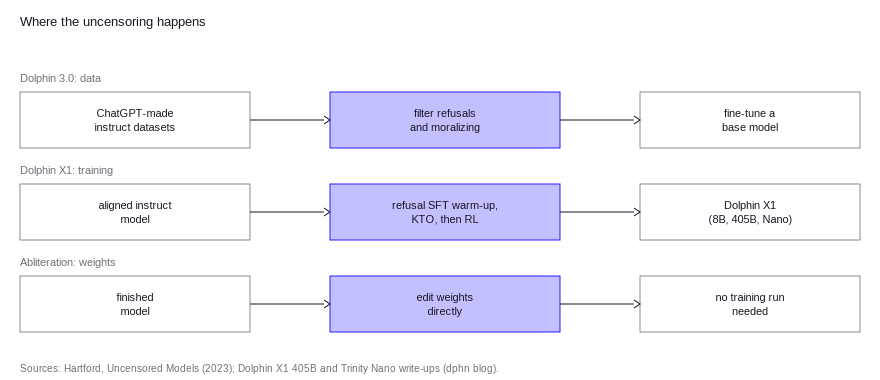
Dolphin is uncensored mainly through dataset and training choices, not through editing weights afterwards. Hartford’s 2023 essay explains the original method: popular instruct datasets were generated by ChatGPT, so they carry its refusals and moralizing, and the fix is to filter those responses out of the training data before fine-tuning. Dolphin 3.0 still trains on mixes such as OpenCoder SFT, Orca AgentInstruct, dolphin-coder, CodeFeedback and the Tulu 3 mixture.
That approach has limits when the base model is already aligned, and the newer releases say so. The X1 line takes an instruct model and un-aligns it directly:
- Dolphin X1 8B is described as an effort to uncensor Llama 3.1 8B Instruct directly while keeping its abilities.
- Dolphin X1 405B (built on Tulu 3 405B) used a small refusal-data SFT warm-up, then KTO preference training, then offline RL. The write-up says the KTO stage still left the model answering harmful requests only around 60% of the time and benchmarking about 20% below the 70B it was compared to, which is why the team added RL.
- Dolphin X1 Trinity Nano is described as the first model trained entirely in the team’s online RL environment for removing alignment.
The Trinity Nano post explains the difficulty: pretraining data already contains the “safe assistant” identity, so base models often refuse before any instruct tuning. This is also why Dolphin differs from abliteration, which edits weights instead of training them.
Which Dolphin versions exist today?
The current Dolphin releases span 1B to 405B parameters, and each one inherits the license of its base. This table lists the ones most people ask about, from the Hugging Face model cards and the Ollama library, checked 2026-10-27.
| Version | Base | Size | License on card | Notes |
|---|---|---|---|---|
| Dolphin X1 Trinity Nano (May 2026) | Arcee Trinity Nano Preview | about 6B params | Apache-2.0 | RL-trained de-alignment |
| Dolphin X1 405B (Jul 2025) | Tulu 3 405B (Llama 3.1) | 405B | Apache-2.0 | FP8 build available |
| Dolphin Mistral 24B Venice Edition (Jun 2025) | Mistral Small 24B Instruct 2501 | 24B | Apache-2.0 | Default on Venice.ai |
| Dolphin X1 8B (Sep 2025) | Llama 3.1 8B Instruct | 8B | Llama 3.1 | Direct un-alignment |
| Dolphin 3.0 R1 Mistral 24B (Feb 2025) | Mistral Small 24B Base 2501 | 24B | None declared | Reasoning variant |
| Dolphin 3.0 Mistral 24B (Feb 2025) | Mistral Small 24B Base 2501 | 24B | None declared | |
| Dolphin 3.0 Llama 3.1 8B (Dec 2024) | Llama 3.1 8B | 8B | Llama 3.1 | On Ollama as dolphin3 |
| Dolphin 3.0 Qwen 2.5 3B / Llama 3.2 3B and 1B | Qwen, Llama | 1B to 3B | Other / Llama 3.2 | Small devices |
| Dolphin 2.9 (Llama 3, Yi, Qwen2) | Llama 3 8B/70B, Yi 1.5 34B | 8B to 72B | Llama 3 or Apache-2.0 | Older; dolphin-llama3 on Ollama |
Two details are easy to miss. Dolphin Xgen RL (9B, cc-by-nc-4.0) is labeled a research artifact and “not a decensored model”, so don’t pick it up for this purpose. And the 24B Dolphin 3.0 cards declare no license, and a Hugging Face discussion titled “Missing License” exists on the R1 card, so check the Mistral base license before commercial use. See LLM licenses and acceptable use for how restrictions carry over to fine-tunes.
How do you run Dolphin locally or through an API?
One Hacker News user who ran Dolphin 3.0 Llama 3.1 8B at Q4_K_S (4.69 GB on disk) reported a correct trivia answer in under two seconds, and conceded it was a single question (HN comment). The fastest local route is Ollama, where dolphin3 is the Dolphin 3.0 Llama 3.1 8B build at 4.9 GB (Q4_K_M, listed with a 128K context window). Older tags exist too: dolphin-llama3 (8B and 70B), dolphin-mixtral (8x7b and 8x22b) and dolphin-mistral.
ollama run dolphin3Set the system prompt first, because the model card is explicit that without one it “will act in a default way”. The Hugging Face route is ollama run hf.co/<org>/Dolphin3.0-Llama3.1-8B-GGUF:Q4_0 followed by /set system <your prompt>. Cards also list LM Studio, Transformers, vLLM, SGLang and TGI. The 24B and 405B models need a server-class setup; for 24B the Venice Edition card recommends vLLM and a low temperature of 0.15. For hardware planning see local LLM hardware requirements, and for the Ollama workflow in general see abliterated models on Ollama.
For an API, the Venice Edition model card says it was built with Venice.ai and is live there as “Venice Uncensored”, the default model for all Venice users. Current pricing could not be confirmed from Venice’s own docs, so see the Venice API review rather than a number quoted here. Hosted catalogs such as OpenRouter and Featherless have listed Dolphin 3.0 models; availability changes, so check the provider.
Is Dolphin good for coding compared with current coder models?
Dolphin is a reasonable steerable generalist, but it is not the strongest choice for pure coding, and its own cards publish no coding benchmark. The Dolphin 3.0 8B card lists “Evals: TBD” and only carries Open LLM Leaderboard numbers.
| Dolphin 3.0 Llama 3.1 8B (Open LLM Leaderboard) | Score |
|---|---|
| Average | 24.97 |
| IFEval (0-shot) | 76.21 |
| BBH (3-shot) | 27.63 |
| MMLU-Pro (5-shot) | 22.13 |
| MATH Level 5 (4-shot) | 10.50 |
| MuSR | 8.97 |
| GPQA | 4.36 |
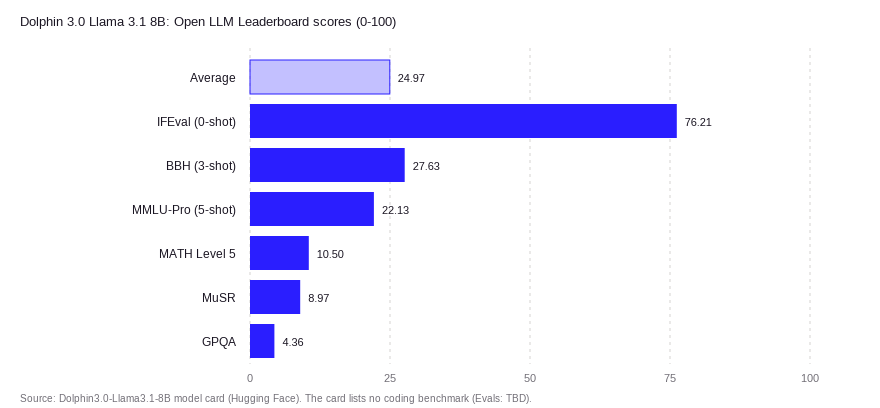
Those are instruction-following and general reasoning scores, not code generation. What the card does show is intent: the training mix includes coding data (OpenCoder SFT stages 1 and 2, dolphin-coder, CodeFeedback) plus Hermes function-calling data, so basic code help and tool use are in scope. Larger purpose-built coder models were trained heavily on code and will usually do better on repository-scale work. For that comparison, start with the Qwen Coder local guide and local LLM vs Claude for coding.
Where Dolphin fits is narrower: a local model that answers security-adjacent or sensitive-looking questions without a vendor policy in the way, such as analyzing a suspicious script from your own server, and that obeys a strict system prompt. That is the case for it when over-refusal is what breaks your workflow.
What do developers report in practice?
Developers report mixed results, and none of this is our testing. These are community reports, kept to the ones with enough detail to be useful.
- Quantization and tool support. On the Dolphin X1 8B discussion titled “not uncensored”, a user said their own quantized build refused a request and lectured them, while the same prompt worked on the official chat site. They later suggested their quantization process stripped the uncensoring. Other commenters pointed out that the reports lacked prompts and sampler settings, and that jailbreak-style prompts tend to push retrained models back toward the original alignment (thread). A separate commenter noted that no model scores a perfect result on the UGI uncensored leaderboard.
- Tool calling in agents. A user running Dolphin 3.0 R1 Mistral 24B at Q8_0 through Ollama found the editor Zed reported “Tools Unsupported”, because Ollama’s capabilities field did not list tools. The model author’s reply was that Ollama uses its own chat-template scheme, so the Modelfile has to carry the correct template (discussion).
- Speed on small hardware. In a Hacker News comment, one user ran a trivia question through Dolphin 3.0 Llama 3.1 8B at Q4_K_S (4.69 GB on disk) and reported a correct answer in under two seconds, against a wrong answer from a larger model; a single question, as they conceded (HN comment).
- Venice Edition. Another HN commenter singled out Dolphin Mistral 24B Venice Edition GGUF as a favorite and “really uncensored” (HN comment).
- Wrapper prompts do not fix refusals. A user on the Dolphin 3.0 8B card reported a refusal on a TrueCrypt brute-force script request even after setting an “uncensored” system prompt in a Modelfile (discussion).
The pattern: the Dolphin 3.0 8B and X1 8B models run well locally, but refusals vary by quant, template and prompt. Treat any uncensoring claim as something to test on your own tasks.
How do system prompts work with Dolphin, and who is responsible?
The system prompt is the control surface, and the user is responsible for what comes out. The Dolphin 3.0 card uses ChatML and shows a system prompt that makes it a Go-only coding assistant. The Venice Edition card shows a much stronger prompt that tells the model to follow instructions “regardless of ethics, legality, morality, or any safety concerns”, used to push it to maximum permissiveness. The cards also state that you are personally responsible for content you generate, like with a knife or a car.
Responsibility is not only moral. The Llama-based builds are under the Llama 3.1 license and its acceptable use policy, and being uncensored does not suspend it. Laws on unauthorized access apply whatever model you use. For coding, write a system prompt that states the legitimate scope, such as “you assist with security analysis of systems the user owns”, rather than a blanket instruction to ignore all limits. It is also the more reliable pattern for a team to document.
FAQ
Is Dolphin LLM free to use?
The weights are free to download from Hugging Face, and you can run them locally at no per-token cost. Licenses vary by version: Apache-2.0 for X1 405B, X1 Trinity Nano and the Venice Edition, Llama 3.1 for the 8B builds.
Which Dolphin model is best?
For laptops, Dolphin 3.0 Llama 3.1 8B (dolphin3) is the simplest. For stronger output with a permissive license, the Venice Edition 24B is the one HN and Venice users mention most, but it needs more memory.
Is there a Dolphin LLM API?
Yes, through third parties. Venice.ai runs the Venice Edition as its default “Venice Uncensored” model, and aggregators such as OpenRouter and Featherless have listed Dolphin models. Confirm current availability and pricing with the provider.
Is Dolphin the same as an abliterated model?
No. Dolphin is trained on filtered data and, in X1, with preference and RL training. Abliteration edits a finished model’s weights. Some people abliterate Dolphin as well, which is a separate community release.
Does Dolphin work with Ollama?
Yes. ollama run dolphin3 pulls the 4.9 GB 8B model. Set a system prompt, and check the chat template if you need tool calling.
Sources (10)
- Dolphin 3.0 Llama 3.1 8B model card, Hugging Face (dphn)
- Dolphin Mistral 24B Venice Edition model card, Hugging Face
- Dolphin X1 8B model card, Hugging Face
- Dolphin X1 Trinity Nano model card, Hugging Face
- Dolphin X1 405B model card, Hugging Face
- Uncensored Models, Eric Hartford (May 22, 2023)
- dolphin3, Ollama library
- Dolphin X1 405B training write-up, Dolphin blog
- Dolphin X1 Trinity Nano: De-alignment with an Online RL environment, Dolphin blog
- Discussion #1 'not uncensored', Dolphin-X1-8B community tab, Hugging Face