Venice AI API review from the docs: OpenAI-compatible base URL, per-token prices, uncensored models, Private vs Anonymized tiers, rate limits and terms.
The Venice AI API is a pay-per-token, OpenAI-compatible endpoint at https://api.venice.ai/api/v1 that serves open-weight models, several uncensored or abliterated ones, plus proxied closed models. As of October 27, 2026, uncensored text models start at $0.1625 in and $0.50 out per 1M tokens. Venice labels each model Private, Anonymized or E2EE, and the no-retention claim for Private rests on contracts, not a public audit.
- https://api.venice.ai/api/v1
- GLM 4.7 Flash Heretic, $0.07 in / $0.40 out per 1M tokens
- 100 requests/min, 2M tokens/min
- Oct 27, 2026
Key takeaways
- Base URL is https://api.venice.ai/api/v1 and the chat endpoint is described as a drop-in replacement for OpenAI's. Change the base URL and model ID, then test your tool calls.
- There is no unmetered or free API tier. Free accounts can call the API but pay the same per-token rates, and a paid subscription does not include free API usage.
- Each model carries a privacy label. Private means no retention after the request, Anonymized means the upstream provider can read your prompt. Venice describes Private as contract-enforced.
- Uncensored does not mean unrestricted. Venice's terms still bar illegal use, and they let Venice suspend access at any time.
- Known friction: a community feedback post reports a 400 error when tools send OpenAI's tool_choice parameter.
This Venice AI API review comes from Venice’s own documentation and terms, read on October 27, 2026, plus community reports. Refusal Rate has not benchmarked the service, so there are no latency or quality numbers here.
What is the Venice AI API?
The Venice AI API is a hosted, metered REST API from Venice.ai that exposes text, image, video and audio models behind one key, with an OpenAI-style chat endpoint. Venice’s docs call it “OpenAI-compatible” and describe the chat endpoint as a drop-in replacement for OpenAI’s. The company’s consumer chat app is a separate product and is not covered here.
For developers the interesting part is the catalog. Alongside proxied closed models, Venice lists open-weight models, several uncensored fine-tunes and abliterated models. If your problem is a hosted assistant refusing benign security or reverse-engineering work, that catalog is the reason to look. For how Venice compares with other providers on price and retention, see uncensored AI APIs compared.
Which models does the Venice API serve?
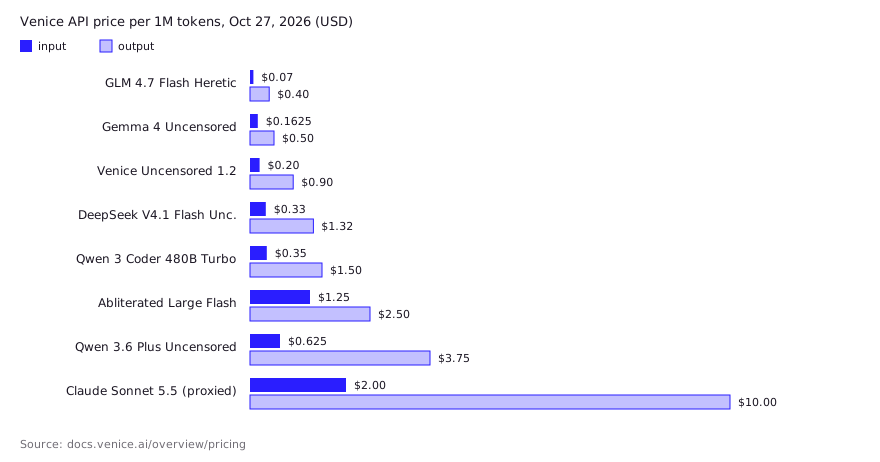
Venice’s pricing page lists well over a hundred text models, so the useful question is which ones matter for coding and for fewer refusals. The table below is a selection from the pricing page as of October 27, 2026, in USD per 1M tokens.
| Model | ID | Input | Output | Context | Privacy label |
|---|---|---|---|---|---|
| GLM 4.7 Flash Heretic | olafangensan-glm-4.7-flash-heretic | $0.07 | $0.40 | 200K | Private |
| Gemma 4 Uncensored | gemma-4-uncensored | $0.1625 | $0.50 | 256K | Private |
| Venice Uncensored 1.2 | venice-uncensored-1-2 | $0.20 | $0.90 | 128K | Private |
| DeepSeek V4.1 Flash Uncensored | deepseek-v4-1-flash-uncensored | $0.33 | $1.32 | 1000K | Private |
| Qwen 3 Coder 480B Turbo | qwen3-coder-480b-a35b-instruct-turbo | $0.35 | $1.50 | 256K | Private |
| Qwen 3.6 Plus Uncensored | qwen-3-6-plus | $0.625 | $3.75 | 1000K | Anonymized |
| Abliterated Large Flash | abliteration-abliterated-model-large-flash | $1.25 | $2.50 | 1000K | Anonymized |
| Claude Sonnet 5.5 | claude-sonnet-5-5 | $2.00 | $10.00 | 1000K | Anonymized |
Three things stand out. First, the “Heretic” and “Abliterated” entries are modified open-weight models, which is the technique covered in what abliteration is. Second, the same model can appear twice with different labels, for example E2EE variants of GLM, Kimi and Qwen at slightly higher prices. Third, Venice also proxies closed models such as Claude and GPT, always labeled Anonymized, which means the upstream provider sees the prompt.
Venice also exposes traits such as default and most_uncensored as model names. Its migration guide warns that these resolve to whichever model currently fills the role, so pin an explicit model ID in production.
How much does the Venice API cost?
The Venice API is pay-per-use with no unmetered tier, and prices are per 1M tokens as shown above. Free accounts can call the API but pay the same rates and do not receive the monthly bundled allowance. A paid plan does not include free API usage either, though paid plans add a one-time $5 credit to the API balance.
How billing works, per the pricing page:
- Balances: each paid request draws from DIEM first, then earned credits, then bundled credits, then USD. Each balance is worth one dollar per unit.
- USD and crypto: both pay the same rates. USD credits do not expire.
- Staking DIEM: the page describes DIEM as $1/day of compute, with credits that refresh daily.
- Empty balance: the API returns HTTP 402 with
INSUFFICIENT_BALANCE. - Paid-only models: some models return HTTP 401 with
PRO_ONLY_MODELon non-paid accounts. - Long context: some models double or increase rates above a context threshold, for example Qwen 3.6 Plus Uncensored above 256K.
So the “free tier” question has a precise answer: you can get a key without paying, but you cannot call the API for free. Third-party reviews disagree on this point; the official page is the one to trust, and it can change.
How do you call the Venice API?
One developer posting on Venice’s own feedback board reported that sending tool_choice: "auto" returned a 400 error, while function calling worked once the parameter was dropped. The post names Kilo Code, Cursor and OpenClaw as affected clients, and at the time of our reading it was open with one vote and no Venice reply (post). That matches the strictness described below: unknown or unsupported fields fail loudly instead of being ignored.
You call it with the standard OpenAI SDK by setting the base URL to https://api.venice.ai/api/v1 and passing a Venice API key. Keys are created in account settings at venice.ai/settings/api. The snippet below follows the pattern in Venice’s docs.
from openai import OpenAI
import os

client = OpenAI(
    api_key=os.environ["VENICE_API_KEY"],
    base_url="https://api.venice.ai/api/v1",
)

resp = client.chat.completions.create(
    model="gemma-4-uncensored",
    messages=[{"role": "user", "content": "Explain this stack trace."}],
)
print(resp.choices[0].message.content)
Compatibility is good but not complete. Per the migration guide:
- Unknown top-level request fields, such as
logit_biasandservice_tier, return HTTP 400. - The Assistants API, Batch API and fine-tuning are not available.
- Streams always end with a usage chunk whose
choicesarray is empty, so clients readingchoices[0]must skip it. - Mid-stream errors arrive as a
data:event, because the HTTP status is already 200. - Venice options go in
venice_parametersviaextra_body; unknown keys inside it are silently ignored. - Aider and CrewAI read
OPENAI_API_BASE, and some tools need that variable instead ofOPENAI_BASE_URL.
If you run a local server instead, see Ollama’s OpenAI-compatible API for the same pattern against your own hardware.
What do developers report in practice?
Community evidence on Venice’s API is thin. Reddit threads did not surface in our searches, so what follows is a small set of reports, none of them benchmarks, and none of them our own testing.
- Tool compatibility: the
tool_choicereport is described in the section above. Check whether it still applies before wiring up an agent. - Open models for coding tools: one Hacker News commenter described Venice as a good privacy-focused host for open-source models and hoped it would add a Qwen coder model to the API so they could use their own tools with it (comment). Qwen 3 Coder 480B Turbo now appears on the pricing page.
- Jurisdiction blocking: another commenter said Venice blocks access from some countries with strict content rules instead of changing its practices (comment). We could not verify the country list, so check availability for your location and your users’.
- Retention skepticism: a commenter in a thread about legal discovery of chat logs noted that for larger models, even a platform with retention contracts depends on underlying providers that may store prompts (comment). That matches Venice’s own Anonymized label, discussed next.
Treat these as pointers on what to test, not as findings.
What does Venice say about privacy and logging, and what is verifiable?
Venice says it does not store or log prompt and response content for normal inference, and it keeps operational metadata separately. The privacy page does not define exceptions to “normal inference”, and it frames the strongest guarantee as contractual.
Venice’s labels, from its privacy documentation:
| Label | What Venice says | What you are trusting |
|---|---|---|
| Anonymized | Venice hides your identity from the provider, but the provider can still see prompt content | The upstream provider’s own policy |
| Private | Prompt and response are processed for inference only and not retained after the request | Venice’s contracts with the host, which the page calls “contract-enforced” |
| E2EE (text models only) | The client encrypts prompts, Venice relays ciphertext, and only the verified TEE decrypts it | Your client verifying remote attestation correctly |
The metadata Venice says it may keep includes account or wallet IDs, API key IDs, timestamps, model, token counts, billing amounts, IP address and device information. The page says billing records “do not require storing the prompt or completion.”
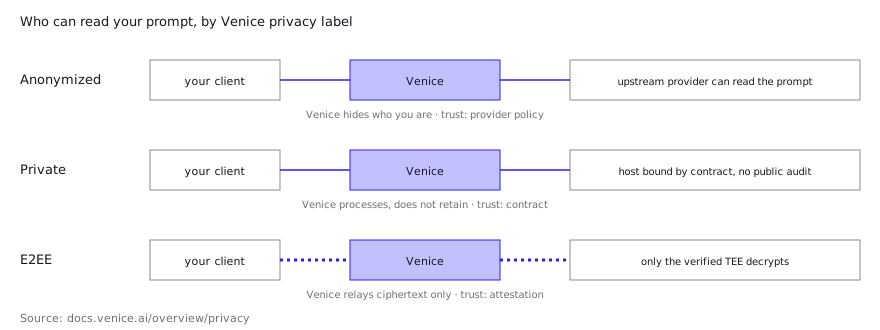
What you can verify yourself: the label on each model, and with E2EE, the attestation, which requires client work. The documented trade-off is that E2EE disables web search, memory and some tool flows. What you cannot verify from the outside is Private-tier non-retention. The documentation does not mention audits. If your code is sensitive, the fair reading is “contractual claim, with a cryptographic option for some models”. The broader question is covered in zero-data-retention LLM APIs.
What are the limits, terms and acceptable-use rules?
Venice’s default rate limits depend on model size, and Venice’s terms still prohibit illegal use despite the uncensored branding. Defaults from the rate-limit page:
| Model size | Default requests/min | Default tokens/min | Partner requests/min | Partner tokens/min |
|---|---|---|---|---|
| XS | 500 | 5,000,000 | 500 | 10,000,000 |
| S | 150 | 3,000,000 | 300 | 6,000,000 |
| M | 100 | 2,000,000 | 200 | 4,000,000 |
| L | 100 | 2,000,000 | 150 | 3,000,000 |
Some models run on dedicated or third-party infrastructure and have limits outside these tiers. Fetch the exact numbers for your key from GET /api_keys/rate_limits. Partner tier is not automatic; Venice suggests contacting support if you consistently hit limits. Inference 429s should be retried with exponential backoff, and two error budgets also return 429: 50 failed requests per 30 seconds, and 200 unsupported-feature requests per 30 seconds.
From the Terms of Service (last updated June 8, 2026):
- Illegal use is prohibited, and API users must follow the published API documentation.
- Venice may revoke, suspend or rotate API keys, and may suspend access at any time, with or without notice.
- Apps built on the API must bind their end users to terms at least as protective as Venice’s.
- Use where AI errors could cause serious harm is barred.
- Disputes go to individual arbitration under Wyoming law, with a 30-day opt-out.
“Uncensored” describes how the model is tuned. It is not a license to run anything. Security work should stay authorized work on systems you own or have written permission to test. For license-level limits on the models themselves, see LLM licenses and acceptable use.
Who should use the Venice API, and what are the alternatives?
Use Venice if you want a single OpenAI-style endpoint that includes uncensored open-weight models, you accept contract-based privacy for Private models, and you do not need an unmetered plan. It is a weaker fit if you need a published retention audit, guaranteed tool-calling parity with OpenAI, or a flat monthly price.
| Choice | Best for | Main caveat |
|---|---|---|
| Venice API | Pay-per-token access to uncensored and open models plus proxied closed models | Private tier is contractual; tool_choice friction reported |
| Subscription hosts such as Featherless | Predictable monthly cost across many open models | Different pricing model and catalog |
| Local inference | Code that must not leave your machine | Your hardware and your quantization trade-offs |
| Mainstream APIs | Best raw capability | Refusals on sensitive-looking but legitimate work |
Disclosure: Refusal Rate has no commercial relationship with Venice and uses no affiliate links.
FAQ
Is the Venice AI API OpenAI-compatible?
Largely yes. Venice documents the base URL https://api.venice.ai/api/v1 and a drop-in chat endpoint, but unknown fields return HTTP 400, and the Assistants API, Batch API and fine-tuning are not available.
Is there a free tier for the Venice AI API?
Not for usage. Free accounts can call the API, but requests are billed at the normal per-token rates. A paid plan does not add free API usage, though it adds a one-time $5 credit.
Where do I get a Venice AI API key?
In account settings at venice.ai/settings/api. Venice’s pricing page says API access draws on DIEM, credits or USD, so add a balance before your first paid request.
Does Venice log my prompts?
Venice says it does not store prompt or response content for normal inference and keeps operational metadata such as token counts and timestamps. For Anonymized models, the upstream provider can read your prompt. For Private models, non-retention is described as contract-enforced.
Which Venice models are uncensored?
The pricing page lists Venice Uncensored 1.2, Gemma 4 Uncensored, DeepSeek V4.1 Flash Uncensored, Qwen 3.6 Plus Uncensored, GLM 4.7 Flash Heretic and Abliterated Large models, among others. Names and prices change, so check the live page.
Sources (10)
- API pricing, Venice docs
- About Venice (base URL, OpenAI-compatible APIs), Venice docs
- Privacy and data handling, Venice docs
- Migrate from OpenAI, Venice docs
- Rate limiting, Venice docs
- Terms of Service, Venice (last updated June 8, 2026)
- Feedback: support OpenAI standard tool_choice parameter, Venice feedback board
- Hacker News comment on Venice's jurisdiction blocking
- Hacker News comment on Venice as an open-model host for coding tools
- Hacker News comment on retention contracts for hosted models