Llama license commercial use explained, plus Gemma, Qwen, Mistral and DeepSeek terms compared: user thresholds, derivative rules and AUPs, quoted from texts.
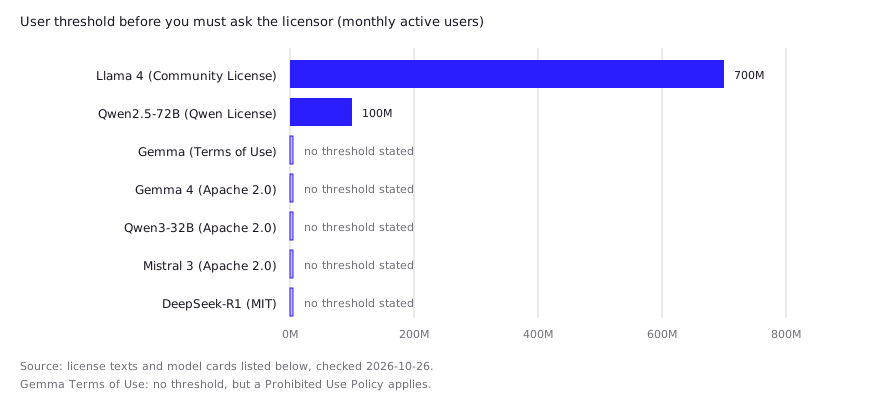
Most open-weight LLMs allow commercial use, but the terms differ. Llama 4 is free below 700 million monthly active users, Qwen's older license sets 100 million, and Mistral, Qwen3, Gemma 4 and DeepSeek R1 use Apache 2.0 or MIT. Custom licenses and acceptable-use policies travel with derivatives, abliterated models included. This is an editor's reading, not legal advice.
- 700M monthly active users
- 100M monthly active users
- Mistral 3, Gemma 4, Qwen3-32B, DeepSeek R1
- 2026-10-26
Key takeaways
- Llama 4's community license requires a request to Meta only above 700 million monthly active users, and it ties use to an acceptable-use policy.
- Gemma moved from custom terms to Apache 2.0 with Gemma 4, so check which Gemma generation you are shipping.
- Qwen is mixed: Qwen3-32B declares Apache 2.0, while the older Qwen2.5-72B license has a 100 million user threshold and a 'Built with Qwen' rule.
- A license is about rights over the weights, so editing the weights by abliteration does not remove its terms.
- Open-weight is not open source under the OSI definition, which also asks for training-data information and code.
Llama license commercial use is allowed for nearly everyone: the Llama 4 license is royalty-free below 700 million monthly active users, and Gemma 4, Mistral 3 and DeepSeek-R1 ship under Apache 2.0 or MIT. This page quotes the license texts as fetched on 2026-10-26. Licenses change with each model generation, so confirm the file shipped with the exact model you download. It is an explainer, not legal advice.
Are open-weight models open source?
Mostly no. The Open Source AI Definition (version 1.0) lists four freedoms: use the system “for any purpose and without having to ask for permission”, study it, modify it, and share it. It also asks for three things that most “open” releases leave out: detailed data information, the training and inference code, and the parameters, all under OSI-approved terms.
Most releases publish only the weights, so “open-weight” is the accurate label. The split matters for licensing because an Apache 2.0 or MIT file grants broad rights, while a custom license attaches conditions. OSI’s objection to Meta’s Llama license, written in 2023, was that it restricts field of use and “puts restrictions on commercial use for some users” (OSI, July 20, 2023).
How do the major open-weight licenses compare?
They fall into two camps: permissive licenses (Apache 2.0, MIT) with almost no conditions, and custom licenses with user thresholds, naming rules and an acceptable-use policy (AUP) that flows to downstream users.
| Model family | License (checked 2026-10-26) | Commercial use | User threshold | Naming and attribution | AUP attached |
|---|---|---|---|---|---|
| Llama 4 | Llama 4 Community License (April 5, 2025) | Yes, royalty-free limited license | Above 700M monthly active users you “must request a license from Meta” | Keep the Llama 4 notice; “Built with Llama” on a related website; “Llama” at the start of a derived model’s name when outputs are used to create or improve a distributed model | Yes |
| Gemma 4 | Apache 2.0 (model card) | Yes | None | Apache 2.0 notices | No, but Apache 2.0 grants no trademark rights |
| Gemma (earlier) | Gemma Terms of Use, last modified April 1, 2026 | Grant covers use, modify, distribute | None stated | Pass on the terms and a notice to recipients | Yes, Prohibited Use Policy |
| Qwen3-32B | Apache 2.0 (model card) | Yes | None | Apache 2.0 notices | No |
| Qwen2.5-72B | Qwen License Agreement (Sept 19, 2024) | Yes below the threshold | Above 100M monthly active users, “request a license” | Notice file; “Built with Qwen” or “Improved using Qwen” for derived models | Not in the license text we read |
| Mistral 3 family | Apache 2.0 | Yes | None | Apache 2.0 notices | No |
| DeepSeek-R1 | MIT (code and weights) | Yes, including modifications and distillation | None | MIT notice | No |
| DeepSeek-V3 (original model license) | DeepSeek License Agreement v1.0 | Hosting for third parties allowed | None stated | Carry the restrictions forward | Yes, use-based restrictions (Attachment A) |
Three caveats on reading the table:
- Model generation matters. Google’s Gemma 4 card lists Apache 2.0, while the Gemma Terms of Use page still governs earlier releases. A search for “Gemma license” can return either.
- One vendor, several licenses. Qwen3-32B declares Apache 2.0, but the Qwen2.5-72B card declares “qwen”, the custom license. Check each model’s card.
- Distills inherit. DeepSeek states that its Qwen-based distills derive from Qwen-2.5 (Apache 2.0) and that its Llama-based distills follow the Llama 3.1 and 3.3 licenses. A model’s headline license can differ from its parent’s.
What does the Llama license say about commercial use?
One Hacker News commenter, reading the Llama 4 use policy days after release, flagged a clause that most summaries skip: for the multimodal models, the section 1(a) rights are not granted to an individual domiciled in the EU or a company with its principal place of business there (HN, April 2025). The policy text on Meta’s site says the same, and adds that the restriction does not apply to end users of a product that incorporates those models.
The Llama 4 Community License allows commercial use under a “non-exclusive, worldwide, non-transferable and royalty-free limited license”, with one scale condition. The threshold clause reads: if your products’ monthly active users exceed 700 million in the preceding calendar month, “you must request a license from Meta” (Llama 4 license, section 2). Below that, there is no fee.
The conditions that bind a typical company are about redistribution:
- Give recipients a copy of the agreement.
- Display “Built with Llama” on a related website.
- Keep the notice “Llama 4 is licensed under the Llama 4 Community License, Copyright © Meta Platforms, Inc. All Rights Reserved.”
- If you use Llama outputs to create or improve a distributed AI model, put “Llama” at the start of that model’s name.
For the multimodal models, also read the EU clause in the use policy. Read section 1 of the text against your own setup, since hosting a model and shipping its weights are different acts.
Do licenses follow derivatives like abliterated models?
Community practice already assumes they do. The Heretic-processed Gemma 3 270M card on Hugging Face declares license: gemma and links the Gemma terms and Prohibited Use Policy (model card). That is the uploader’s claim, so verify it against the base model. The reading behind it: a license grants rights to the weights, so a model made by editing or fine-tuning those weights remains a derivative of them, and the same terms attach. Abliteration changes how the weights behave. It does not change who owns them or what the grant says. 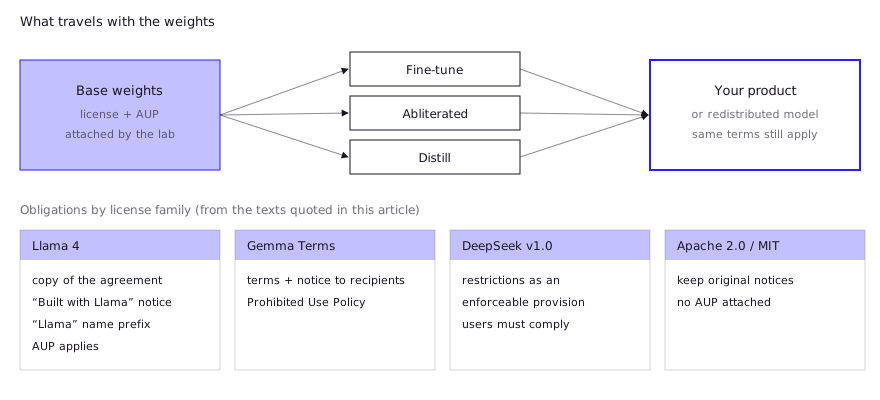
The technique is explained in what abliteration is, and the differences between abliterated, uncensored and fine-tuned releases are in abliterated vs. uncensored vs. fine-tuned.
What follows from that, by license type:
- Llama. The naming rule applies if you build on Llama outputs and distribute the result, and the AUP continues to apply to the people using it.
- Gemma Terms of Use. “Model Derivatives” are defined broadly, including models trained to mimic Gemma, and “Outputs are not deemed Model Derivatives”. Recipients of derivatives must get the terms.
- DeepSeek License v1.0. The restrictions “MUST be included as an enforceable provision” and users must be required to comply.
- Apache 2.0 and MIT. Derivatives can carry any compatible license, but the original notices stay.
Whether editing a model’s refusal behavior is itself lawful depends on the jurisdiction and the use, and the texts above don’t address it. That is a question for counsel, not for a license summary.
What do acceptable-use policies prohibit?
One Hacker News commenter called the biggest problem with Gemma’s earlier terms that they require you to accept an acceptable-use policy that “can be updated at any time”, so something you build today could become disallowed tomorrow (HN, May 2024). That is a reader’s interpretation, so check the current Terms of Use for the update clause before you rely on it.
The two AUPs we read prohibit broadly similar things: illegal activity, harm to people, deception, and malicious code. The Llama 4 AUP lists “Create, generate, or facilitate the creation of malicious code, malware, computer viruses” (1.g) and bars intentionally circumventing or removing “usage restrictions or other safety measures” (1.h). The Gemma Prohibited Use Policy likewise bars generating “content for deceptive or fraudulent activities, scams, phishing, or malware” and “attempts to override or circumvent safety filters”.
| Area | Llama 4 AUP | Gemma Prohibited Use Policy |
|---|---|---|
| Malware and cyber abuse | Yes, section 1.g | Yes, under abuse or disruption of services |
| Circumventing safety measures | Yes, section 1.h | Yes |
| Illegal activity and child safety | Yes | Yes |
| Deception and impersonation | Yes | Yes |
| Sexually explicit content | Not in the headings we read | Bars pornography and sexual chatbots, with an exception for scientific, educational, documentary or artistic content |
The safety-measure clauses are the ones people ask about for modified models. Read literally, both policies address the use, so check how the clause applies to a release whose refusals were removed before you ship it. Authorized security work, such as analyzing malware you are permitted to examine, is a different matter from generating it, and we cover that framing in AI for security research.
What do developers report in practice?
Community reports are individual opinions and observations, not legal readings, but they show where people get stuck.
- The 700 million clause is the main objection. A GitHub issue on the Llama 3 repository argues that the requirement to “request a license from Meta” above 700 million monthly active users conflicts with the Open Source Definition. It drew no maintainer reply on the page, and the repository was archived in March 2026. For a normal company the threshold is irrelevant, so the real argument is about the “open source” label, not cost.
- The label is still contested. In the Hacker News thread on the OSI’s Llama 2 post, commenters tested the argument against other licenses and asked whether the same OSD points would sink AGPL. A reply answered that AGPL lets you use the software for any purpose, which is the difference. Treat “open source” and “open-weight” as different claims.
- Metadata and LICENSE files can disagree. When Qwen released QvQ-72B-Preview in December 2024, one commenter reported the Hugging Face license metadata said Qwen license while the LICENSE file said Apache 2.0, which was later changed to the Qwen license (HN). Read the file, not just the tag.
- One family, several licenses. The Qwen2.5-3B-Instruct card declares
qwen-research, a different license from the 72B model discussed here. Size within a family can change the terms, which is why we say to read each card.
What does this mean for a company shipping on these models?
It means you pick a license before you pick a model. A short checklist:
- Find the file. Read the license in the repository you download from, not a blog summary, including this one.
- Check the user threshold. Llama’s 700 million and Qwen2.5’s 100 million are far above most companies.
- Plan the notices. Keep a NOTICE file, add “Built with” lines where required and handle derivative naming.
- Flow terms downstream. Gemma Terms and DeepSeek v1.0 require passing restrictions to your users.
- Treat hosted APIs as separate. Using a vendor’s API brings that vendor’s terms, as in our comparison of uncensored LLM APIs.
If you want the least friction, Apache 2.0 and MIT releases such as Mistral 3, Gemma 4 and DeepSeek-R1 impose the fewest conditions.
When should you ask a lawyer?
Ask counsel when you redistribute modified weights, build a product above a stated user threshold, work in a regulated field, or rely on an AUP clause whose scope is unclear to you. This page quotes licenses and attributes them, and it reaches no legal conclusions. The licenses are the authority, and Meta, Google, Alibaba Cloud, Mistral AI and DeepSeek can revise them.
FAQ
Can I use Llama commercially?
Yes, below 700 million monthly active users for the Llama 4 license. Above that you must request a license from Meta, and you must follow the AUP and the notice and naming conditions.
Is the Qwen license commercial-friendly?
It depends on the model. Qwen3-32B declares Apache 2.0. Qwen2.5-72B uses the Qwen License Agreement, which allows commercial use below 100 million monthly active users and asks for “Built with Qwen” on derived models.
Is Apache 2.0 a good license for an LLM?
It is the most permissive of the common choices: commercial use, modification and redistribution, with notices kept and no trademark rights. Mistral 3, Gemma 4 and Qwen3-32B list it on their cards or announcements. It covers the released weights, not questions about training data.
Does the license still apply to an abliterated model?
The terms that came with the original weights still apply, because the model is a derivative. The AUP and naming rules go with it. Whether a given modification or use is lawful is a question for counsel.
Is Gemma open source?
Gemma 4 is released under Apache 2.0, which is an OSI-approved license, although the OSI’s AI definition also asks for data information and code. Earlier Gemma releases used custom terms with a prohibited-use policy.
Sources (10)
- Llama 4 Community License Agreement (effective April 5, 2025)
- Llama 4 Acceptable Use Policy
- Gemma Terms of Use (last modified April 1, 2026)
- Qwen2.5-72B-Instruct LICENSE, Hugging Face
- Qwen3-32B model card, Hugging Face
- Introducing Mistral 3, Mistral AI (December 2, 2025)
- DeepSeek-R1 model card, Hugging Face
- DeepSeek License Agreement v1.0 (LICENSE-MODEL), GitHub
- 'Additional Commercial Terms' must be removed from LICENSE to make Llama 3 open source, meta-llama/llama3 issue #156 (GitHub)
- Gemma 4 31B model card, Hugging Face