Featherless AI serves Hugging Face open models on an OpenAI-compatible API. Plans, concurrency units, context limits, coding-tool setup and privacy terms.
Featherless AI is a serverless inference service that hosts open-weight models from Hugging Face behind an OpenAI-compatible API at api.featherless.ai/v1. Its $25/month Chat plan is flat-rate with unlimited tokens, but it is capped by concurrency units and a 32K context, and its pricing page excludes app and API traffic. Developer-style API use is on the metered Developer plan, from $50 in credits per month.
- https://api.featherless.ai/v1
- $25/month, 4 units, 32K context
- From $50 credits/month, 100 units, up to 256K
- Official pages, 2026-10-27
Key takeaways
- The flat rate is real but narrow: Chat is $25/month with unlimited tokens, 4 concurrent units and up to 32K context, and the pricing page lists app/API traffic and background automation as excluded uses.
- Coding tools and agents belong on the Developer plan, which is metered per token from $50 in credits per month, with up to 256K context and 100 concurrent units.
- Concurrency, not tokens, is the ceiling: a model under 16B costs 1 unit, under 35B costs 2, and 70B-plus costs 4. Going over budget returns HTTP 429.
- Featherless says it does not store prompts or completions. It does not state a retention period or address training, and its terms call the service a beta.
- Its own pages disagree on catalog size, context sizes and tool support, so check the model page for the exact model you plan to use.
All Featherless AI plan details below come from the company’s own pages, fetched on 2026-10-27. Pricing pages change, so recheck before you pay.
What is Featherless AI?
Featherless AI is a serverless inference provider whose goal, in its own words, is to make “all AI models available for serverless inference.” It started with open-weight language models such as Qwen, Llama, Mistral, DeepSeek and RWKV, and exposes them through an API it describes as designed to be compatible with OpenAI’s.
The pitch to developers is breadth. Public Hugging Face models with 100 or more downloads are added automatically, and the pricing page advertises a catalog of “40,000+” models. That includes community fine-tunes that mainstream hosts skip, which is why it shows up in uncensored LLM API comparisons. Featherless is one hosted option among several; the same question for a different provider is covered in the Venice API review.
The practical API facts, from the API overview:
- Base URL:
https://api.featherless.ai/v1, with a Bearer API key from your account. - Endpoints:
/v1/chat/completionsand/v1/completions, plus/v1/models,/v1/tokenizeand/v1/audio/speech. - Migration: point an existing OpenAI client at the new base URL and swap the key. The docs call the compatibility an informal spec and ask users to contact support if a client breaks.
How does flat-rate pricing work?
Flat-rate pricing exists on exactly one plan: Chat, at $25 per month with unlimited tokens. Developer API use is billed per token from credits instead. The table below is the pricing page as of 2026-10-27.
| Plan | Price | Context | Concurrent units | Token billing |
|---|---|---|---|---|
| Chat | $25/month | Up to 32K | 4 | Unlimited, not metered |
| Developer | From $50 in credits/month | Up to 256K | 100 | Per token, rates vary by model |
| Pay-as-you-go | No monthly commitment | Up to 256K | 100 | Per successful request |
| Business | Custom, annual contracts | As requested | Sized to dedicated GPUs | Fixed contract amount |
Three details matter more than the headline price:
- Chat is for interactive use. The pricing page lists reselling, app/API traffic, background automation and benchmarking as excluded uses. The terms say individual plans are “for interactive use or proto-typing and experimentation by the purchaser.”
- Developer credits are forgiving. Per the pricing page, credits draw down only on successful requests, never expire, and HTTP 503 “temporarily at capacity” responses are not billed.
- Switching has no proration. Moving from Chat to Developer takes effect immediately, and the remaining paid time on Chat is not credited or refunded. The current month is non-refundable.
Older third-party pages list a $10 Basic tier limited to models up to 15B and a $25 Premium tier. Those do not appear on the current pricing or plans pages.
What are concurrency units, and why do they matter?
A concurrency unit is Featherless’s cap on simultaneous work, and it replaces token limits as the thing you run out of. The concurrency docs weight models by size:
| Model size | Units per request | Examples named in the docs |
|---|---|---|
| Under 16B | 1 | Qwen, Llama |
| Under 35B | 2 | Qwen Coder, Mistral |
| 70B or more | 4 | MiniMax, Kimi, DeepSeek |
Units are reserved when a request starts and released when it finishes or is cancelled. A request that would push you over your plan’s budget is rejected with HTTP 429. Some models are exceptions, and each model page shows its exact cost. The docs do not say how models between 35B and 70B are weighted.
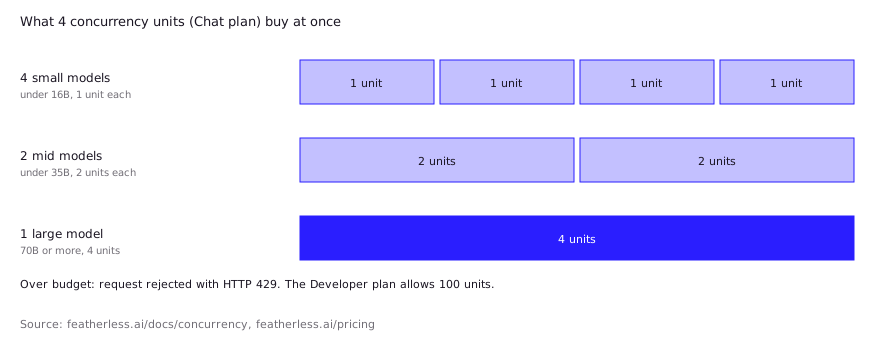
For the Chat plan’s 4 units, that works out to four parallel small-model chats, or one 70B-plus model at a time. An agent that fans out several tool calls at once will hit the ceiling fast. The pricing page’s own arithmetic for Chat is “4 parallel chats” with no metered tokens, meaning concurrency is the only limit.
Which models can you run?
You can run most public Hugging Face text models in supported architectures, served at FP8. The model compatibility page lists these constraints:
- Architectures: fine-tunes of listed base families. Examples named include Llama 3.1, Qwen 3.5, Gemma 4, DeepSeek 4, GLM 5.2 and MiniMax M3.1. There are also TTS, embedding and OCR models.
- Ingestion format: full FP16 safetensors weights with no tensor shape changes from a supported base. LoRA-only repos and GGUF are not accepted.
- Serving precision: FP8, except models under 5B, which run at FP16.
- Adding a model: public models with 100+ downloads appear automatically. Others can be requested by email or in the Discord model-suggestions channel.
- Private models: for Scale customers, up to 10 private slots per organization, limited to compatible classes at 72B parameters and below.
Treat the numbers on this page with care, because Featherless’s pages contradict each other:
- The pricing page says 40,000+ models. The compatibility page says “over 4,000 text generation models,” which may be a narrower count of text models.
- The compatibility page says all models are served at one of 4k, 8k or 16k context, then lists per-model values up to 1,048,576 for one model. The plan pages say 32K for Chat and up to 256K for Developer.
The dependable move is to open the model page for the exact model, read its context and unit cost, and send a test request before you build around it.
How do you use it with coding tools?
One developer’s pull request in an open-source agent project shows how this goes wrong in practice. Running Featherless behind LiteLLM, the featherless_ai/ prefix routed to a /v1/responses path that Featherless does not serve (404), and a later Anthropic-to-OpenAI translation step dropped tool definitions, so the agent could not read or write files. The fix was to drop the translator and use OpenAI format directly (dark-factory PR #2). The lesson is to keep the client-to-Featherless path as short as possible.
Use the Developer plan, point your tool at the OpenAI-compatible base URL, and pick a model with documented tool calling. The Chat plan’s excluded-use list makes it a poor fit for editor extensions and agents.
For Cline, the official guide is short:
- Open Cline settings in VS Code and set API Provider to Featherless.
- Paste the API key. The key is shown once, so store it.
- Enter the model ID exactly as listed in the catalog. IDs are case-sensitive.
- Save and send a test prompt. If output truncates, raise max output tokens.
For generic OpenAI-compatible clients the config is the same two values:
export OPENAI_BASE_URL="https://api.featherless.ai/v1"
export OPENAI_API_KEY="$FEATHERLESS_API_KEY"
Tool calling is the common failure point, not the endpoint. The OpenClaw provider docs default to Qwen3-32B with a 32,768-token context and note that Featherless documents native tool calling for the Qwen 3 family. If tool calls show up as plain text, switch to a family with documented function calling. That is also the angle to keep in mind for using a non-Anthropic model with Claude Code: the client’s tool format must survive the translation to the provider.
What do developers report in practice?
Community reports are thinner than the marketing, and they cluster around roleplay clients rather than coding. These are anecdotes, not our tests.
- Router bugs, not API bugs. The LiteLLM routing failure described in the coding-tools section above.
- Client support gaps. A SillyTavern feature request notes that Featherless works only through Text Completion mode there, so Chat Completion presets do not apply, even though Featherless documents a chat-completions API (SillyTavern issue #5923).
- Reputation for variety. In an r/SillyTavernAI thread on paid APIs, one commenter recommended Featherless as having everything short of Claude. A reply asked about quantization, and the commenter said the models are not compressed (thread mirror). That conflicts with the official docs, which say models are served at FP8, so check quantization yourself if output quality matters.
- Listed as a provider. On Hacker News, a commenter in a GLM 5.2 thread lists Featherless among US hosts serving the model, next to Together and Fireworks (HN comment).
No community reports found of measured tokens per second or 429 rates, so neither is quantified here. Featherless’s own claims about speed are marketing until someone publishes numbers with hardware and settings.
What are the privacy and terms?
Featherless says it does not store prompts or completions, but it gives no retention period for the data it does keep. The FAQ states: “No, we do not log any of the prompts or completions sent to our API.” The privacy policy adds the following:
- It collects usage metrics such as number of prompts and tokens in and out.
- Account data is email and payment details. Deletion is by request.
- It does not mention training on user data, so it neither confirms nor denies it.
- It says it does not transfer personal data internationally, and may change the policy at any time without notice.
The terms add that the service is in beta and can be changed or discontinued, access can be terminated at any time, and models “may produce content that is not suitable for minors.” Use is limited to lawful purposes, and you may not present generated content as human-written. Outputs depend on the model you pick, not on a Featherless-wide filter. A no-logging statement is a policy, not an audit; see zero-data-retention LLM APIs for what to ask a provider to put in writing.
Who does it suit versus per-token APIs?
Featherless suits people who want many open models behind one key and who work interactively. It suits others less: production services, heavy parallel agents, and anyone who needs a fixed SLA on a self-serve plan.
| If you are | Featherless fit | Why |
|---|---|---|
| A hobbyist trying many fine-tunes in a chat client | Strong | Chat plan, huge catalog, flat monthly cost |
| A developer using an editor agent daily | Workable | Developer plan, but metered and tool-calling varies by model |
| A team shipping an app on open models | Weak on self-serve | Chat excludes app traffic, terms say beta; Business adds SLA |
| Someone needing guaranteed zero retention | Verify first | Policy says no logging, no retention period stated |
| Someone with a spare 24GB GPU and steady load | Compare | See self-host vs API cost |
The flat rate is a good deal only if your use is genuinely interactive and fits within 4 units. Once you need automation, the comparison shifts to per-token pricing on the Developer plan, and a broader router or a self-hosted model may win.
FAQ
Is Featherless AI free?
No. The pricing page lists Chat at $25 per month, Developer from $50 in credits per month, pay-as-you-go with no monthly commitment, and custom Business contracts.
Is Featherless AI OpenAI compatible?
Yes. The base URL is https://api.featherless.ai/v1, and the docs say existing OpenAI client code usually works after changing the URL and key. The docs call the spec informal.
Does Featherless log my prompts?
Its FAQ and privacy policy say it does not collect or store prompts or completions. It does collect usage metrics, and the policy gives no retention period for account data.
Can I use Featherless with Cline or other coding tools?
Yes, Cline has a Featherless provider and an official setup guide. Use the Developer plan, since Chat lists app/API traffic as an excluded use, and pick a model with documented tool calling.
Can I run any Hugging Face model on Featherless?
Mostly. Public models with 100+ downloads in supported architectures are added automatically, but they must be full FP16 safetensors, not GGUF or LoRA-only, and are served at FP8.
Sources (10)
- Featherless AI pricing (fetched 2026-10-27)
- Featherless docs: Plans
- Featherless docs: Concurrency
- Featherless docs: Model compatibility
- Featherless docs: API overview and common options
- Featherless docs: FAQ
- Featherless privacy policy
- Featherless terms of service
- Featherless docs: Cline guide
- OpenClaw docs: Featherless provider