Every Qwen Coder model you can run locally in 2026: sizes, MoE vs dense, context, Apache 2.0 licensing, base vs instruct, and the Ollama tag for each.
Qwen Coder is Alibaba's open-weight code model family. As of late October 2026, the lineup is Qwen3-Coder-Next (80B total, 3B active), Qwen3-Coder-30B-A3B (the one most single-GPU setups should start with), the 480B flagship, and the older dense Qwen2.5-Coder in six sizes from 0.5B to 32B. Almost all are Apache 2.0, and all run in Ollama, LM Studio and llama.cpp.
- Qwen3-Coder-Next (Feb 2026)
- qwen3-coder:30b, 19 GB
- 262,144 tokens (Qwen3)
- Apache 2.0 (most models)
Key takeaways
- Start with qwen3-coder:30b on Ollama: a 19 GB download, 30.5B total parameters but only 3.3B active per token, 256K native context.
- Qwen3-Coder-Next is 80B total and 3B active, and the Ollama q4_K_M build is 52 GB, so it targets 64 GB+ machines, not a single mid-range GPU.
- Qwen2.5-Coder is still the choice below 16 GB: dense models at 0.5B, 1.5B, 3B, 7B, 14B and 32B, with both base and instruct builds.
- Qwen3-Coder 30B and 480B ship only as instruct models. Of the Qwen3 generation, only Qwen3-Coder-Next has a published base model.
- Licensing is Apache 2.0 for everything except Qwen2.5-Coder-3B, which carries the separate qwen-research license.
Which Qwen Coder models exist today?
Qwen has shipped three coder generations, and all three are still downloadable. The table below is built from the Hugging Face model cards and the Ollama library pages as fetched on October 26, 2026.
| Model | Architecture | Total / active params | Native context | Ollama tag (size) | Base build? |
|---|---|---|---|---|---|
| Qwen3-Coder-Next | MoE, hybrid Gated DeltaNet + attention | 80B / 3B | 262,144 | qwen3-coder-next (52 GB q4_K_M, 85 GB q8_0) | Yes, -Base |
| Qwen3-Coder-480B-A35B | MoE, 160 experts, 8 active | 480B / 35B | 262,144 | qwen3-coder:480b (290 GB) | No |
| Qwen3-Coder-30B-A3B | MoE, 128 experts, 8 active | 30.5B / 3.3B | 262,144 | qwen3-coder:30b (19 GB) | No |
| Qwen2.5-Coder | Dense | 0.5B, 1.5B, 3B, 7B, 14B, 32B | 32,768 default, 131,072 with YaRN | qwen2.5-coder:7b etc. (0.4 to 20 GB) | Yes, all sizes |
Three details trip people up:
- “Qwen coder next” means Qwen3-Coder-Next. It was released in early February 2026, per the Hugging Face collection dates, and its model card describes it as built for coding agents and local development.
- There is no “Qwen4 Coder” in the lineup. The Qwen Hugging Face organization lists no such model as of October 26, 2026, so treat third-party listings of one with suspicion.
- Qwen’s newer general models are not Coder-branded. Qwen3.8-27B, a dense 27B Apache 2.0 model, claims strong coding results on its own model card, but those are the publisher’s self-reported numbers. This guide covers the Coder line only. For how it stacks up against other coding models, see the best local LLMs for coding.
What does MoE vs dense mean for running these locally?
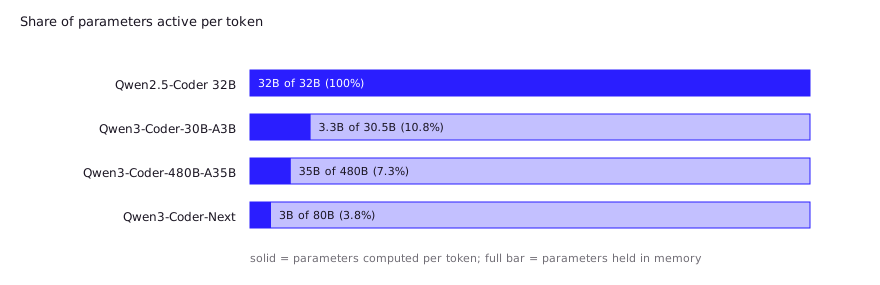
A mixture-of-experts (MoE) model stores all its weights in memory but only computes a few of them per token, so it needs the memory of a big model and the speed of a small one. Qwen3-Coder-30B-A3B holds 30.5B parameters but activates 3.3B per token, according to its model card. Qwen2.5-Coder is dense: every parameter is used on every token.
In practice that gives you a trade:
- Memory is set by total parameters. The 30B MoE costs roughly what a 30B dense model costs to load, and the 19 GB Ollama download is the floor, not the total.
- Speed is set by active parameters. Fewer active parameters means less computation per token than a dense 32B, though real throughput depends on your hardware and runtime.
- Quality isn’t predicted by either number. Don’t pick on parameter count alone. Qwen’s own benchmark tables are self-reported, and this site hasn’t run its own tests on these models yet.
Which size fits your hardware?
One developer who pulled the 51 GB Qwen3-Coder-Next through Ollama onto an RTX 5090 with 32 GB of VRAM measured about 12 tok/s, because roughly half the layers landed in system RAM (HN comment, Feb 2026). That is the failure this section is about. Pick the largest model whose download size fits in your VRAM or unified memory with several GB to spare for the context cache. The file size is a hard lower bound on memory use, and a long context adds to it. Sizes below are Ollama download sizes from the library pages.
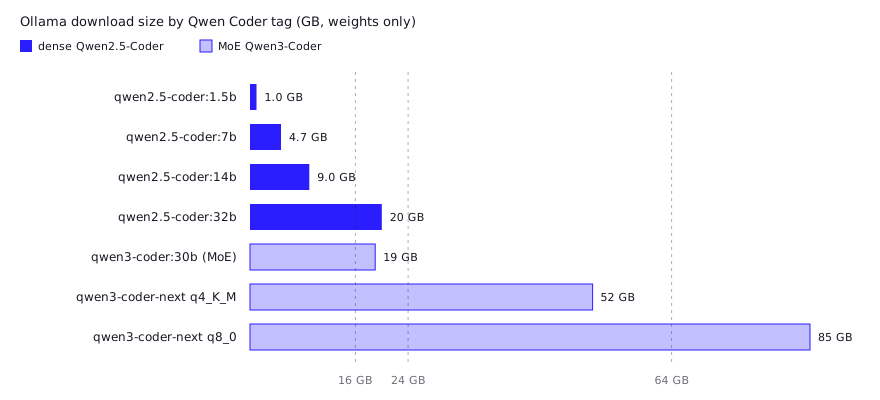
| Model and tag | Download | Sensible starting point |
|---|---|---|
qwen2.5-coder:1.5b | 986 MB | Autocomplete on a laptop with no GPU |
qwen2.5-coder:7b | 4.7 GB | 8 GB GPUs, base build for editor completion |
qwen2.5-coder:14b | 9.0 GB | 12 to 16 GB GPUs |
qwen2.5-coder:32b | 20 GB | 24 GB GPUs, dense and slower per token |
qwen3-coder:30b | 19 GB | The default pick if you have about 24 GB or a 32 GB+ Mac |
qwen3-coder-next:q4_K_M | 52 GB | 64 GB unified memory or multi-GPU |
qwen3-coder-next:q8_0 | 85 GB | 96 GB+ |
qwen3-coder:480b | 290 GB | Ollama says it needs at least 250 GB of memory. A server, not a desk. |
LM Studio lists a minimum of 15 GB of system memory for its Qwen3-Coder-30B build, which is lower than Ollama’s 19 GB download, so the two defaults are evidently different builds. See local LLM hardware requirements for how to size a GPU or Mac for any of these.
Quantization matters as much as the model name. Ollama publishes 199 Qwen2.5-Coder tags across q2_K up to fp16. The official Qwen3-Coder-Next GGUF repository lists Q4_K_M at 48.4 GB, Q8_0 at 84.8 GB and F16 at 159 GB. Lower bit-widths shrink the file and cost some accuracy, and how much depends on the model, so verify on your own code.
How much context do you actually get?
Qwen3 Coder models support 262,144 tokens natively, but Ollama will not give you that by default. Ollama chooses its default context from your VRAM: 4k tokens under 24 GiB, 32k from 24 to 48 GiB, and 256k at 48 GiB or more, per its documentation. The same page recommends at least 64,000 tokens for coding tools and agents.
Set it explicitly, and confirm with ollama ps:
OLLAMA_CONTEXT_LENGTH=64000 ollama serveOther facts from the model cards:
- Qwen3-Coder-30B-A3B can be extended to 1M tokens with YaRN, and Qwen3-Coder-Next is validated up to 131,072 with YaRN scaling in its GGUF card.
- Qwen2.5-Coder’s default config is capped at 32,768 tokens. YaRN reaches 131,072, but the card warns static YaRN in vLLM can hurt short-text performance.
- Every extra token of context costs memory on top of the weights. If a model runs out of memory, the Next card suggests cutting context to 32,768 first.
What do developers report in practice?
Community reports agree on the shape: the 30B MoE is the practical sweet spot, the 80B Next is a memory-and-offload problem, and agent use depends on the client. These are individual reports on different hardware, not our tests.
| Setup | Report | Source |
|---|---|---|
qwen3-coder:30b-a3b-q8_0 at 32k context, split across an RTX 3090 and an RTX 4060 Ti under Ollama, driven from Claude Code | About 36 GB loaded; the poster says it “runs great” | HN comment, Jan 2026 |
| Qwen3-Coder-30B-A3B GGUF on a 6 GB RTX 2060 laptop GPU with 13 GB RAM, via ik_llama and opencode | Usable on small projects at up to 64k context; the poster expects it to struggle on larger ones | HN comment, Feb 2026 |
| Qwen3-Coder-Next on an RTX 7900 XTX, llama.cpp with Vulkan, UD-Q4_K_XL | About 39 tok/s | HN comment, Feb 2026 |
| Qwen3-Coder-Next Q8_0 on a 96 GB RTX 6000 Blackwell | Over 60 tok/s; wrote a working Wordle clone in four prompts | HN comment, Feb 2026 |
| Qwen3-Coder-Next (51 GB) via Ollama on an RTX 5090 32 GB with 192 GB DDR5, 128k context | About 12 tok/s, flat across tasks, because roughly half the layers sat in system RAM; prompt processing ran at 280 to 410 tok/s | HN comment, Feb 2026 |
| Qwen3-Coder-Next Q4_K_M on an M1 64 GB Mac | About 20 tok/s on llama.cpp; MLX was more than twice as fast but, the poster says, often re-processes the whole prompt because of KV-cache problems, which hurts agent loops | HN comment, Feb 2026 |
Three practical lessons come out of them:
- Fit the whole model in fast memory. The 5090 report is the clearest case: an 80B model that spills to system RAM runs at CPU speed no matter how fast the GPU is.
- Tool calling needs the right parser. Users of the 30B model in Roo Code, Cline and opencode reported inconsistent agent behavior until the server used the right tool-call parser, for example
--enable-auto-tool-choice --tool-call-parser qwen3_coderon vLLM (Level1Techs forum, Aug 2025). Unsloth’s Qwen3-Coder-Next guide also says llama.cpp fixes for looping and tool-call parsing landed after launch, so update llama.cpp and re-download older GGUFs (Unsloth guide). - Expect a ceiling on agent work. One developer who keeps coming back to Qwen3-Coder 30B on a 20 GB workstation GPU describes it as decent in isolation but weaker on multi-step, context-heavy agentic work than hosted frontier models (HN comment, Oct 2025). For the wider trade-off, see local LLM vs Claude for coding.
Base vs instruct: which do you need?
Use an instruct model for chat, agents and editor assistants, and a base model only for raw completion or your own fine-tuning. The Qwen2.5-Coder base card says “we do not recommend using base language models for conversations,” and points to post-training or fill-in-the-middle (FIM) tasks instead.
The Qwen3 generation changes the picture:
- Qwen3-Coder 30B and 480B are instruct only. The Qwen3-Coder README labels them as instruct models for chatting, and says FIM is supported in every version, so the instruct builds already handle completion.
- Qwen3-Coder-Next has both.
Qwen3-Coder-Next-Baseexists on Hugging Face, but it has had far fewer downloads than the instruct model (about 1.6 thousand versus about 479 thousand at the time of writing), and the Ollama library has no base tag. - Qwen2.5-Coder has both at every size. Ollama carries
-baseand-instructtags for all six sizes. For tab-completion in an editor, the small base builds are the natural fit. - None of the Qwen3-Coder models think out loud. The cards say they only support non-thinking mode and do not emit
<think>blocks. Don’t build prompts that expect a reasoning trace.
Recommended sampling differs by generation: temperature 0.7, top_p 0.8, top_k 20 for Qwen3-Coder-30B-A3B, and temperature 1.0, top_p 0.95, top_k 40 for Qwen3-Coder-Next. Check the card for your exact model.
How do you run Qwen Coder in Ollama, LM Studio and llama.cpp?
Ollama is the shortest path: one pull, one run. All three runtimes load the same GGUF weights, so the choice is about interface, not quality.
# Ollama: the default 30B MoE (19 GB)
ollama pull qwen3-coder:30b
ollama run qwen3-coder:30b

# Ollama: Qwen3-Coder-Next, 4-bit (52 GB)
ollama run qwen3-coder-next:q4_K_M

# Ollama: the dense 14B for a 16 GB GPU
ollama run qwen2.5-coder:14b

# Straight from Hugging Face's official GGUF repo
ollama run hf.co/Qwen/Qwen3-Coder-Next-GGUF:Q4_K_M
For llama.cpp, the official GGUF card gives a serve command in the form ./llama-server -hf Qwen/Qwen3-Coder-Next-GGUF:Q4_K_M, plus a llama-cli line that uses --jinja, -fa on and --no-context-shift. Copy it from the card rather than from a blog, since flags change between releases. In LM Studio, search for the model name, or use the Qwen3-Coder-30B page’s “Use Model in LM Studio” link, which also offers MLX builds at 4 to 8 bits for Apple silicon.
What are the license terms?
Almost all Qwen Coder models are Apache 2.0, which allows commercial use, modification and redistribution. The Hugging Face license field reads apache-2.0 for the Qwen3-Coder models, Qwen3-Coder-Next and its Base and GGUF repos, and Qwen2.5-Coder at 0.5B, 1.5B, 7B, 14B and 32B.
The exception is Qwen2.5-Coder-3B, whose card lists qwen-research rather than Apache 2.0. Read that license before shipping it in a product.
Apache 2.0 requires you to pass on the license text, mark files you changed, and keep notices if you redistribute. It also ends your patent license if you sue over the Work. It does not add an acceptable-use policy, which is a difference from Llama’s license. Hosting providers may add their own terms.
What should you know about abliterated Qwen Coder variants?
Abliterated Qwen Coder models are community re-uploads with the refusal behavior edited out, not Qwen releases. A Hugging Face search on October 26, 2026 found several for Qwen3-Coder, including huihui-ai’s Huihui-Qwen3-Coder-30B-A3B-Instruct-abliterated and an abliterated Qwen3-Coder-Next, plus many GGUF conversions by third parties.
Three things to keep in mind:
- They are unofficial. The huihui-ai card calls its method “a crude, proof-of-concept implementation” and says the model “has not undergone rigorous safety optimization.” Quality loss is possible and unmeasured here.
- The upstream license still applies. The cards list Apache 2.0, but you remain responsible for what you do with the output, and for using it on code and systems you are authorized to work on.
- Check whether you need one. Test the official weights on your own workload first. Read what abliterated models are and how to run them in Ollama before swapping out the official weights.
For head-to-head questions about DeepSeek Coder, see DeepSeek Coder vs Qwen Coder.
FAQ
Which Qwen Coder model is best for Ollama?
For most developers with a 24 GB GPU or a 32 GB Mac, qwen3-coder:30b. It’s a 19 GB download with only 3.3B parameters active per token and 256K native context. On 8 to 16 GB GPUs, use qwen2.5-coder:7b or qwen2.5-coder:14b.
What is Qwen3-Coder-Next?
Qwen3-Coder-Next is an 80B-parameter MoE model that activates 3B parameters per token, released in February 2026 under Apache 2.0. It supports 262,144 tokens natively and is non-thinking only. The Ollama q4_K_M build is 52 GB.
What context length does Qwen Coder support?
Qwen3-Coder models support 262,144 tokens natively, and Qwen2.5-Coder supports 32,768 by default and 131,072 with YaRN. Ollama’s default context is smaller than either on cards under 48 GiB of VRAM, so set OLLAMA_CONTEXT_LENGTH.
Should I use the base or instruct version of Qwen Coder?
Use instruct for chat, agents and most editor integrations. Use base only for raw completion or fine-tuning. Qwen3-Coder 30B and 480B have no base release, and Qwen’s README says FIM works in every Qwen3-Coder version.
Is Qwen Coder free for commercial use?
Yes for nearly every model: they’re Apache 2.0. The exception is Qwen2.5-Coder-3B, which uses the qwen-research license, so read it before commercial use.
Sources (10)
- qwen3-coder, Ollama library
- qwen3-coder-next, Ollama library
- qwen2.5-coder tags, Ollama library
- Qwen/Qwen3-Coder-30B-A3B-Instruct, Hugging Face model card
- Qwen/Qwen3-Coder-Next, Hugging Face model card
- Qwen/Qwen3-Coder-Next-GGUF, Hugging Face model card
- QwenLM/Qwen3-Coder, GitHub README
- Qwen3-Coder-Next discussion, Hacker News (Feb 3, 2026)
- Qwen3-Coder-Next 80B benchmark on RTX 5090 via Ollama, Hacker News comment (Feb 10, 2026)
- Context length, Ollama documentation