DeepSeek has no current Coder model, Qwen does. Benchmarks, local hardware, licenses and API prices for DeepSeek V4.1 vs Qwen3.8 and Qwen3-Coder-Next, Oct 2026.
DeepSeek Coder is no longer a live product line: the last DeepSeek-branded coder weights on Hugging Face date from 2024, and DeepSeek's current models are the general V4 family. Qwen still ships a dedicated Qwen3-Coder-Next (80B total, 3B active). On vendor-reported agentic benchmarks DeepSeek V4.1-Flash leads, but Qwen's 27B and Coder-Next are the ones a single workstation can actually run.
- V4.1-Flash (MIT), V4-Pro-0813 (MIT)
- Qwen3-Coder-Next, 80B/3B active
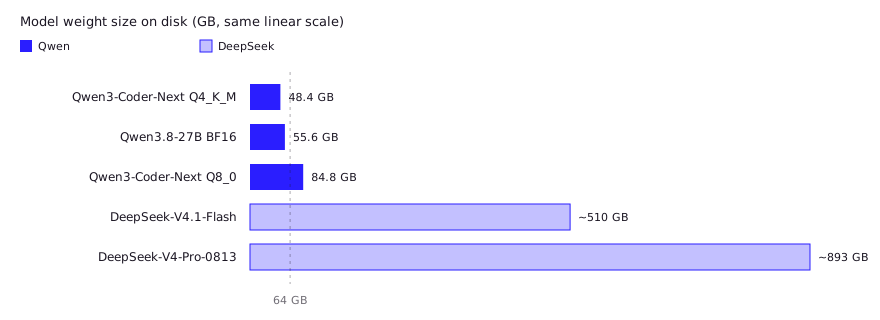
- 510 GB vs 55.6 GB weights
- Oct 26, 2026
Key takeaways
- DeepSeek folded coding into its V4 models. The newest DeepSeek-Coder repo is V2, last modified October 2024.
- Qwen3-Coder-Next (Feb 2026, Apache 2.0) is the only dedicated coder in this comparison: 80B total, 3B active, 48 GB at Q4_K_M.
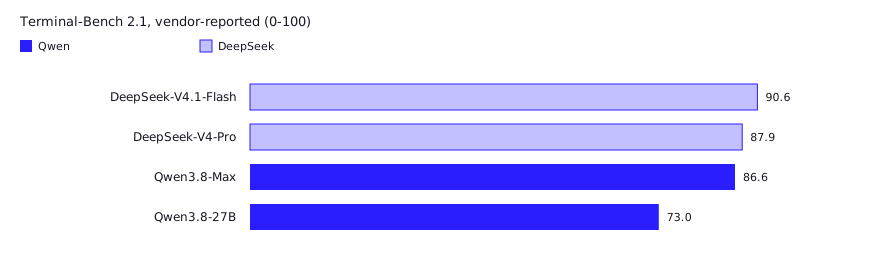
- DeepSeek V4.1-Flash reports 90.6 on Terminal-Bench 2.1 against 73.0 for Qwen3.8-27B, but the harnesses differ and both are vendor numbers.
- V4.1-Flash weights are about 510 GB, so local use means a multi-GPU server. Qwen3.8-27B is 55.6 GB in BF16.
- Hosted Flash-class prices are close: DeepSeek lists $0.15 per million input tokens (cache miss, off-peak) and Alibaba lists $0.15 for qwen3.8-flash.
DeepSeek Coder vs Qwen Coder: which models are actually in play?
In a DeepSeek Coder vs Qwen Coder comparison, only one side still has a Coder: “DeepSeek Coder” no longer names a current model, so we compare DeepSeek’s V4 family against Qwen’s Qwen3.8 family and Qwen3-Coder-Next. The most recent DeepSeek-Coder repository on Hugging Face is DeepSeek-Coder-V2-Instruct-0724, a 236B-parameter model with 21B active and a 128K context window, last modified in October 2024. DeepSeek’s current releases are general models that carry the coding work.
As of October 26, 2026, the lineup looks like this:
| Model | Maker | Size (total / active) | Context | Notes |
|---|---|---|---|---|
| DeepSeek-V4.1-Flash | DeepSeek | 763B on the Hub / 8B prefill, 16B decode | 1M | Served as deepseek-flash |
| DeepSeek-V4-Pro-0813 | DeepSeek | 1.7T / not stated | 1M (API) | Served as deepseek-v4-pro |
| Qwen3-Coder-Next | Qwen | 80B / 3B | 262,144 | Dedicated coder, non-thinking only, Feb 2026 |
| Qwen3.8-27B | Qwen | 27B dense | 262,144, up to 1M | General model, thinking on by default |
| Qwen3.8-Flash-Next | Qwen | 125B + 51B n-gram embedding + 4B MTP / 6B | 262,144, up to 1M | Experimental preview of the architecture behind Qwen4 |
| Qwen3.8-2.4T-A95B | Qwen | 2.4T / 95B | 262,144, up to 1.01M | Open-weight base of Qwen3.8-Max |
Sizes and context come from each model card. The “Coder” label survives only on the Qwen side: Qwen3-Coder-Next, and the older 480B and 30B Qwen3-Coder releases from 2025.
How do they compare on coding benchmarks?
On the numbers each vendor publishes, DeepSeek-V4.1-Flash leads the agentic coding rows, while Qwen3.8-27B and Flash-Next lead the competitive-coding row against DeepSeek’s older Flash. Treat the table as a map of claims, not a ruling. Every score below is self-reported, the harnesses are not identical, and no independent leaderboard result is included.
| Benchmark | DeepSeek V4.1-Flash | DeepSeek V4-Pro | Qwen3.8-27B | Qwen3.8-Flash-Next | Qwen3-Coder-Next |
|---|---|---|---|---|---|
| Terminal-Bench 2.1 | 90.6 | 87.9 | 73.0 | not reported | 36.2 (v2.0)* |
| DeepSWE 1.1 | 74.2 | 62.7 | 42.2 | 58.7 | not reported |
| SWE-bench Pro | not reported | not reported | 61.7 | 62.5 | 44.3* |
| NL2Repo-Bench | 64.0 | 61.5 | 42.3 | 48.1 | not reported |
| LiveCodeBench v6 | not reported | not reported | 90.3 | 91.9 | not reported |
| Codeforces rating | 3471 | 3348 | not reported | not reported | not reported |
| SWE-bench Verified | not reported | not reported | not reported | not reported | 70.6* |
Starred Qwen3-Coder-Next scores are listed without an explanation of the asterisk on the model card, and its Terminal-Bench figure is version 2.0, not 2.1. Three caveats matter more than any single cell:
- Different harnesses. Qwen states that its SWE-bench Pro and DeepSWE 1.1 runs use the Claude Code harness at temperature 1.0 and a 256K context. DeepSeek reports DeepSWE across several scaffolds, from 65.5 to 74.2 for V4.1-Flash, so the scaffold alone moves the score by nearly 9 points.
- Dated comparisons. The Flash-Next card pits Qwen against DeepSeek-V4-Flash-0731, not V4.1-Flash. In that table, Flash-Next scores 91.9 to V4-Flash-0731’s 90.6 on LiveCodeBench v6, and 58.7 to 54.4 on DeepSWE 1.1.
- In-house tests. Several rows, including Qwen’s QwenSWEBench and DeepSeek’s DSBench sets, are internal. They are not reproducible by outsiders.
Qwen’s flagship tells the same story at the top end: the 2.4T model’s card reports Terminal-Bench 2.1 at 86.6 and SWE-bench Pro at 67.7 for Qwen3.8-Max, below DeepSeek-V4.1-Flash’s 90.6 on Terminal-Bench but on a different harness. Run your own repository through both before you switch.
Can you run them locally?
One commenter on Hacker News sizes it from the hardware side: two DGX Sparks only reach Q2 on the biggest DeepSeek weights, so a single Spark or a used 64 GB M1 Max running Qwen3-Coder-Next is the better trade (HN, Oct 26). The file sizes agree. You can run Qwen’s models locally on workstation hardware, but DeepSeek’s V4 weights need a server. DeepSeek-V4.1-Flash occupies about 510 GB on the Hub (a mix of FP8 and INT8 tensors), and V4-Pro-0813 about 893 GB (mostly INT8 tensors). That is multi-GPU territory before you count KV cache.
The Qwen side spans a wider range:
| Model | Weight size | Source |
|---|---|---|
| Qwen3-Coder-Next, Q4_K_M GGUF | 48.4 GB | Qwen’s GGUF repo |
| Qwen3-Coder-Next, Q8_0 GGUF | 84.8 GB | Qwen’s GGUF repo |
| Qwen3.8-27B, BF16 safetensors | 55.6 GB | Hub file listing |
| DeepSeek-V4.1-Flash, native | about 510 GB | Hub file listing |
| DeepSeek-V4-Pro-0813, native | about 893 GB | Hub file listing |
Qwen3-Coder-Next activates only 3B parameters per token, which makes it fast for its size, but all 80B still have to sit in memory. At Q4_K_M, a 64 GB unified-memory machine is the realistic floor. The 27B dense model is 55.6 GB at BF16 and shrinks further when quantized. Neither Qwen card publishes VRAM requirements, so see local LLM hardware requirements for memory math and the Qwen coder local guide for setup.
If your machine tops out at consumer GPUs, the practical choice is Qwen. For wider model choice, see best local LLM for coding.
How do the licenses compare?
DeepSeek’s V4 models are MIT licensed, and the two Qwen models you are most likely to self-host are Apache 2.0. Both are permissive, but Qwen’s license varies by model, so check the file in the repository you download.
| Model | License tag on Hugging Face |
|---|---|
| DeepSeek-V4.1-Flash | MIT |
| DeepSeek-V4-Pro-0813 | MIT |
| DeepSeek-Coder-V2 (legacy) | deepseek-license; the card says the series supports commercial use |
| Qwen3-Coder-Next | Apache-2.0 |
| Qwen3.8-27B | Apache-2.0 |
| Qwen3.8-Flash-Next | qwen-community-1.0 |
| Qwen3.8-2.4T-A95B | qwen3.8-max |
The last two rows are custom licenses that we haven’t summarized here, and you should read them before building a product on those weights. MIT and Apache 2.0 impose no use-case restrictions of their own, but laws on unauthorized access still apply to what you do with a model. For how acceptable-use clauses differ across model licenses, see the license explainer.
What do the APIs cost?
Hosted prices for the small models are close, and DeepSeek’s Pro tier lists below Alibaba’s Max tier. The figures below are USD per million tokens, read from each vendor’s official pricing page on October 26, 2026.
| Model | Input | Output | Notes |
|---|---|---|---|
deepseek-flash (V4.1-Flash-1017) | $0.15 off-peak, $0.30 peak (cache miss) | $0.60 off-peak, $1.20 peak | 1M context; cache hit $0.003 / $0.006 |
deepseek-v4-pro (V4-Pro-0813) | $0.66 off-peak, $1.32 peak (cache miss) | $1.98 off-peak, $3.96 peak | 1M context; cache hit $0.022 / $0.044 |
qwen3.8-flash | $0.15 (Singapore, US Virginia), $0.113 elsewhere | $0.47, or $0.382 elsewhere | Single tier up to 1M tokens |
qwen3.8-27b | $0.50 (Singapore), $0.424 (Beijing) | $3.00 (Singapore), $1.696 (Beijing) | Open model, hosted |
qwen3.8-max | $2.00 (Singapore, US Virginia) | $6.00 | Region-dependent |
qwen3-coder-flash | $0.30 up to 32K tokens, rising to $1.60 above 256K (Singapore) | $1.50 up to 32K, rising to $9.60 | Tiered by request size |
DeepSeek charges half price off-peak. Peak hours are 01:00 to 04:00 and 06:00 to 10:00 UTC, Monday to Friday, excluding Chinese public holidays. Alibaba’s page says its Singapore region includes a free 1M-token quota for the models above and lists region-specific rates, so confirm yours.
Prices change often, and reasoning models bill thinking tokens as output, so a long agentic session costs more than the headline rate suggests. For hosted options beyond these two vendors, see uncensored LLM APIs compared.
What do developers report in practice?
Practitioners mostly echo the hardware split, and disagree more about quality than the vendor tables suggest. The items below are community reports from Hacker News, not our tests, and each is one person’s setup.
- Serving cost favors DeepSeek’s MoE design. One commenter says Qwen3.8-27B is a dense model with expensive KV caching: great on 32 to 48 GB of VRAM for one or two local agent sessions, costly for batch serving. They put DeepSeek V4 Flash 0731 at under 10% of the cost at scale (HN, Oct 25).
- Qwen3-Coder-Next is the pick for unified-memory machines. A commenter argues that two DGX Sparks only reach Q2 on the biggest DeepSeek weights, so Qwen3-Coder-Next on a single Spark, or a used 64 GB M1 Max, is the better trade (HN, Oct 26). Another runs a 6-bit Qwen3-Coder-Next on a 128 GB Framework and says it works fine, while a Qwen 27B model ran about 20 tok/s with MTP (HN, Jul 10).
- GPU offload is the usual speed trap. One user on Qwen3-Coder-Next-UD-Q4_K_XL says later prompts return in under a minute once the context is loaded, and that anything much slower probably means llama.cpp is running on CPU (HN, Jul 23).
- Dense 27B can beat the dedicated coder. Another commenter finds Qwen3-Coder-Next very usable but not as good as Qwen3.6-27B, though faster on their hardware, and wishes for a newer Qwen coder (HN, Jul 8).
- “Good enough” is common. A developer who uses Opus 5.5 at work says DeepSeek V4 (Flash or Pro) and GLM at home cover all but under 5% of their tasks (HN, Oct 26).
The pattern: DeepSeek wins on hosted cost and reported capability, Qwen wins on what fits under a desk. Neither claim replaces running your own repository through both.
Which one should you pick?
Pick by where the model runs, not by the headline benchmark. These are judgment calls from the published specs, not test results.
- Single workstation or laptop, private code: Qwen3-Coder-Next at Q4_K_M or Qwen3.8-27B. DeepSeek’s V4 line isn’t a realistic option here.
- Cheapest hosted agent loop: DeepSeek-V4.1-Flash or qwen3.8-flash. Their input prices match at $0.15 in the headline regions, so compare cache pricing and your traffic pattern.
- Best reported agentic score on a hosted API: DeepSeek-V4.1-Flash, going by its Terminal-Bench 2.1 and DeepSWE numbers. Verify on your own repository, since the scaffold changes the score.
- Own a GPU server and want permissive terms: DeepSeek-V4.1-Flash (MIT) or Qwen3.8-27B (Apache 2.0).
- You specifically want a dedicated coder: Qwen3-Coder-Next. DeepSeek has none after V2.
FAQ
Is there a new DeepSeek Coder model in 2026?
No dedicated one. DeepSeek’s newest models are DeepSeek-V4.1-Flash and V4-Pro-0813, general models with strong coding scores. The last DeepSeek-Coder repository is V2, last modified in October 2024.
Is Qwen Coder better than DeepSeek for coding?
It depends on the benchmark and the harness. DeepSeek-V4.1-Flash reports higher agentic scores (90.6 on Terminal-Bench 2.1), while Qwen3-Coder-Next and Qwen3.8-27B are far smaller and easier to run locally.
Which is better for local use, DeepSeek or Qwen?
Qwen. Qwen3-Coder-Next is 48.4 GB at Q4_K_M, and Qwen3.8-27B is 55.6 GB in BF16, while DeepSeek-V4.1-Flash is about 510 GB.
Are DeepSeek and Qwen models free for commercial use?
DeepSeek-V4.1-Flash and V4-Pro-0813 are MIT, and Qwen3-Coder-Next and Qwen3.8-27B are Apache-2.0. Some Qwen3.8 releases use custom licenses, so read the file before shipping.
Are there abliterated versions of DeepSeek or Qwen coder models?
Community releases exist for some open models, but we haven’t verified any for these specific versions. See what is abliteration for the method and its trade-offs.
Sources (10)
- DeepSeek API Docs: Models & Pricing
- DeepSeek-V4.1-Flash model card, Hugging Face
- DeepSeek-V4-Pro-0813 model card, Hugging Face
- DeepSeek-Coder-V2-Instruct-0724 model card, Hugging Face
- Qwen3.8-27B model card, Hugging Face
- HN comment: Qwen3.8 27B vs DeepSeek V4 Flash serving cost and KV cache (Oct 25, 2026)
- HN comment: Qwen3-Coder-Next on Apple silicon vs DGX Spark (Oct 26, 2026)
- Qwen3-Coder-Next model card, Hugging Face
- Qwen3-Coder-Next-GGUF file listing, Hugging Face
- Alibaba Cloud Model Studio: model pricing (updated Oct 22, 2026)