Local LLM for coding vs Claude: open-weight models trail by a few points on vendor benchmarks. Where the gap is real, what runs locally, and where local wins.
A local LLM is close to Claude on public coding benchmarks but not equal. Vendor-reported tables put the best open-weight models within a few points of the older Claude models they compare against, yet no independent run pits them against Claude Opus 5.5 on one harness. The biggest open models need datacenter hardware. A 27B model like Qwen3.8-27B fits one GPU, and developers report it works for small, well-scoped edits but not yet for long agent runs.
- 80.6 (DeepSeek V4 Pro, vendor-reported)
- Qwen3.8-27B, 61.7 on SWE-bench Pro
- $4 / $20 per MTok
- Oct 26, 2026
Key takeaways
- On vendor-reported tables, DeepSeek V4 Pro scores 80.6 on SWE-bench Verified against 80.8 for Claude Opus 4.6, but the comparison is one generation behind Anthropic's current Opus 5.5.
- The open models that reach that level have 1.6T to 2.8T parameters, far beyond a single consumer GPU. Qwen3.8-27B, which fits one GPU, reports 61.7 on SWE-bench Pro against 53.4 for Opus 4.6 Max in its own table.
- Benchmark numbers from different scaffolds are not comparable: Opus 4.6 Max scores 57.3 on SWE-bench Pro in DeepSeek's table and 53.4 in Qwen's. SWE-bench Verified itself has been criticized for flawed tasks.
- Local still wins on privacy, offline use, flat cost at high volume, and refusals on work you are authorized to do. Developers report local models handle small edits but struggle with agent tool calling and long multi-file work, where hosted Claude still wins.
- Most teams do not have to choose: route routine edits to a local model and hard tasks to a hosted one.
How big is the gap between local LLMs and Claude today?
In a local LLM for coding vs Claude comparison, the gap is small on paper and larger in practice. One developer running Qwen3-Coder-30B-A3B on a 6 GB RTX 2060 laptop found it usable for small changes and expects it to fall apart on larger projects (HN comment). On the model cards we checked on October 26, 2026, the best open-weight coding models land within roughly 0 to 6 points of the Claude models they chose to compare against. Those are vendor-reported numbers, the Claude comparators are usually one generation old, and the biggest open models do not fit on a workstation.
Three facts frame everything below:
- Frontier open-weight models are not local in any practical sense. DeepSeek V4 Pro has 1.6T total parameters (49B active per token). Kimi K3 has 2.8T (104B active). At 4-bit precision, weights alone run to roughly a terabyte or more, which is multi-GPU server territory. That is arithmetic from the parameter counts, not a figure from either card.
- What runs on one machine is a different tier. Qwen3.8-27B is a 27B dense model under Apache 2.0, released in August 2026. By the same arithmetic its weights are around 14 GB at 4-bit, before the KV cache.
- Claude moved on. Claude Opus 5.5 shipped September 22, 2026, and Anthropic’s own table for it reports no SWE-bench score and no open-weight comparison.
What do the public coding benchmarks say?
Vendor-reported tables show open-weight models trading blows with older Claude models, and trailing Claude Fable 5 on some agentic tests. Each row below comes from the open model’s own card, which picks its own comparator and its own scaffold. Treat it as a map of claims, not a leaderboard.
| Benchmark | Open-weight model (score) | Claude model in the same table (score) |
|---|---|---|
| SWE-bench Verified | DeepSeek V4 Pro Max (80.6) | Opus 4.6 Max (80.8) |
| SWE-bench Pro | DeepSeek V4 Pro Max (55.4) | Opus 4.6 Max (57.3) |
| SWE-bench Pro | Qwen3.8-27B (61.7) | Opus 4.6 Max (53.4) |
| Terminal-Bench 2.0 | DeepSeek V4 Pro Max (67.9) | Opus 4.6 Max (65.4) |
| LiveCodeBench | DeepSeek V4 Pro Max (93.5) | Opus 4.6 Max (88.8) |
| LiveCodeBench v6 | Qwen3.8-27B (90.3) | Opus 4.6 Max (88.8) |
| Terminal-Bench 2.1 (Terminus) | Qwen3.8-27B (73.0) | Opus 4.6 Max (78.2) |
| Terminal-Bench 2.1 | Kimi K3 (88.3) | Claude Fable 5 (88.0) |
| FrontierSWE | Kimi K3 (81.2) | Claude Fable 5 (86.6) |
| DeepSWE | Kimi K3 (67.5) | Claude Fable 5 (70.0) |
| Kimi Code Bench 2.0 | Kimi K3 (72.9) | Claude Fable 5 (76.9) |
Sources: the Qwen3.8-27B, DeepSeek-V4-Pro and Kimi-K3 model cards, checked October 26, 2026. The Kimi K3 card does not report SWE-bench or LiveCodeBench at all.
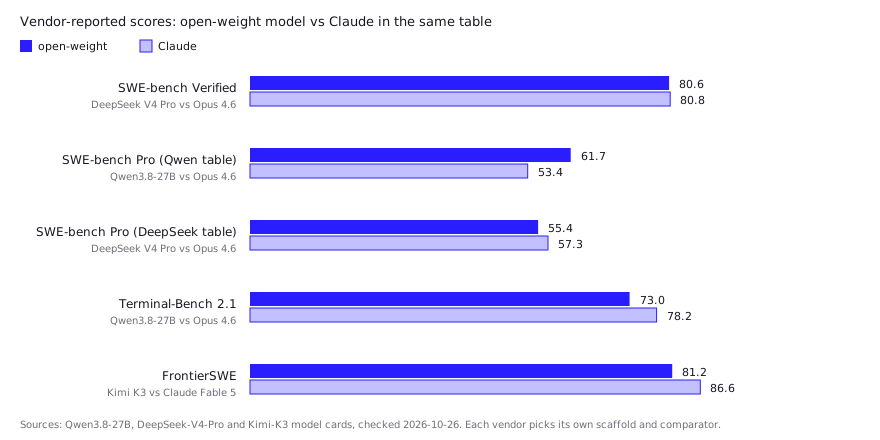
Read it this way: open-weight models are competitive on well-defined tasks (single issues, competitive coding) and behind on terminal and broader agentic suites, though the Qwen3.8-27B card shows it ahead of Opus 4.6 Max on two of three rows. The sizes differ, and several rows favor the open model.
Why should you not trust these numbers at face value?
Because the same benchmark name can hide different scaffolds, different effort settings and different generations of Claude. Four concrete reasons:
- Scaffolds differ. The SWE-bench site notes that its leaderboard spans everything from simple agent loops to multi-rollout systems and that scores across scaffolds are not directly comparable. For example, the same Opus 4.6 Max scores 57.3 on SWE-bench Pro in DeepSeek’s table but 53.4 in Qwen’s.
- The comparators are stale. Both DeepSeek’s and Qwen’s tables use Claude Opus 4.6. Neither is the current model.
- Anthropic reports different benchmarks. Its Opus 5.5 announcement lists Terminal-Bench 4.0 (66.4%), FrontierCode and CursorBench. None of those appear on the open-weight cards, so there is no direct cross-read. Anthropic also states a standard error of about 2.6 points for Opus 5.5 on Terminal-Bench 4.0, which is larger than several gaps in the table above.
- SWE-bench Verified is contested. AI Weekly reported in July 2026 that OpenAI audited 138 of the benchmark’s hardest tasks, found material test or description flaws in 59.4% of them, and moved to recommending SWE-bench Pro. The same article notes that a separate May 2026 audit questioned Pro’s grading, which Scale AI had not confirmed.
One older reference point is worth knowing but not leaning on: the Aider polyglot leaderboard data has no entry newer than October 3, 2025, so it says nothing about current models.
Where does a local LLM for coding beat Claude?
A local model wins when control matters more than the last few benchmark points. Four situations come up repeatedly:
- Privacy. Code stays on your machine. That removes a vendor review from the path for regulated or contract-restricted codebases.
- Offline and latency-independent work. Planes, air-gapped networks and flaky connections all work.
- Cost at sustained volume. A fixed hardware cost beats per-token billing only once usage is high enough. The break-even is a calculation you can run; see self-host vs API cost.
- Refusals on authorized work. Anthropic’s own Opus 5.5 notes say that when its production safeguards intervened on cybersecurity tasks, the model’s benchmark scores were likely lowered. A model you host has no such layer, and you decide the policy. That does not change the license or the law: reverse engineering your own binary or analyzing malware on your own network is authorized work, and anything else is not. For the broader pattern, see why LLMs over-refuse.
Where do hosted frontier models still win?
Hosted Claude still wins on the hardest long-running agentic tasks and on convenience. A developer who pointed Claude Code at a small local model saw tool calls fail, because the harness expects XML-style tool use and the model had JSON tool use baked in (HN comment). Anthropic positions Opus 5.5 “for long-running agentic coding and knowledge work” and Fable 5.1 for “demanding reasoning and long-horizon agentic work”, each with a 1M-token context window and 128K max output.
- Long-horizon agents. The Kimi K3 card shows the largest gaps to Claude Fable 5 on FrontierSWE (81.2 vs 86.6) and Kimi’s own code benchmark (72.9 vs 76.9), the kind of multi-step suites where local-class models are weakest.
- No hardware. A 1.6T or 2.8T model is a deployment project. An API key is not.
- Staying current. Anthropic shipped Opus 5.5 on September 22 and states a retirement date of not sooner than September 22, 2027 for it. Your local setup updates only when you do.
- Context. A 1M-token window is a hardware and memory problem locally; Qwen3.8-27B natively supports 262,144 tokens, extensible to 1M.
What do developers report in practice?
Community reports are more cautious than the benchmark tables, and they say the weak spot is the agent loop, not raw code quality. These are anecdotes from different hardware and harnesses, not our tests.
| Report | What they found | Source |
|---|---|---|
| Qwen3-Coder-30B-A3B on a 6 GB RTX 2060 laptop GPU with 13 GB RAM, using opencode and ik_llama | Usable for small projects and small changes at up to 64k context; the poster expects it to fall apart on larger ones | HN comment |
| A developer with a 64 GB MacBook Pro | Had not found a local model that runs Codex CLI or Claude Code well enough to be useful; another replier had mild success with GPT-OSS-120b | HN thread |
| A developer pointing Claude Code at a small local model | Tool calls failed: the harness expects XML-style tool use and the small model had JSON tool use baked in | HN comment |
| A developer running glm-4.7-flash via Ollama on a 32 GB M2 Pro Mac mini | Good enough for cleaning up code, adding docs and tests to old projects | HN comment |
| Level1Techs forum users trying Qwen3-Coder 30B in Roo Code, Cline and others (Aug 2025) | Results ranged from “pretty good” to “surprisingly difficult” as an agent, depending on the client; vLLM needed --enable-auto-tool-choice --tool-call-parser qwen3_coder | Forum thread |
The pattern across independent reports: small edits, docs, tests and code reading work locally. Agentic tool calling depends on the client and the server’s parser, and long multi-file work is where people go back to hosted Claude. The reports are also dated, and both llama.cpp tool parsing and Qwen releases have moved since.
What does a hybrid setup look like?
A hybrid setup sends routine work to a local model and escalates only what it fails. This is a judgment call, not a benchmarked recipe, and the right split depends on your codebase.
| Task | Where to run it | Why |
|---|---|---|
| Autocomplete, small edits, test stubs | Local 27B-class model | Latency and cost; the quality bar is low |
| Reading and summarizing private code | Local | Code never leaves the machine |
| Security tooling on systems you own | Local | You control the refusal policy |
| Multi-file refactors, long agent runs | Hosted Claude | Strongest on long-horizon work |
| Final review of risky changes | Hosted Claude | A second, independent model catches different mistakes |
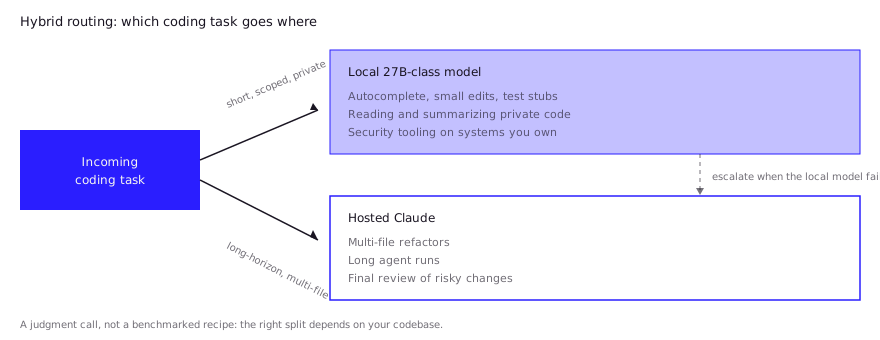
If you already use Claude Code as your agent, you can point it at a local model for some workloads. Setup details live in running Claude Code with a local LLM, and the model choices behind the local tier are in the best local LLMs for coding in 2026.
When does local pay off on cost?
Local pays off when your volume is high and steady and your hardware is already paid for. Claude API list prices on the models overview are $2 / $10 per million input / output tokens for Sonnet 5.5, $4 / $20 for Opus 5.5, $10 / $50 for Fable 5.1, and from $0.10 / $0.50 for Haiku 5.5. Batch requests are 50% off and cache reads cost a fraction of base input price.
Two honest observations follow from those numbers:
- Haiku 5.5 and prompt caching push the hosted floor low enough that light users rarely save money by buying a GPU.
- Heavy agentic use is the opposite case. Agents burn many output tokens per task, and that is where per-token pricing compounds. Run the numbers on your own token counts, not on a blog’s averages, using the worked model in self-host vs API cost.
FAQ
Is Qwen3.8-27B as good as Claude for coding?
On Qwen’s own table it beats Opus 4.6 Max on SWE-bench Pro (61.7 vs 53.4) and LiveCodeBench v6 (90.3 vs 88.8) and trails on Terminal-Bench 2.1 (73.0 vs 78.2). Those are vendor numbers against a Claude model that is no longer current, and developers report weaker results in long agent runs.
Can I run DeepSeek V4 or Kimi K3 locally?
Only on server-class hardware. DeepSeek V4 Pro has 1.6T parameters and Kimi K3 has 2.8T, so even 4-bit weights are on the order of a terabyte. Smaller open models are the realistic local choice.
Which benchmark should I trust most?
None alone. Prefer results that state the scaffold, effort level and number of runs, and weigh a benchmark that matches your own work, such as terminal tasks or issue resolution, over a headline average. SWE-bench Verified in particular has drawn audit criticism.
Is open-weight the same as open source?
No. DeepSeek V4 Pro is MIT-licensed and Qwen3.8-27B is Apache 2.0, but Kimi K3 ships under its own Kimi K3 License. Read the license before using a model commercially.
Sources (10)
- Qwen3.8-27B model card, Hugging Face (Qwen team)
- DeepSeek-V4-Pro model card, Hugging Face (DeepSeek)
- Kimi-K3 model card, Hugging Face (Moonshot AI)
- Introducing Claude Opus 5.5, Anthropic (Sep 22, 2026)
- Models overview, Claude API documentation
- SWE-bench Verified leaderboard and methodology notes
- OpenAI drops SWE-Bench Verified, backs Pro after flaw audit, AI Weekly (Jul 8, 2026)
- Aider polyglot leaderboard data, GitHub (latest entry dated 2025-10-03)
- Qwen3-Coder-Next discussion, Hacker News (Feb 3, 2026)
- Local qwen 3 coding, Level1Techs forum (Aug 2025)