Venice AI review from its own pages and user reports: what the chat app is, which models it runs, Free vs Pro limits, how uncensored it is, and who should pay.
Venice AI is a private, uncensored AI chat app that runs open-weight models on its own or zero-retention infrastructure and proxies closed models such as Claude and GPT. As of November 9, 2026, Free allows 10 text prompts a day and Pro costs $18 a month for unlimited text on Pro models. It is worth it if you want fewer refusals and local-only chat history; complaints center on billing, support and credit-metered models.
- 10 text prompts/day, 15 image prompts/day
- $18/mo on the web, $23.99 through the iOS app
- 138 (76 Private, 62 Anonymized)
- Nov 9, 2026
Key takeaways
- Free gives 10 text prompts a day. Pro is $18 a month on the web for unlimited text on Pro models, but it includes only $1 of monthly credits, so frontier models cost extra.
- The catalog is large: Venice's public model list shows 138 text models, 76 labeled Private and 62 Anonymized. Claude, GPT and Gemini models are all Anonymized, meaning the upstream provider sees your prompt.
- Only about a dozen text models are explicitly uncensored. The default is an uncensored DeepSeek V4.1 Flash build; most of the rest keep their makers' refusal training.
- The only published refusal number is Venice's own: 2.2% on 45 prompts for its earlier Dolphin-based model. No independent benchmark of the current Venice Uncensored 1.2 turned up.
- Store ratings split: 4.3 on the US App Store from 1.9K ratings, 1.9 on Trustpilot from 72 reviews, where most complaints are about errors, billing and slow support.
This Venice AI review covers the consumer chat app at venice.ai, read from Venice’s own pricing, privacy and terms pages and its public model list on November 9, 2026, plus user reports from the App Store, Trustpilot, Reddit, Hacker News and Venice’s feedback board. Refusal Rate has not run its own tests on Venice, so there are no refusal or latency numbers of ours here. For the developer API (endpoints, per-token prices, rate limits), see the Venice AI API review.
Short verdict. Venice is a good fit if you want an uncensored AI chat app with chat history kept on your device and one subscription that reaches both open-weight and closed models. It is a weaker fit if you mostly want Claude or GPT, because those run through Venice in a mode where the provider still sees your prompts, and they cost credits on top of Pro.
What is Venice AI?
Venice AI is a browser and mobile chat app that sells “private and uncensored” access to a large catalog of AI models, plus a separate pay-per-token API. Its privacy page says conversation history “stays on your device” and that Venice never stores it on its servers. Text, image, video and music generation sit in one interface; this page covers the text side only.
What Venice is used for, going by its own positioning and the reports below: long-form chat and writing with fewer refusals, research questions that mainstream assistants decline or hedge on, coding help on open-weight models, and roleplay with custom characters (a Pro feature).
Venice describes four privacy modes, and the mode depends on the model you pick:
| Mode | What Venice says happens | Who can read the prompt |
|---|---|---|
| Private (default) | Runs on Venice-controlled GPUs or zero-retention partners; no prompt or response stored, enforced by contract | You trust Venice and its partners’ contracts |
| Anonymous | Venice proxies the request to a frontier provider and hides your identity | The provider, which you should assume stores it |
| TEE (Pro) | Inference in a hardware-isolated enclave, checked by remote attestation | Not the GPU provider, per Venice |
| E2EE (Pro) | Prompt encrypted on your device and decrypted only inside a verified TEE; no web search or memory | Only the enclave, per Venice |
Whether those claims hold up is a separate question, covered in is Venice AI safe. The short version: Private rests on contracts, not a public audit.
Which models and features does it offer?
Venice offers a very wide text catalog, but only a small slice of it is uncensored by design. Its public model list, fetched November 9, 2026, shows 138 text models: 76 marked Private and 62 marked Anonymized.
The list breaks down roughly like this:
- Uncensored builds (about a dozen): Venice Uncensored 1.2 (tagged “most uncensored”), uncensored or “Heretic” variants of DeepSeek V4.1 Flash, Gemma 4, Qwen 3.6 Plus and GLM 4.7 Flash, and a role-play model. The app’s default model is DeepSeek V4.1 Flash 1017 Uncensored.
- Open-weight models run privately: DeepSeek V4 and V4.1, Kimi K3 and K3.1 Pro, GLM 5.x, Qwen 3.x including Qwen 3 Coder 480B, Gemma 4, MiniMax, Nemotron and gpt-oss-120b.
- Closed models, Anonymized: Claude (Opus, Sonnet, Haiku, Fable), GPT-5.x and GPT-6, Gemini 3.x and 4, and some Qwen Max builds. These keep their makers’ refusal behavior.
- Grok 4.x: marked Private in the list, with Grok 4.7 tagged “most intelligent”.
- E2EE variants: 13 model IDs carry an e2ee prefix, including GLM 5.3, Kimi K3 and an uncensored Gemma 4 build.
Two things follow. First, “uncensored” describes Venice’s default and a handful of models, not the whole app: pick Claude in Venice and you get Claude’s refusals. Second, the catalog changes often. A RoboRhythms review that went through Venice’s changelog counted 17 models deprecated in August 2026 alone (review). Model names in this section are a snapshot.
Pro adds custom characters, extended context windows, encrypted chat backup and restore, and image tools, per the pricing page.
Free vs Pro: what do you get?
Free is a trial; Pro is the real product, and anything frontier costs credits on top. Venice’s pricing page lists four plans as of November 9, 2026:
| Plan | Price | Text prompts | Monthly credits | Notes |
|---|---|---|---|---|
| Free | $0 | 10 a day | none | Base models only; API usable if you buy credits |
| Pro | $18/mo | Unlimited on Pro models | 100 ($1) | 500-credit welcome bonus; frontier text models use credits |
| Pro Plus | $68/mo | Unlimited | 7,500 ($75) | Credits bank for 2 months; higher API limits |
| Max | $200/mo | Unlimited | 22,500 ($225) | Credits bank for 3 months; highest API limits |
Venice prices credits at 100 credits = $1. Annual billing is discounted, but the strikethrough totals on the page didn’t match the stated percentages when we read it, so check the price at checkout.
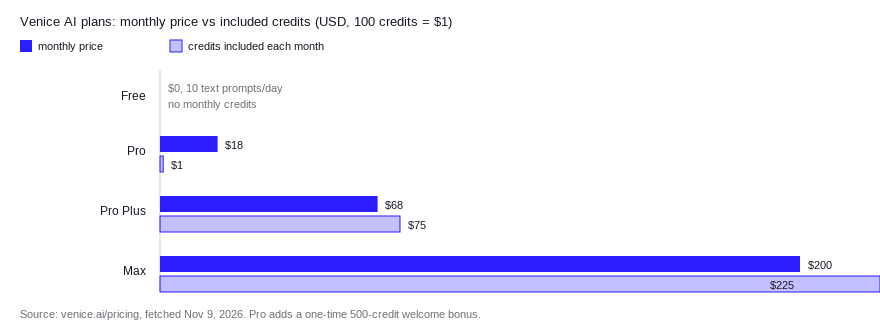
Two buying notes. The iOS app lists Venice AI Pro at $23.99 as an in-app purchase, more than the $18 web price, so subscribing on the web is cheaper. And on Pro, “unlimited” applies to Pro models: the $1 of monthly credits buys about 250,000 input tokens on Claude Opus 5.5 at Venice’s listed $4 per 1M, so heavy Claude or GPT use through Venice is effectively pay-as-you-go.
How uncensored is it in practice?
Venice’s default models refuse far less than mainstream assistants, but there are no independent numbers, and Venice’s terms still set limits. The only published refusal figure is Venice’s own: when it launched Dolphin Mistral 24B Venice Edition (sold as Venice Uncensored 1.1), an r/VeniceAI admin post claimed it refused 2.2% of requests on a 45-question set, against higher rates for Grok, GPT-4o-mini and Claude (post). That is a vendor test on a small prompt set, and it is about the previous model. We found no independent benchmark of Venice Uncensored 1.2. For the Dolphin lineage behind that model, see our Dolphin LLM review.
Three limits apply whatever the model:
- Terms of Service. Venice’s terms (updated June 8, 2026) ban illegal use, child sexual abuse material including AI-generated, infringing others’ rights or likeness, and automated or scripted use of the web interface. Venice can suspend accounts “at any time for any reason or no reason”.
- Age gate. The minimum age is 13, and users under 18 need guardian consent and may not disable the mature filter.
- Model choice. Only the explicitly uncensored builds are tuned to avoid refusals. Users who switch to a mainstream model for quality get that model’s guardrails back.
What do users report in practice?
User reports praise the privacy model and the uncensored defaults, and complain about reliability, billing and credit creep. Every item below is a community report, not our test.
- Daily use on cheap private models. A Hacker News commenter in November 2026 said they run Venice through its DIEM token, which gives daily inference credits, use DeepSeek V4.1 Flash 1017 as their main model because it is cheap and private on Venice, and switch to Claude or GPT only for tasks without personal data (comment). That matches the Private/Anonymized split above.
- Credits creeping into Pro. A Pro user on Venice’s feedback board asked in December 2025 that text models stop requiring extra credits on the Pro plan, arguing per-token charges undercut the subscription; the post had 9 votes and no Venice reply when we read it (post). RoboRhythms’ review summarizes an r/VeniceAI thread where GLM 5.2 suddenly charged credits on Pro and staff called it a bug, and another where a Pro Plus subscriber lost 9.4k banked credits on the day they cancelled (review).
- Trustpilot is harsh. Venice’s Trustpilot page showed a 1.9 TrustScore from 72 reviews, 71% of them one-star. Recent reviews (November 2026) report frequent “unexpected error” messages and dropped connections, unanswered support tickets and a refund that never arrived; one five-star review from the same week calls it a cheap place for a private, uncensored model (Trustpilot). Venice replies to many of them.
- The App Store is kinder. The US App Store listing shows 4.3 out of 5 from 1.9K ratings, rated 18+ (listing).
The two stores sample different users, so neither number is the full picture. Read the billing complaints as a real pattern, not as the average experience.
Pros, cons and alternatives
Venice’s strengths are breadth and privacy defaults; its weaknesses are the credit model and support.
Pros
- Uncensored default model and chat history kept on your device.
- One account reaches open-weight, uncensored and closed frontier models.
- TEE and E2EE options for some models on Pro, with stated limits.
- Pro at $18 a month covers unlimited text on the uncensored and private open-weight models.
Cons
- Most of the catalog is not uncensored; closed models are Anonymized, so the provider sees prompts.
- Frontier models need credits beyond Pro’s $1 a month.
- Frequent model churn; a model you rely on can be renamed, repriced or retired.
- Recurring complaints about errors, billing, refunds and support response.
Who should use it: people who want fewer refusals on writing and research, care that chats aren’t stored server-side, and are fine working mostly with open-weight models.
Who shouldn’t: anyone who mainly wants Claude or GPT (pay those vendors directly), anyone who needs predictable billing and fast support, and developers who would rather call an API, who should read the Venice AI API review instead.
Alternatives:
| Option | Why consider it |
|---|---|
| Running a model locally | No third party at all; see how to run an uncensored LLM locally |
| Other uncensored chat apps | Compared in best uncensored AI |
| Candor (candorai.dev) | An uncensored AI chat app; disclosure: we build it, so weigh this entry accordingly |
FAQ
Is Venice AI good?
For uncensored chat on open-weight models with local-only history, the reports are mostly positive. For frontier models, billing predictability or support, user reviews are much more mixed.
Is Venice AI worth it?
Pro at $18 a month is worth it if you use the uncensored or private open-weight models daily. If you mainly want Claude or GPT, the credits and Anonymized mode make a direct subscription the better deal.
Is Venice AI free?
Yes, with limits: the Free plan gives 10 text prompts and 15 image prompts a day on base models. Unlimited text needs Pro.
Is Venice AI really uncensored?
Its default model and about a dozen others are uncensored builds. Closed models keep their makers’ guardrails, and Venice’s terms still ban illegal content and let it suspend accounts.
What is Venice AI used for?
Private chat, writing and research with fewer refusals, coding help on open-weight models, and character roleplay on Pro, plus image and video tools outside this review’s scope.
Sources (10)
- Venice pricing (Free, Pro, Pro Plus, Max)
- Venice public text model list, GET /api/v1/models?type=text
- Venice privacy page (Anonymous, Private, TEE, E2EE)
- Venice Terms of Service (last updated June 8, 2026)
- Venice AI on the US App Store
- Venice reviews on Trustpilot
- r/VeniceAI admin post introducing Dolphin Mistral 24B Venice Edition (2.2% refusal claim)
- Venice feedback board: Don't charge extra credits for text models on Pro (Dec 5, 2025)
- Hacker News comment on daily Venice use with DIEM credits (Nov 5, 2026)
- Venice AI review: when privacy depends on the model you pick, RoboRhythms