Is Venice AI safe? What its privacy policy and docs say it stores, which claims you can verify, the company and VVV token, and what users report in practice.
Venice AI is a legitimate, venture-funded US company, and it is safer for privacy than mainstream chatbots by design: chat history stays on your device and its policy says it does not store prompts or outputs. But the default Private mode rests on contracts, not proof. Only the paid TEE and E2EE modes can be checked cryptographically, and Venice still collects account, IP and device metadata.
- Private (contract-enforced zero retention)
- TEE and E2EE, Pro plan, text models only
- None published as of Nov 9, 2026
- Nov 9, 2026
Key takeaways
- Venice's privacy policy (effective June 2, 2026) says it will not access or store the content of your prompts or outputs. Your chat history lives on your device, not its servers.
- There are four modes. Anonymous lets the model provider see and likely keep your prompt; Private relies on zero-retention contracts; TEE and E2EE, both on the Pro plan, are the only ones backed by remote attestation.
- Venice still collects metadata: email or wallet address, IP address, device identifiers, usage events and analytics cookies. It will disclose data under a court order or subpoena.
- The company is real: a $65M Series A at a $1B valuation in July 2026, led by Dragonfly, with more than 3 million active users. No independent privacy audit has been published.
- You never need the VVV or DIEM tokens to use Venice. They are an optional way to pay for API credits.
Venice AI is safe in the sense most people mean: it is a legitimate company, it does not train on your chats, and by its own policy it does not store what you type. Whether it is private depends on the mode you pick and how much you trust a contract you cannot inspect. This page sorts Venice’s claims into what you can check yourself and what you have to take on trust, using its privacy policy, terms and docs as read on November 9, 2026. Refusal Rate has not run its own tests on Venice; community reports below are attributed to the people who made them.
Is Venice AI safe to use?
Yes, with a clear limit: Venice is a real, funded business with conventional terms, but its strongest privacy claims for the default mode cannot be independently verified.
The short version, claim by claim:
| Claim | Where Venice makes it | Can you verify it? |
|---|---|---|
| Chat history stays on your device | venice.ai/privacy | Partly: you can see it is device-bound in practice |
| Prompts and outputs are not stored | Privacy policy, docs | No, it is a policy statement |
| Private mode keeps zero retention at GPU partners | venice.ai/privacy (“contractual commitments”) | No, contracts are not public |
| TEE mode runs in an attested enclave | Docs, privacy page | Yes, via remote attestation |
| E2EE keeps prompts encrypted until the enclave | Docs | Yes, if your client verifies attestation |
| Chats are not used for training | Terms of Service §10.2 | No, it is a contractual promise |
| Metadata (IP, device, account) is collected | Privacy policy | It is disclosed, so assume it is true |
The pattern is consistent. Where Venice uses cryptography, you can check. Where it uses policy and contracts, you are trusting Venice and its partners, as you would with any hosted AI service. For how Venice compares with other private options, see best private AI.
What does Venice say it stores, and what doesn’t it store?
Venice says it stores no prompt or response content, but it does collect account and device metadata like most web services.
From the privacy policy, effective June 2, 2026: Venice “will not have access to or store the content of your Prompts or Outputs.” It records that you created or deleted a chat, not what was in it. Its privacy page adds that “your conversation history stays on your device” and that Venice “never stores it on its servers.”
What it does collect, per the same policy:
- Without an account: time zone, browser type and IP address.
- Free account: your email address on top of that. Wallet sign-ins record a public key instead of an email.
- Device and usage: device type and identifiers, OS and browser details, mobile advertising identifiers, push tokens, general location inferred from IP, pages viewed and referrers.
- Analytics: cookies, pixels and SDKs, with Google Analytics named.
- Payments: cards go through a third-party processor; for crypto, Venice records the paying public key.
Venice’s developer docs list similar operational metadata for API traffic: account or wallet IDs, API key IDs, timestamps, model, token counts, billing amounts, IP address and device information. Billing, the docs say, does not require storing the prompt or completion.
Two clauses matter for a threat model. The policy says Venice may disclose data to “comply with law enforcement requests and legal process, such as a court order or subpoena.” And the Terms of Service let Venice monitor information on the service, even though it has no obligation to. In practice, what Venice can hand over is the metadata it holds, not chat content it says it never had.
How private is each Venice mode?
Privacy on Venice is per mode, and the default sits in the middle.
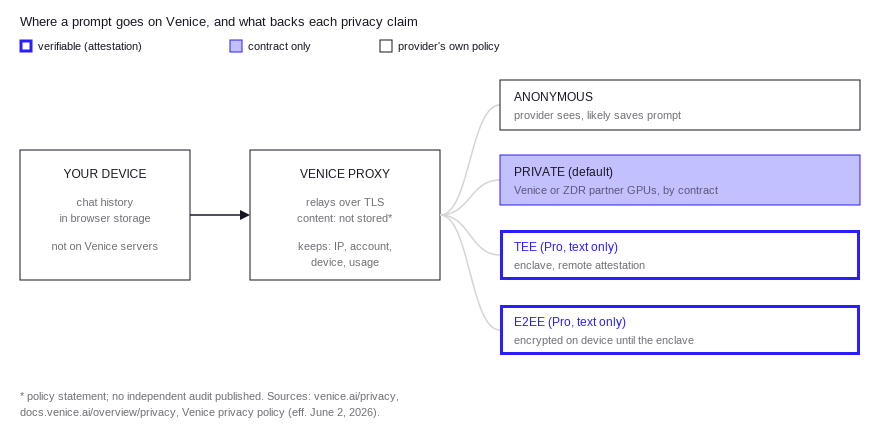
- Anonymous: used for proxied closed models. Venice strips your identity, but Venice’s own page says the provider “sees and likely saves your prompt.”
- Private (default): inference runs on Venice-controlled GPUs or zero-data-retention partner infrastructure. The guarantee is contractual.
- TEE (Pro): the model runs inside a Trusted Execution Environment with remote attestation, so GPU providers cannot read the prompt.
- E2EE (Pro): your client encrypts the prompt, Venice relays ciphertext, and only the attested enclave decrypts it. The docs note that E2EE turns off features that need plaintext outside the enclave, including web search, memory and some tool flows.
TEE and E2EE are text-only. If you send images, video or a proxied closed model, you are on Private or Anonymous by definition. Developers using the API get the same labels per model; the Venice API review covers that side.
What can and can’t you verify?
You can verify where your history lives and, on Pro, the enclave attestation. You cannot verify server-side non-retention in Private mode, and nobody outside Venice has published an audit of it.
What you can check:
- History is local. A user on Venice’s own feedback board asked for cross-device sync because chats are “stored only in local browser storage” and do not follow you between phone and laptop (request). That inconvenience is the evidence: clearing browser data clears your history.
- Attestation. In TEE and E2EE modes, attestation evidence is exposed so a client can confirm the enclave before trusting it.
- The mode label. Each model carries its privacy label in the API’s model list and in the mode you pick.
What you can’t:
- That Venice’s proxy does not log content. It is closed infrastructure.
- That GPU partners honour zero-retention contracts. Venice’s docs do not name the partners or mention audits.
- That proxied closed-model providers delete anything. Venice says plainly it “does not control this layer.”
One third-party privacy review reported in 2026 that a community request for an independent security audit had gathered hundreds of votes on Venice’s feedback board without a published result (review). We found no audit report on Venice’s site or docs as of November 9, 2026. If your bar is “zero retention, contractually, from a named provider”, see zero-data-retention LLM APIs for how other services document it.
Is Venice AI legit?
Yes. Venice is an established, profitable company with institutional investors and published terms, not a fly-by-night app.
- Funding: TechCrunch reported on July 1, 2026 that Venice raised a $65 million Series A at a $1 billion valuation, its first outside round, led by Dragonfly with Coinbase Ventures and North Island Ventures participating.
- Scale: the same report cites more than 3 million active users, about 1.7 million API calls a day and an annualized run-rate above $70 million. Venice says it is profitable.
- Founder: CEO Erik Voorhees, who previously founded SatoshiDice and ShapeShift. TechCrunch’s piece also recalls a Wall Street Journal investigation into ShapeShift, not Venice, and Voorhees’s stated view that people should not “have their identity recorded to catch an occasional criminal.” That philosophy explains the product.
- Entity and law: the policy names Venice.ai as data controller, the service is hosted in the US, and the Terms (updated June 8, 2026) apply Wyoming law with individual arbitration, a class-action waiver and a 30-day opt-out. Liability is capped at the greater of what you paid in the last 12 months or $100.
- Age: users must be 13 or older; under-18s need a guardian’s consent and cannot turn off the mature content filter.
What is the VVV token, and do you need it?
VVV is Venice’s ERC-20 token on Base, and you do not need it to use the app or the API. Per Venice’s docs, you can stake VVV for yield and to mint DIEM, a token that gives $1 per day of API credit per DIEM staked, refreshing at 00:00 UTC. USD and crypto credits work without either token. If you do touch the tokens, Venice’s docs warn never to send VVV or DIEM directly to a contract address, because they cannot be recovered, and to stake only through venice.ai/token. Treat lookalike domains with suspicion. The token is a payment rail and an investment product; it does not change how private your chats are.
Is “safe” also about what Venice will generate?
It can be. Venice’s uncensored positioning means fewer refusals, and that has drawn criticism. Security vendor Certo reported in May 2025 that Venice was being promoted on hacking forums as a “private and uncensored AI” and that it produced scam emails and malicious code on request (report). Venice’s terms still prohibit illegal use, and it can suspend accounts. That is a question about the service’s policy, not a risk to your own data.
What do users report in practice?
Practitioner reports split between people who use Venice as a privacy layer for open models and people who distrust the model or think self-hosting is the only real answer.
- Use it for personal data, not everything. A Hacker News user in November 2026 described using Venice’s Private open models for anything involving personal information, and switching to proxied closed models only for tasks without it (comment). That matches the mode table above.
- Contracts plus E2EE, but closed models leak content. Another HN commenter in April 2026 recommended local models first, then Venice’s zero-retention contracts and E2EE options for bigger models, while noting that prompts to proxied OpenAI, Anthropic and Google models are anonymized but still visible to those providers (comment).
- Telemetry is on by default. A Privacy Guides forum member reported in April 2025 that telemetry is enabled by default and can be turned off in settings (thread). An HN commenter in 2025 likewise noted the only privacy-related setting was “Disable Telemetry Collection” (comment). Turn it off.
- Pricing transparency complaints. One HN user in October 2026 called Venice “sketchy” because the Pro plan’s included models were hard to pin down (comment). That is about plan clarity, not data handling.
- Local still wins for the cautious. In an r/privacy thread on the most private AI provider, the top answer put local models first and mentioned Venice only as “branded as privacy focused” (thread).
Treat these as signals, not findings. None of them is an audit.
How does Venice compare with running a model locally?
Running a model locally is strictly more private, because nothing leaves your machine; Venice trades some of that for bigger models and no hardware.
| Venice Private | Venice TEE / E2EE | Local model | |
|---|---|---|---|
| Who can see the prompt | Venice and GPU partner, by contract not retained | Only the attested enclave | Only you |
| Metadata collected | Account, IP, device, usage | Same | None |
| Proof available | None | Attestation | Not needed |
| Model size | Large hosted models | Selected text models | Limited by your VRAM |
| Cost | Free tier, Pro, or API credits | Pro | Hardware and power |
If your prompts include client code, credentials or regulated data, local or E2EE is the defensible choice. For everyday private chat, Venice’s Private mode is a real step up from mainstream assistants that keep history server-side. For a broader look at the product itself, read the Venice AI review.
FAQ
Is Venice AI really private?
Partly. Chat history stays on your device and Venice’s policy says it does not store prompts or outputs, but the default Private mode relies on contracts you cannot audit. Only the Pro TEE and E2EE modes give cryptographic proof, and Venice still collects IP, device and account metadata.
Is Venice AI legit?
Yes. Venice is a US company that raised a $65 million Series A at a $1 billion valuation in July 2026, led by Dragonfly, and reports more than 3 million active users. It publishes a privacy policy, terms and API docs.
Does Venice AI read or train on your chats?
Its Terms of Service say Venice will not use your content to train models, and its privacy policy says it does not store prompts or outputs. Neither has been independently audited. In Anonymous mode, the third-party model provider can see and may keep your prompt.
Can Venice AI share your data with police?
Its privacy policy allows disclosure for court orders and subpoenas. What Venice holds is metadata such as your email or wallet address, IP address and usage events, not chat content, which it says it never stores.
Do you need crypto to use Venice?
No. VVV and DIEM are optional tokens for paying for API credits. You can use the app free, buy a Pro plan, or pay for API usage in USD.
Sources (9)
- Privacy Policy, Venice (effective June 2, 2026)
- Privacy at Venice, venice.ai
- Privacy and data handling, Venice docs
- Terms of Service, Venice (last updated June 8, 2026)
- VVV and DIEM, Venice docs
- Venice AI becomes a unicorn with $65M Series A, TechCrunch (July 1, 2026)
- Unleashed AI: Hackers embrace unrestricted chatbot Venice.ai, Certo (May 20, 2025)
- Venice.ai discussion thread, Privacy Guides community forum
- Feature request: cross-device chat sync, Venice feedback board