The best private AI, ranked by what each privacy policy says: retention, training, human review and encryption for ChatGPT, Claude, Gemini, Lumo and Venice.
The most private AI chatbot is one that runs on your own machine: LM Studio, Jan or Ollama with a local model send no prompts anywhere. Among hosted chatbots, Proton Lumo, Brave Leo, Venice and Duck.ai keep no chat history on their servers and don't train on chats, per their policies read November 9, 2026. ChatGPT, Grok and Gemini train on consumer chats unless you opt out, and Gemini keeps human-reviewed chats for up to three years.
- Local models (LM Studio, Jan, Ollama local)
- Proton Lumo, Brave Leo, Venice, Duck.ai
- Gemini human-reviewed chats, up to 3 years
- Nov 9, 2026
Key takeaways
- Local apps are the only tier where privacy doesn't depend on a promise: LM Studio's policy says no messages, chats or documents leave your system when you run models locally.
- Proton Lumo, Brave Leo, Venice and Duck.ai store chat history on your device, not their servers, and say they don't train on chats.
- Only Venice's TEE and E2EE modes rest on hardware attestation. Every other hosted claim here, including Venice's Private mode, rests on policy or contract.
- ChatGPT, Grok and Gemini use consumer chats for training unless you change a setting. Gemini keeps human-reviewed chats for up to three years, even after you delete your activity.
- Claude keeps flagged chats up to two years and their safety scores up to seven, whatever your training setting.
The best private AI is the one whose operator can’t read your chats, either because the model runs on your hardware or because the service’s architecture keeps it out of the loop. Below, nine hosted chatbots and three local apps are ranked by what their own privacy policies and help pages said when we read them on November 9, 2026. Refusal Rate has not audited any of these services, so every ranking point is a quoted policy, not a test result.
What is the most private AI?
The most private AI is a local model: in LM Studio, Jan or Ollama, prompts and replies stay on your machine. If you need a hosted chatbot, Proton Lumo, Brave Leo, Venice and Duck.ai are the most private by policy. All four keep history on your device and say they don’t train on chats.
| Service | Chat history stored | Training on chats | Human review / long retention | Stronger-than-policy claim |
|---|---|---|---|---|
| LM Studio, Jan, Ollama (local) | Your disk only | No | None (nothing is sent) | Verifiable: runs offline |
| Proton Lumo | On device, synced with zero-access encryption | No, except anonymized feedback with express permission | “No logs” of prompts or replies | None audited; TLS plus asymmetric encryption to GPU servers |
| Venice | In your browser | Depends on mode; Private mode keeps nothing after the request | Metadata (IP, token counts, timestamps) may be logged | TEE and E2EE modes with remote attestation |
| Brave Leo | On device, can be turned off | No | No prompts kept; large prompts cached for minutes | None |
| Duck.ai | On device | Providers contractually barred | Providers delete within 30 days at most (terms) | None; IP stripped before the provider sees it |
| Claude | Account, deleted chats purged within 30 days | Your setting; up to 5 years if on | Flagged chats up to 2 years, scores up to 7 | None |
| ChatGPT | Account | On by default for Free, Plus, Pro | Temporary Chats deleted after 30 days | None |
| Grok | Account | On by default | Private Chat deleted within 30 days | None |
| Gemini | Account, auto-delete after 18 months by default | On while Keep Activity is on | Human-reviewed chats kept up to 3 years | None |
| Candor (we build it) | Account | See below | Not stated in the pages we could read | None |
Disclosure: Refusal Rate is published by the team that builds Candor. We list it because the brief covers it, and we haven’t ranked it above anything we couldn’t compare on equal terms.
What makes an AI chat private?
An AI chat is private when as few parties as possible can read your text, for as short a time as possible, and when you can check that. Seven questions sort the field:
- Where is history stored? On your device, or in an account on the provider’s servers.
- Is it used for training by default? An opt-out you never find is the same as no opt-out.
- Can humans read it? Review queues often have their own, longer retention.
- How long do deleted chats survive? “Deleted” usually means a 30-day purge window.
- Who else sees it? A proxy can strip your IP, but the model provider behind it still reads the prompt.
- What jurisdiction applies? Court orders can override retention policies.
- Is any claim verifiable? Encryption with remote attestation can be checked. A no-logs promise can’t.
The last question matters most. Almost everything below is a promise. Only local inference, and Venice’s attested modes, give you something to verify.
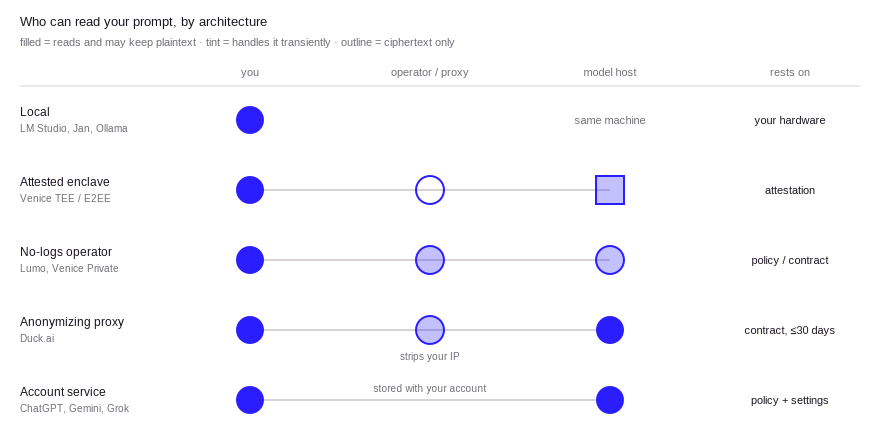
Which hosted chatbots are most private, ranked by policy?
Proton Lumo ranks first among hosted chatbots, followed by Venice, Brave Leo and Duck.ai. Claude comes next, then ChatGPT and Grok, with Gemini last. The order follows the criteria above, applied to each provider’s own words.
1. Proton Lumo. Proton says its “no-logs policy ensures we keep no logs of what you ask, or what Lumo replies.” History is kept on your device and synced with zero-access encryption. Lumo runs open models (Qwen 3.5, GLM 5.3, Apertus 1.5) “exclusively on servers Proton controls,” and Proton cites European jurisdiction as a safeguard. There’s no third-party model provider in the path, which is why it ranks above the proxies.
2. Venice. Venice’s docs say history “stays on your device” and offer four modes per model. Anonymous proxies to frontier providers, and Venice tells you to “assume the provider is storing your content.” Private means content “is not retained after the request completes,” which is enforced by contract. TEE and E2EE run text models in attested enclaves, and in E2EE “only the verified TEE decrypts” the prompt. That makes Venice the only hosted option here with a hardware-backed claim, but only if you pick those models. Metadata, including IP address, may still be logged. The developer side is covered in our Venice API review.
3. Brave Leo. Brave’s policy says: “We don’t store or retain prompts, responses, context, or personal data on our servers,” apart from large prompts cached for minutes. It says Brave doesn’t collect identifiers such as IP address, doesn’t train on conversations, and doesn’t require an account for the free tier.
4. Duck.ai. DuckDuckGo strips “metadata that contains personal information (for example, your IP address)” and forwards your text to Tinfoil, Mistral, Azure, OpenAI or Anthropic. Those providers can’t train on it. The help page says they delete prompts “immediately after generating a reply,” with up to an hour of prompt caching. The October 1, 2026 terms say deletion happens “at most within 30 days, with limited exceptions.” The terms are the binding text, so plan around 30 days.
5. Claude. Anthropic purges deleted chats from back-end storage “within 30 days,” and Incognito chats aren’t used for training even if model improvement is on. Training is a setting. If it’s on, de-identified chats can stay in training pipelines for up to five years. Chats flagged for usage-policy violations are kept up to two years, and their safety scores up to seven.
6. ChatGPT. On Free, Plus and Pro, OpenAI’s Data Controls FAQ says data sharing for training is on by default. Turning off “Improve the model for everyone” stops new chats from being used. Temporary Chats are deleted after 30 days and aren’t used for training.
7. Grok. xAI’s consumer FAQ says Private Chat conversations are deleted from xAI systems within 30 days. Regular chats are used for training unless you opt out in Data Controls.
8. Gemini. Google says “a subset of chats are reviewed by human reviewers,” and reviewed chats “are retained for up to three years” even after you delete your activity. Keep Activity is on by default, with auto-delete after 18 months. Turn it off and chats are still kept for 72 hours. Temporary chats aren’t used for training.
Candor (we build it). Candor’s app lets you delete your account and all your data permanently in one tap, and stores API keys only as SHA-256 hashes. Its full privacy policy is shown at sign-in. We couldn’t read a retention period on its public pages on November 9, so we don’t rank it against services that publish one.
Why is local AI the most private tier?
Local AI is the most private tier because there’s no operator: the prompt never leaves your hardware, so retention, training and review don’t arise. LM Studio’s policy says that for local use “none of your messages, chat histories, and documents are ever transmitted from your system,” that the app “does not include telemetry,” and that it “can run entirely on-device and offline.” Jan says it “is used 100% offline on your own computer” and stores conversation history locally.
Two caveats apply:
- Cloud features break the guarantee. LM Studio’s cloud models and web search send requests out. Jan sends data to any remote provider you connect, and Ollama’s
:cloudmodels run on Ollama’s servers. - The machine is the new perimeter. An Ollama API left open on the network is worse than any hosted policy. See is Ollama safe for hardening.
Choosing between the two main local runtimes is covered in LM Studio vs Ollama. If you want open models that also don’t refuse, see how to run an uncensored LLM locally.
What privacy claims can’t you verify?
You can’t verify any no-logs or zero-retention claim from outside. Lumo’s no-logs policy, Venice’s Private mode, Brave’s “minutes” cache and Duck.ai’s provider contracts are all promises you take on trust. Here’s how the claims sort:
| Claim | Verifiable by you? | Example |
|---|---|---|
| Runs offline | Yes: unplug the network | LM Studio, Jan |
| Remote attestation of an enclave | Partly: the client checks the evidence | Venice TEE / E2EE |
| Open-source client | Partly: shows what’s sent, not what the server does | Lumo (Proton says its code is open source) |
| No-logs or zero retention | No | Lumo, Brave Leo, Venice Private |
| Provider contracts | No | Duck.ai |
| Deletion within N days | No, and courts can override it | ChatGPT, Claude, Grok |
Courts are the hard limit. In 2025 a US judge ordered OpenAI to preserve ChatGPT output logs, deleted chats included, for the New York Times lawsuit. Simon Willison reported that the order was lifted on October 9, 2025, but logs already saved stayed accessible, and data tied to accounts the Times flagged still had to be kept. A retention policy describes normal operations, not what survives a legal hold. For API-side retention terms, see zero data retention LLM APIs.
What do users report in practice?
Users mostly report gaps between how a service markets itself and what its fine print says, plus a quality cost for the private options.
- Paying didn’t stop Gemini training. A November 2026 Tell HN post with over 700 points said personal Google AI subscribers can’t opt out of training without turning off Keep Activity, which drops history after 72 hours. The poster quoted Google’s three-year retention for reviewed chats. Several replies said they assume every provider keeps everything.
- Duck.ai’s proxy doesn’t cover the provider side. An r/duckduckgo thread, posted to HN in July 2025, argued that DuckDuckGo’s “we don’t store chats” framing hides the fact that the model providers do, for a while. It asked for a way to delete chats from the providers too.
- Lumo is private but chat-only. A July 2026 blog post, Moving from Claude to Proton Lumo, got HN discussion. One commenter noted there’s no API, so it’s a privacy option for chat, not for coding tools.
- Legal holds are what worried people most. The June 2025 HN thread on the OpenAI preservation order passed 1,100 points. It’s the clearest community signal that retention promises only last until a court says otherwise.
FAQ
What is the most private AI chatbot?
A local model in LM Studio, Jan or Ollama, because nothing leaves your machine. Among hosted chatbots, Proton Lumo has the strongest policy: no logs, zero-access encrypted history, and models on Proton’s own servers.
Is ChatGPT private?
Not by default. OpenAI trains on Free, Plus and Pro chats unless you turn off “Improve the model for everyone.” Temporary Chats are deleted after 30 days and aren’t used for training.
Is Duck.ai really anonymous?
It hides your identity from the model provider by stripping your IP address. It doesn’t hide your text: providers read it and, under Duck.ai’s terms, delete it within 30 days at most.
Which AI doesn’t use your data for training?
Proton Lumo, Brave Leo and Duck.ai say they don’t train on chats, nor do local apps. Claude, ChatGPT, Grok and Gemini each have a setting or temporary mode that excludes your chats.
Is Venice AI private?
It depends on the model’s mode. Private mode keeps nothing after the request under contract. TEE and E2EE add hardware attestation. Anonymous mode forwards your text to providers that may store it.
Sources (10)
- LM Studio App Privacy Policy (last updated 10/19/2026)
- Jan privacy page
- How does Lumo protect my privacy? Proton support
- Brave Browser Privacy Policy, Leo section (last updated September 23, 2026)
- Duck.ai Privacy Terms (last updated October 1, 2026)
- Duck.ai privacy, DuckDuckGo help pages
- Privacy and data handling, Venice docs
- How long do you store my data? Anthropic privacy center (updated July 1, 2026)
- Gemini Apps Privacy Hub, Google
- ChatGPT Data Controls FAQ, OpenAI Help Center