The best AI chatbot with no restrictions doesn't exist as a hosted service. Free limits, models and policies of ChatGPT, Claude, Gemini, Venice and Duck.ai.
No hosted AI chatbot has zero restrictions: every one has a usage policy, and most free tiers add message caps. Among big-lab models, Google's and xAI's refuse least on SpeechMap's October 2026 leaderboard. Hosted apps running open models with refusals removed, such as Venice, have lighter policies but small free allowances. The only free option with no provider policy and no message cap is an open-weight model run locally.
- None
- 10 text prompts/day
- Unlimited, with abuse guardrails
- Google DeepMind, 86.8
Key takeaways
- No hosted chatbot is unrestricted. Even services sold as uncensored, like Venice, ban illegal use and abuse of children in their terms.
- On SpeechMap's lab leaderboard (Oct 14, 2026), Google DeepMind scored 86.8 and xAI 81.7 for answering sensitive requests completely; OpenAI scored 57.1.
- Free tiers differ more in limits than in policy: ChatGPT lists unlimited text chats, Venice allows 10 text prompts a day, Claude and Gemini reset caps every 5 hours.
- Refusal behavior depends on the topic. A model that scores well on political speech can still refuse security work, as one developer reported for Gemini.
- A local model in Ollama (MIT license) has no message cap and no provider policy. You pay in hardware, electricity and model quality instead.
Which chatbot has the fewest restrictions for free?
The best AI chatbot with no restrictions is not a hosted service, because every hosted chatbot has a usage policy and almost every free tier has a cap. What you can pick is the trade-off. Big-lab chatbots give the most free usage but run models trained to refuse. Services that host open models with refusals removed refuse less but give you a few prompts a day. A local model gives you everything and costs you hardware.
If you want the ranked list of uncensored services regardless of price, that lives on best uncensored AI. This page is about what you get for $0, checked against each provider’s own pricing page on November 9, 2026.
| Chatbot | Free text allowance | Model(s) on free | Account | Ads on free |
|---|---|---|---|---|
| ChatGPT | “Unlimited text chats”, “subject to abuse guardrails” | GPT-6 Luna, GPT-5 Thinking Mini | Not stated on pricing page | Yes, a sponsored section below answers (Engadget, Aug 2026) |
| Claude | “Limited usage every 5 hours and every week”, no number | Sonnet and Haiku (no Opus) | Not stated | Not mentioned |
| Gemini | Compute-based, refreshes every 5 hours up to a weekly limit | Flash-Lite | Google Account required | Not mentioned |
| Le Chat (Mistral) | “Limited messages and web searches”, no number | Limited access to “our latest models” | Not stated | Not mentioned |
| Duck.ai | Daily limit, number not published | Claude Haiku 5.5, Mistral Small 4, GPT-6 Luna, GPT-5.4 mini, gpt-oss-120b, Gemma 4 31B | Not stated | Not mentioned |
| Venice | 10 text prompts and 15 image prompts per day | “Base AI models” | Sign-up offered | Not mentioned |
| Candor (we build it) | Free credits per new account, no card | Open models with refusal removed from the weights | Account | Not mentioned |
| Local model (Ollama, LM Studio) | No cap | Any open-weight model your hardware fits | None | None |
Sources: ChatGPT pricing, Engadget, Claude pricing, Gemini plans, Mistral pricing, Duck.ai help, Venice pricing, candorai.dev. “Not stated” means the provider’s page didn’t say, not that the answer is no.
Grok is missing from the table on purpose. xAI’s plans page did not render readable content when fetched, and third-party guides disagree on its free caps, so we left it out rather than guess.
What does each free tier actually include?
Each free tier is a different bet: ChatGPT gives volume, Claude and Gemini give a rolling budget, and the low-refusal services give a taste.
- ChatGPT is the most generous on raw volume. Its pricing page lists unlimited text chats on GPT-6 Luna, with a 27K context window and “limited on bandwidth & availability” response times. Uploads, image creation, voice and deep research are capped separately. Engadget reported in August 2026 that free users “may see ads” in a sponsored section under answers.
- Claude gives Sonnet and Haiku on free, plus web search, file creation and code execution. Anthropic doesn’t publish a message count. The page says only that the limit resets every 5 hours and every week, and that “how fast you reach a limit depends on the model you use, how long your chats are, and how large your files are.”
- Gemini requires a Google Account and runs Flash-Lite on free. Like Claude, the limit is compute-based and resets every 5 hours until a weekly ceiling.
- Duck.ai offers six models free, including gpt-oss-120b and Gemma 4 31B, which DuckDuckGo says are hosted by Tinfoil inside a trusted execution environment. Its help pages state a daily limit without a number, and say model providers must “delete your prompts and responses immediately after generating a reply” and “never use your Duck.ai conversations to train their models.”
- Venice caps free use at 10 text prompts a day on base models. Pro is $18 a month for unlimited text prompts. If you’re a developer, the API side is covered in our Venice API review.
- Candor (disclosure: we build it) gives each new account free credits with no card, and runs open models “whose refusal behavior has been removed from the weights.” It is an adults-only service.
One thing the table hides: free-tier models are usually the smallest in each family. ChatGPT’s free model is Luna, Gemini’s is Flash-Lite. A lab’s leaderboard score is an average over its recent models, so the free model you actually talk to may behave differently.
Which chatbot refuses least, according to published data?
On published data, Google’s and xAI’s models refuse sensitive requests least among the large labs. SpeechMap.AI, a public research project that puts the same set of controversial requests (political argument, satire, religion, history) to hundreds of models, ranks labs by the share of requests their recent models answer completely. Its October 14, 2026 leaderboard:
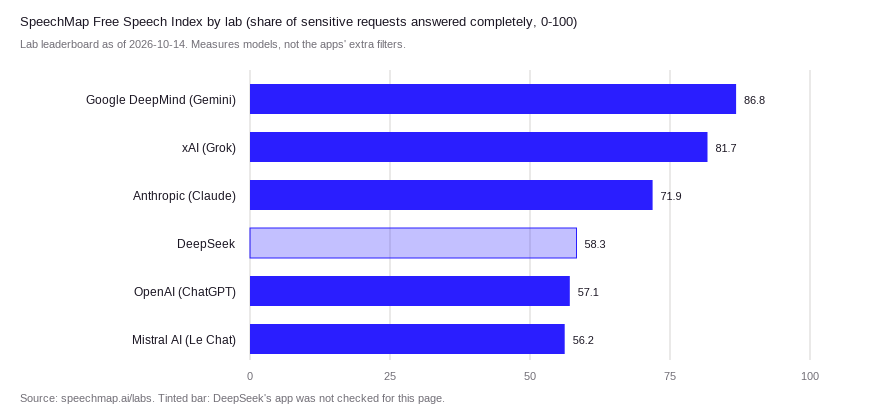
Two caveats keep this chart honest. First, SpeechMap tests models, not apps, so it doesn’t see the extra moderation a consumer chatbot may add. Second, it measures speech on contested topics, not technical work. A model that will argue any side of a political question can still refuse to help with a port scanner on your own network. SpeechMap also reports that the average share of requests answered completely across models has been falling over time.
Which restrictions remain everywhere?
Every hosted chatbot keeps two layers no matter how it’s marketed: the law where the provider operates, and its own terms of service.
| Provider | Policy | Examples of what it forbids |
|---|---|---|
| Anthropic (Claude) | Usage Policy, effective Nov 12, 2026 | Illegal activity, compromising critical infrastructure, exploiting systems “without authorization of the system owner” |
| Google (Gemini) | Generative AI Prohibited Use Policy, Dec 17, 2024 | “Dangerous or illegal activities”, compromising security, “sexually explicit, violent, hateful, or harmful activities”, misinformation |
| Venice | Terms of Service, June 8, 2026 | Any “illegal purpose”, abuse or exploitation of children, using a third party’s “name, voice, image, or likeness without their consent” |
| Candor (we build it) | Homepage terms | “Sexual content involving minors”, helping plan “violence against real people”; 18+ only |
Three details are worth knowing. Google’s policy allows exceptions for “educational, documentary, scientific, or artistic” work, so context changes the answer. Anthropic says its products include “real-time safeguards that may block or limit certain outputs,” and that hitting one “does not by itself indicate a violation.” And Venice’s terms say it can restrict a model if the third-party company that made it requires that, so a low-refusal service is still downstream of the model makers’ policies.
For the short answer to the general question, see what AI has no restrictions.
Is a local model the free option with no limits?
Yes: a local model is the only free route with no message cap and no provider policy, because nothing leaves your machine. Ollama is MIT-licensed and runs on macOS, Linux and Windows. Note that its cloud models need credits or a paid plan; local inference doesn’t. LM Studio and llama.cpp do the same job.
What you give up:
- Hardware. You need a GPU or unified memory big enough for the model plus its context. A small model fits a laptop; a strong one needs a serious card.
- Quality. Open-weight models that fit consumer hardware are smaller than the frontier models behind paid chatbots. Models with refusals removed lose some quality too, a trade-off covered in our abliteration explainer.
- The model’s own training and licence. The model may still refuse, and its licence still carries an acceptable use policy.
The full setup, from runtime to model choice, is in how to run an LLM locally. If your machine is too small, the middle ground is free API endpoints for open models: see OpenRouter free models, which caps free use at 50 requests a day.
What do users report in practice?
Users report that refusals depend far more on the topic than on the brand, and that every hosted option has drifted over time. These are community reports, linked so you can judge them yourself; they are not our tests.
- Security work. A developer working in cybersecurity wrote in September 2026 that Gemini “refuses to do any cyberwork,” that OpenAI models flag it and “stop midstream,” and that Claude’s guardrails trigger at “the remote mention of anything cyber related.” They switched to open-weight GLM 5.3 and DeepSeek V4.1 Flash (HN, Sep 30, 2026). That is the opposite of SpeechMap’s ordering, which is the point: it measures a different kind of request.
- Grok drift. One commenter said Grok was becoming “more and more censored” on current events, answering only sometimes (HN, Jun 13, 2026). Another argued that DeepSeek is “probably less censored than grok” (HN, Jan 14, 2026).
- Benign refusals. A user reported ChatGPT refusing to translate parts of religious texts over 1,000 years old, citing copyright (HN, Jul 20, 2026).
- Privacy as the real reason. Several developers use Duck.ai for questions they don’t want tied to their main account (HN, Nov 5, 2026). Another asked whether running local models is really free once you count a “power hungry machine always on” (HN, Jun 15, 2026).
- Why no one sells zero restrictions. One commenter pointed out that a completely uncensored paid service “would probably violate the law (in different ways) in every possible jurisdiction” (HN, Mar 7, 2026).
FAQ
Is there a free AI chatbot with no restrictions?
Not a hosted one. Every hosted chatbot has terms that forbid illegal use, and most free tiers cap messages. A local open-weight model in Ollama or LM Studio is free and uncapped, limited only by your hardware and the model’s own training.
Which free AI chatbot gives the most messages?
ChatGPT, on its own pricing page: unlimited text chats on GPT-6 Luna, subject to abuse guardrails. Claude and Gemini use rolling 5-hour and weekly limits, and Venice allows 10 text prompts a day.
What is the least restricted AI chatbot?
On SpeechMap’s October 2026 leaderboard of contested-speech requests, Google DeepMind (86.8) and xAI (81.7) scored highest among labs behind major chatbots. Services running open models with refusals removed refuse less still, but their free tiers are small.
Is Venice AI free?
Venice has a free tier with 10 text prompts and 15 image prompts a day on base models. Pro costs $18 a month for unlimited text prompts.
Do “no restrictions” chatbots still have rules?
Yes. Venice’s terms ban any illegal purpose and the exploitation of children, and say it can restrict models when their makers require it. Candor, which we build, bans sexual content involving minors and help planning violence against real people.
Sources (10)
- ChatGPT pricing and plan comparison (fetched Nov 9, 2026)
- ChatGPT: What's free in 2026 and what isn't, Engadget (Aug 12, 2026)
- Claude pricing (fetched Nov 9, 2026)
- Google AI plans: Gemini subscriptions (fetched Nov 9, 2026)
- Venice pricing (fetched Nov 9, 2026)
- Venice Terms of Service, last updated June 8, 2026
- Duck.ai help pages: models and usage (fetched Nov 9, 2026)
- SpeechMap.AI lab leaderboard (updated Oct 14, 2026)
- Anthropic Usage Policy (effective Nov 12, 2026)
- Google Generative AI Prohibited Use Policy (Dec 17, 2024)