OpenRouter free models cap at 50 requests a day, or 1,000 after a 10-credit purchase. Which coding models are free now, and what the data terms mean.
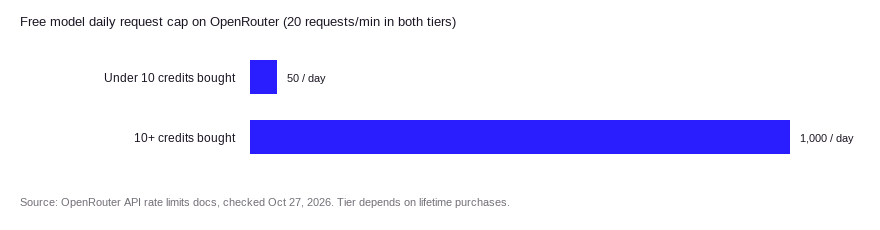
OpenRouter free models are the catalog entries whose IDs end in :free. They cost nothing per token but are capped at 20 requests per minute and 50 per day, or 1,000 per day once you have bought at least 10 credits. As of November 2, 2026, the coding-capable ones include Cohere North Mini Code, Recursive Flint and Google Gemma 4. Free endpoints are single-provider, can be withdrawn, and some run on hosts whose terms allow training on prompts.
- 20 req/min, 50 req/day
- 20 req/min, 1,000 req/day
- 14 (Nov 2, 2026)
- Off by default
Key takeaways
- The cap is 20 requests per minute for every account, plus 50 requests per day, which rises to 1,000 after you have purchased at least 10 credits.
- OpenRouter's models API listed 14 free entries on November 2, 2026. The coding-focused ones are North Mini Code and Flint, with Gemma 4 31B and 26B A4B as general models that support tools.
- Training terms are set per provider, not by OpenRouter. One October 2026 analysis found 9 of 19 free models on hosts that may train on prompts.
- Free variants disappear. Both Poolside Laguna 2.1 free endpoints were listed with an October 31, 2026 expiry and were gone from the catalog by November 2.
- Fine for open-source code, side projects and trying models. Don't use free endpoints for proprietary code without checking the serving provider's terms.
How do OpenRouter free models work?
OpenRouter free models are separate catalog entries, marked by a :free suffix on the model ID, that cost nothing per token but run under their own, tighter rate limits. OpenRouter’s FAQ describes the :free variant as an entry with its own pricing, context length and endpoints, which exists only for models that list one. There is also a router, openrouter/free, that picks a free model for each request (router page). For coding, pin a specific model instead, since a random pick means a random tool-calling quality.
The limits, from OpenRouter’s rate limit docs, checked November 2, 2026:
| Credits purchased, all time | Requests per minute | Requests per day |
|---|---|---|
| Fewer than 10 | 20 | 50 |
| 10 or more | 20 | 1,000 |
A few details that matter for agents:
- The tier depends on lifetime purchases, not current balance. The docs describe the threshold in credits.
- Exceeding a platform limit returns HTTP 429 with a
rate_limit_exceedederror type. TheGET /api/v1/keyendpoint reports your daily counter, but not the per-minute one. - A negative credit balance can cause errors even on free models.
- The docs don’t say whether failed requests count toward the daily limit. A third-party analysis says they can (TrueFoundry). Budget as if they do.
- A 429 can also come from the upstream provider being busy, even when your own quota is fine.
One developer running the Crush coding agent on a very small VPS reported in March 2026 that it used up all of their free OpenRouter requests (comment). That is what a request-hungry agent does to a 50-per-day budget: a single edit-and-test loop in a tool like Cline or Aider can send dozens of requests in one task.
Which free models are worth using for code today?
Several free entries are explicitly coding-oriented, but the list changes monthly, so treat this table as a snapshot. It comes from OpenRouter’s public models API, queried November 2, 2026, which returned 14 free entries, down from 18 on October 27. Descriptions are the vendors’ own, as listed by OpenRouter. We haven’t benchmarked any of these.
| Model ID | Size (total / active) | Context | Notes from OpenRouter listing |
|---|---|---|---|
cohere/north-mini-code:free | 30B / 3B | 256K | Cohere’s first agentic coding model. |
recursive/flint-v1.0:free | 40B / ~2.5B | 262K | Open-weight MoE built for coding agents. |
google/gemma-4-31b-it:free | 31B dense | 262K | General model with native function calling and a configurable thinking mode. |
google/gemma-4-26b-a4b-it:free | 25.2B / 3.8B | 262K | MoE sibling of Gemma 4 31B. |
nvidia/nemotron-3.5-super-vl:free | 120B / 12B | 1M | General multimodal MoE. The older Nemotron 3 Super free entry is no longer listed. |
All five advertise tool support in the API, which coding agents need. That is the useful filter: a free model without tool calling won’t work in most agent harnesses. The 1M-context entries, like Nemotron 3 Ultra and Inkling, are general reasoning models, so pick them for long-context reading rather than for being coding specialists. Liquid’s LFM2.5-2.6B is also free, but its listing advises against using it for agentic coding.
Two cautions. First, free variants come and go. Both Poolside Laguna 2.1 entries were in the October 27 list with an October 31 expiry, and by November 2 they were gone. TrueFoundry reported a median listing age of 75 days across free models and said some free variants were withdrawn while their paid versions stayed (TrueFoundry, Oct 5, 2026). Second, vendor benchmark numbers describe the vendor’s harness, not your repository.
What happens to your prompts on free endpoints?
OpenRouter itself doesn’t keep your prompts by default, but the provider serving a free model sets its own retention and training terms. OpenRouter’s privacy docs list two opt-in settings, private input and output logging, and letting OpenRouter use your data in exchange for a 1% discount. Both are off by default. The logging docs add that each provider has its own data handling policy, and that account settings control whether requests can route to providers that may train on your data, with separate settings for paid and free models.
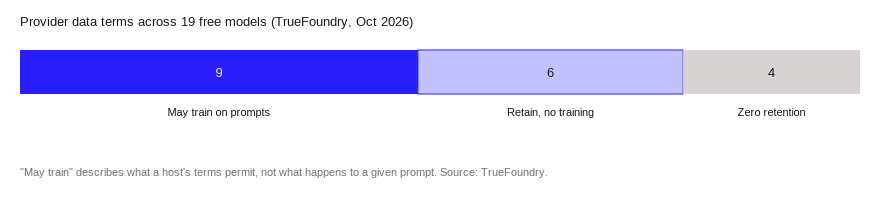
That second point is the catch. TrueFoundry’s October 2026 review of 19 free models found nine on hosts whose published policy says they may train on prompts, six that retain prompts without training, and four with zero retention. It also noted that the labels reflect default provider terms and that “may train” describes what the terms permit, not what happens to a given prompt. Each free model has a single endpoint with no fallback, so if you switch off routing to training hosts, those nine models become unavailable.
What this means in practice:
- Open-source or throwaway code: the risk is low.
- Client code, secrets, unreleased product code: check the serving provider’s policy for that exact model, set the free-model training toggle in your privacy settings, and assume anything sent could be retained.
- Strict requirements: use a paid endpoint on a host with a zero-retention policy. See zero data retention LLM APIs for how those compare.
What do developers report in practice?
Developers report that the quotas are the first wall, and that the data terms are the second. These are community comments, not our tests:
- One Hacker News commenter summarized the free tier as a 50-requests-per-day limit plus data collection, citing OpenRouter’s docs (thread, April 2026). The first half matches the docs today. The second is accurate only for providers whose terms allow it, as above.
- The Crush agent report from March 2026 is above, with the quota numbers.
- A third said a local 27B model was too slow to use compared with free hosted models from OpenCode Zen or OpenRouter (comment, August 2026). That is the real appeal of free tiers: they’re faster than a mid-range local GPU, as long as you accept the terms.
Third-party guides add that free endpoints get throttled hardest at peak hours and that a $10 top-up raises the daily cap but not the per-minute cap or the upstream throttling. We couldn’t retrieve Reddit threads from our research environment, so this section leans on Hacker News and the sources above.
How do you use free models in coding tools?
Point any coding tool that supports OpenRouter or a custom OpenAI-compatible base URL at OpenRouter and set the model to a :free ID. For example, with Aider:
export OPENAI_API_BASE=https://openrouter.ai/api/v1
export OPENAI_API_KEY=sk-or-...
aider --model openrouter/cohere/north-mini-code:free
A few habits keep a free budget alive:
- Pin one model for the session instead of using
openrouter/free, so tool-call behavior is consistent. - Cut context. Send only the files you need, because every retry spends a request.
- Use the key endpoint to watch your daily counter.
- Handle 429s with backoff, and have a second model ready for when one endpoint is saturated.
If you want a fully private loop, a local model avoids all of this; see local LLM coding agents. Models with fewer refusals, if that matters for your security tooling, are covered in uncensored LLM APIs compared.
When should you pay or self-host instead?
Pay or self-host when you hit the daily cap, need privacy guarantees, or can’t tolerate a model disappearing. The cheapest upgrade is the same model on a paid endpoint: OpenRouter says the paid variant has no platform-level request cap, and TrueFoundry estimated that running a model like Nemotron 3.5 Lightning at 1,000 requests a day on a zero-retention host would cost about $6.33 a month (its estimate, not a quote).
| Situation | Best fit |
|---|---|
| Trying models, open-source projects | Free :free endpoint |
| Daily coding on public code | Free with 10 credits bought, or a cheap paid endpoint |
| Proprietary code | Paid zero-retention endpoint, or self-hosting |
| Sustained agent workloads | Paid endpoint, or your own GPU |
For the break-even between paying per token and owning hardware, see self-hosting vs API cost.
FAQ
What is the OpenRouter free model limit?
Free (:free) models allow 20 requests per minute and 50 requests per day. After you have purchased at least 10 credits, the daily limit is 1,000. These are the figures in OpenRouter’s docs as of November 2, 2026.
Is the OpenRouter free tier really free?
Per-token cost is zero, but you pay with rate limits, no uptime guarantee, and provider data terms that may allow training on your prompts. A negative credit balance can also cause errors on free models.
What is the best free OpenRouter model for coding?
There is no stable answer, because the roster changes. As of November 2, 2026, the coding-oriented options are Cohere North Mini Code and Recursive Flint, plus Gemma 4 31B as a general model with tool calling. Check the live model list and test on your own repo.
Does OpenRouter log or train on my prompts for free models?
OpenRouter doesn’t store prompts or completions unless you opt in. The company serving the free model has its own policy, and some may train. Check the provider and your privacy toggles for free models.
Does buying credits remove the free model rate limits?
It raises the daily cap from 50 to 1,000 requests. The 20-per-minute cap stays, and upstream providers can still throttle you.
Sources (10)
- OpenRouter API rate limits and free model limits
- OpenRouter FAQ: free models and the :free variant
- OpenRouter privacy: data collection
- OpenRouter privacy: logging
- OpenRouter models API (queried November 2, 2026)
- OpenRouter Free Models Router (openrouter/free)
- OpenRouter free models: what's actually free and what it costs you, TrueFoundry (Oct 5, 2026)
- Hacker News comment on OpenRouter free model limits and data collection (Apr 2026)
- Hacker News comment on a coding agent exhausting OpenRouter free requests (Mar 2026)
- Hacker News comment comparing a local 27B model with free hosted models (Aug 2026)