What AI has no restrictions? None, strictly. Hosted services with lighter policies and local open or abliterated models come closest, but law and licences stay.
No AI has zero restrictions. Every hosted chatbot or app runs under its provider's terms and the law, and most add moderation. The closest options are hosted services that serve less-filtered open models, and open-weight or abliterated models you run on your own hardware. Even those keep the law, the model licence's use policy and whatever the training left in, and removing refusals usually costs some quality.
- None
- Local open-weight model
- Law + licence or ToS
- Some quality, model-dependent
Key takeaways
- No hosted AI is unrestricted: Venice, one of the most permissive, still bans illegal use and CSAM in section 12 of its June 8, 2026 terms.
- Running an open model locally removes the provider's moderation, but not the law or the licence: Gemma's prohibited use policy explicitly covers model derivatives.
- Abliteration weakens trained refusals by deleting one activation direction (Arditi et al., 13 models up to 72B), but community reports say some abliterated models still refuse.
- Fewer refusals cost something: one LessWrong comparison found an abliterated Qwen3.5-27B lost 0.66 points on MMLU and 5.75 on TruthfulQA MC1.
- 'Edgy' branding is not a policy: a Hacker News commenter reports Grok refusing low-level code review that other assistants accept.
Is there an AI with no restrictions?
No AI has no restrictions: what you can find is an AI with fewer of them, and the fewest come from open-weight models you run yourself. So the useful answer to “what AI has no restrictions” is a ranking, not a name. Hosted services sit at the restrictive end, because the company running the model is legally responsible for it and writes terms to match. Local models sit at the permissive end, because nobody stands between you and the weights. In between are hosted services that deliberately serve less-filtered open models.
The question usually comes from a real annoyance. Mainstream assistants over-refuse: they turn down a malware analysis question, a pentest report for a client, a frank medical question or a scene in a crime novel because it looks like something harmful. That is a fair complaint, and it has fixes. “No restrictions at all” isn’t one of them, because it doesn’t exist.
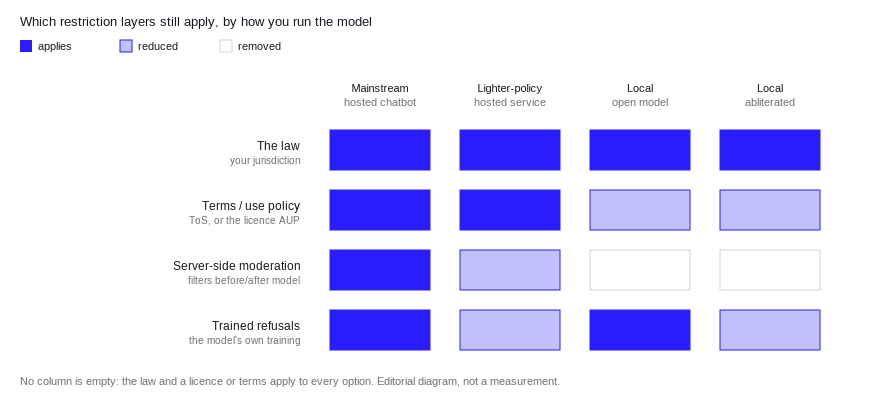
Which AIs come closest to no restrictions?
The AIs that come closest are, in order: local abliterated or uncensored fine-tuned models, local stock open-weight models, then hosted services built around uncensored open models. The table sums up what each one still keeps.
| Option | Examples | What’s reduced | What still applies |
|---|---|---|---|
| Mainstream hosted chatbot | ChatGPT, Claude, Gemini, Grok | Nothing; this is the baseline | Law, terms, server-side moderation, trained refusals |
| Lighter-policy hosted service | Venice | Moderation and refusals on its uncensored models | Law, the provider’s terms, account enforcement |
| Local stock open-weight model | Mistral Small, Gemma, Qwen via Ollama or LM Studio | Provider moderation and logging | Law, licence use policy, trained refusals |
| Local abliterated or uncensored fine-tune | Abliterated or Heretic builds of open models | Most trained refusals | Law, licence use policy, leftover training priors |
A few notes on reading that table:
- Brand image is not policy. Grok is marketed as the edgy one, yet one Hacker News commenter reports it refusing religion- or nationality-based roleplay that ChatGPT and Claude accept, and refusing to look at low-level code for pentesting work (HN, Nov 8, 2026). That’s one person’s report, but it’s a reminder to judge a service by its behavior and its terms, not its marketing.
- “Uncensored” hosted services still have a rulebook. Venice is one of the most permissive mainstream options, and section 12 of its terms still bars any illegal purpose, child sexual abuse material including AI-generated material, and use of someone’s likeness without consent, and lets Venice suspend accounts that break the rules (Venice ToS, updated June 8, 2026).
- Apps are hosted services. If you’re asking “is there an AI app with no restrictions”, the answer is the same: an app on your phone talks to someone’s server, and that someone has terms and an app store to answer to. The exception is an app that runs a model on-device.
For a ranked list of specific tools, see our best uncensored AI roundup. This page only answers whether “no restrictions” exists.
Why does every hosted AI keep some restrictions?
Every hosted AI keeps restrictions because the provider, not you, is the one running the model, so the provider carries the legal and commercial risk of each output. That shows up in three layers you can’t opt out of:
- The law. Child sexual abuse material, fraud, threats and helping someone attack a system they don’t own are illegal whoever generated the text. No provider in a jurisdiction with courts can promise otherwise.
- Terms of service. These define what you agree not to do, and they let the provider close your account. They apply even when the model itself would comply.
- Server-side moderation. Many services run classifiers on your prompt and the model’s answer, separate from the model. This is why the same open model can refuse on one host and answer on another.
There’s also a practical reason. Payment processors, app stores and cloud providers have their own rules, and a service that breaks them loses the ability to charge or to be downloaded. One Hacker News commenter put the market reality bluntly: nobody seems willing to run a truly uncensored subscription because no jurisdiction would leave it alone (HN, Oct 31, 2026). Whether or not that’s the full reason, the effect is visible: every hosted product has a floor.
Is a local open model truly unrestricted?
A local open model is the least restricted option, but it isn’t unrestricted. Running the weights on your own machine removes the provider’s moderation and the provider’s logs, and nobody can ban your account. What remains:
- The licence’s use policy. Open weights come with terms. Google’s Gemma prohibited use policy, for example, says you may not use “Gemma or Model Derivatives” for facilitating illegal activity, malware, harassment and a list of other uses (Gemma Prohibited Use Policy). An abliterated Gemma is still a Gemma derivative. Running it at home makes enforcement unlikely, not the terms void.
- The model’s training. Stock open models are safety-tuned too, so out of the box many refuse about as often as hosted ones. Removing that takes a modified model.
- The law. Same as everywhere.
The modified models fall into two families. Uncensored fine-tunes retrain a model on data without refusals. Abliterated models edit the weights directly: Arditi et al. (2024) found that across 13 open chat models up to 72B parameters, refusal is carried by a single direction in the model’s activations, and removing that direction stops most refusals without retraining. Our explainer on what abliteration is covers how it works. Tools like Heretic now automate the process and tune it to keep the model as close as possible to the original, measured by KL divergence.
For the general setup (runtime, quantization, hardware), see how to run an LLM locally.
What does “no restrictions” cost?
“No restrictions” costs you some quality, some safety net, and on hosted services, some privacy you have to take on trust.
Quality. Editing out refusals is not free. A LessWrong comparison of Qwen3.5-27B against a popular abliterated build found small MMLU changes (84.44% to 83.78%) but a clear TruthfulQA drop: MC1 from 40.27% to 34.52%, MC2 from 58.25% to 51.39% (LessWrong, Jun 5, 2026). The author notes that this build calls itself a crude proof of concept, so cleaner methods may cost less. The pattern still matches what practitioners describe: the loss shows up unevenly, often on truthfulness and complex instructions rather than on general knowledge.
Safety net. A model that never refuses also never stops you from a bad idea, and it will state wrong things just as confidently. If you use it for anything with real stakes, like medical, legal or security questions, you’re the only check.
Privacy. Locally, your prompts never leave your machine. On a hosted “uncensored” service, you’re trusting its retention claims, which are usually contract language rather than audited fact. Read the privacy page before pasting anything sensitive.
What do developers report in practice?
Developers report that “uncensored” is a spectrum: some modified models still refuse, others answer everything but feel dumber, and the best results come from picking the base model carefully.
- Some abliterated models still refuse. A 2024 r/LocalLLaMA thread titled “Abliteration fails to uncensor models, while it still makes them stupid” argued that early abliterations got the worst of both worlds, and commenters pushed for objective tests with identical prompts rather than vibes (r/LocalLLaMA). A Hacker News commenter said in May 2026 that every abliterated model they tried, Heretic builds included, lost capability and still often refused or produced garbage on “unsafe” requests (HN).
- Others report the opposite. In an r/LocalLLM thread on truly uncensored local models, one user said an abliterated Gemma 3 build never turned them down, while others recommended Mistral Nemo and Mistral Small as the least restricted stock models that fit in 16 GB of VRAM, and pointed to Heretic builds of several families (r/LocalLLM). Another commenter in the same thread called results hit or miss, depending on what the modder optimized for.
- The appeal is control, not edginess. One Hacker News user summed up why they run locally: the model never says no and never bans them when they do security work, reverse engineering, politics or medical questions (HN, Oct 26, 2026).
- Training data sets a ceiling. A commenter noted that abliteration only removes the reluctance: if a topic was filtered out of the training data, the model doesn’t know it, however willing it is (HN, Jul 30, 2026).
These are community reports, not our tests. Together they say the same thing as the research: fewer refusals is achievable, zero restrictions with full quality is not.
FAQ
Which AI has no restrictions at all?
None. Every hosted AI has terms of service and follows the law, and open models have licence use policies. The least restricted setup is an abliterated or uncensored open-weight model running on your own hardware.
Is there an AI app with no restrictions?
No. A chat app sends your prompts to a provider’s servers, so it inherits that provider’s terms and app store rules. Apps that run a model fully on-device come closest, with the same limits as any local model.
Is an uncensored AI legal to use?
Running an open or abliterated model for lawful purposes is generally legal, but what you generate is still subject to the law, and the model’s licence may forbid certain uses. Check the licence for the specific model.
Does an uncensored AI have no filter?
Mostly, but not entirely: leftover training and gaps in training data still shape answers. Our page on what AI has no filter covers filters specifically.
Why does my AI keep refusing harmless requests?
Usually because safety training ties surface words like “exploit” or “kill” to refusals. Clear context often fixes it; see why LLMs over-refuse.
Sources (8)
- Refusal in Language Models Is Mediated by a Single Direction, Arditi et al., arXiv 2406.11717 (2024)
- Venice.ai Terms of Service, section 12 Prohibited Conduct (last updated June 8, 2026)
- Gemma Prohibited Use Policy, Google (last modified Feb 21, 2024)
- What Does Abliteration Actually Cost?, LessWrong (Jun 5, 2026)
- Heretic: automatic censorship removal for language models, GitHub (AGPL-3.0)
- Hacker News comment on Grok's refusals (Nov 8, 2026)
- r/LocalLLM: Looking for truly uncensored LLM models for local use
- r/LocalLLaMA: Abliteration fails to uncensor models, while it still makes them stupid (Aug 2024)