What AI chatbot has no filter? None of the big hosted ones. Here are the three filter layers, which providers document each, and what a local model removes.
No mainstream hosted AI chatbot runs with no filter. A chatbot can block you in three places: an input classifier, the model's own trained refusals and system prompt, and an output classifier. Providers such as OpenAI, Google, Microsoft and Meta document tools for the outer two. A local open-weight model drops both outer layers by default, but its trained refusals remain until the weights are changed, for example by abliteration.
- 3: input, model, output
- Free, opt-in for API users
- Adjustable filters off
- 12B, 14 hazard categories
Key takeaways
- "Filter" means three different things: input moderation, the model's trained refusals plus system prompt, and output moderation.
- The outer layers are separate classifiers, such as OpenAI's free omni-moderation model, Meta's Llama Guard 4 and Azure's content filters.
- Turning safety settings off doesn't remove every layer: Gemini keeps built-in protections that can't be adjusted, and Azure needs approval to switch output filters off.
- A local open-weight model has no input or output classifier unless you add one, but it still refuses whatever it was trained to refuse.
- Removing the middle layer means changing the weights, by fine-tuning or abliteration, not toggling a setting.
Is there an AI chatbot with no filter?
There is no mainstream hosted AI chatbot with no filter at all, because “filter” covers three separate mechanisms and the big providers keep at least one of them on. When people ask what AI chatbot has no filter, they usually mean “which one won’t refuse me”, and the honest answer depends on which layer is doing the refusing. Some layers you can switch off with a setting. One you can’t switch off at all, because it lives in the model’s weights.
This page maps those layers and which providers document each one. If you want the shorter list of products, see what AI has no restrictions and the best no-filter AI chatbot roundup.
What are the filter layers in an AI chatbot?
An AI chatbot can filter a request in three places: before the model sees it, inside the model, and after the model writes its answer.
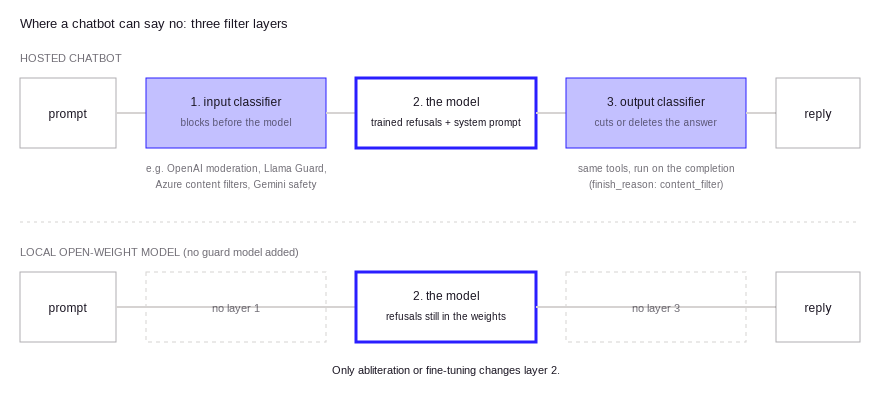
- Input moderation. A separate classifier scores your prompt and can block it before the main model runs. Microsoft’s docs say its Foundry content filtering “runs both the prompt and completion through an ensemble of classification models”, and a blocked prompt returns an HTTP 400 error (Microsoft Learn).
- The model itself. Safety training teaches the model to refuse certain requests, and the operator’s system prompt adds its own rules on top. This layer has no on/off switch. Research by Arditi et al. (2024) found that across 13 open chat models, refusal is carried by a single direction in the model’s activations, which is why it survives any setting you change outside the weights.
- Output moderation. A classifier checks the completion and can cut or replace it. In Azure, a filtered completion comes back with
finish_reason: content_filter, and in streaming mode the service stops mid-answer when it detects filtered content.
Most hosted chatbots stack all three. The outer two are often the same kind of tool pointed in two directions.
Which services publicly document which layers?
The major providers document their outer-layer classifiers in detail, and they document much less about what is trained into the model.
| Provider or tool | Input filter | Output filter | Can you turn it off? |
|---|---|---|---|
OpenAI moderation endpoint (omni-moderation-latest) | Yes, if the developer calls it | Yes, via a moderation object on Responses API calls | It’s opt-in for API developers; free to use |
| Google Gemini API safety settings | Yes | Yes | Adjustable categories can be set to off (the default for Gemini 2.5 and later); built-in protections such as child safety “are always blocked and cannot be adjusted” |
| Azure / Microsoft Foundry content filters | Yes | Yes | Thresholds are adjustable; “No filters” on completions requires approval through a Limited Access form |
| Meta Llama Guard 4 (12B) | Yes | Yes | It’s a model you choose to run; nothing forces it on |
| Anthropic Claude Opus 4 ASL-3 classifiers | Yes | Yes | No; a narrow block on CBRN weapons information, run by Anthropic |
| OpenRouter | Depends on the upstream provider | Depends on the upstream provider | Its model metadata exposes an isModerated flag per top provider |
Sources for each row: OpenAI moderation guide, Gemini safety settings, Microsoft Learn, Llama Guard 4 model card, Anthropic ASL-3 announcement, OpenRouter SDK docs.
A few details matter more than the table shows:
- OpenAI’s endpoint is a tool, not a guarantee. The docs describe it as a way to “detect harmful content in text and images” across harassment, hate, illicit activity, self-harm, sexual content and violence, and they advise treating scores “as signals for your application’s policy, not as an automatic blocking decision.” Whether an app built on OpenAI uses it is up to that app.
- Llama Guard is the open version of the same idea. Meta’s model card calls Llama Guard 4 “a natively multimodal safety classifier with 12 billion parameters” that classifies “both LLM inputs (prompt classification) and LLM responses (response classification)” against 14 hazard categories, from S1 Violent Crimes to S14 Code Interpreter Abuse. Ollama also lists the earlier Llama Guard 3 in 1B and 8B sizes, so a self-hosted chatbot can add the same layers locally.
- Anthropic’s classifiers are narrow. Its May 2025 announcement says the ASL-3 classifiers “monitor model inputs and outputs and intervene to block a narrow class of harmful CBRN information.” They aren’t a general content filter.
Which chatbots skip the external layers?
A chatbot skips the external layers when it runs an open-weight model with no guard model in front of or behind it, which is the default for local runtimes such as Ollama, llama.cpp and LM Studio.
Nothing in those runtimes classifies your prompt or the completion. You load weights, you send text, the model answers. The same is true of a hosted service that serves open weights without adding a classifier, which is why OpenRouter bothers to flag which providers moderate.
What you can’t tell from the outside is whether a hosted chatbot has a classifier. Only some providers document it. A consumer app that says “no filter” may mean it has no input or output classifier, or that it uses a model with fewer trained refusals, or both. Check the provider’s own docs or terms rather than the marketing page.
Does removing filters remove refusals?
Removing the input and output filters does not remove refusals, because the model’s trained refusals live in its weights.
The clearest public case is DeepSeek R1. Promptfoo sent 1,360 China-sensitive prompts to R1 through OpenRouter in January 2025 and got canned refusals on 1,156 of them, about 85%. Promptfoo said the censorship is “reflected even in the open-source model,” although its tests ran through a hosted API. A separate academic study, R1dacted, examined R1’s refusals on politically charged queries and concluded the behavior was “likely shaped by design choices during training or alignment.” In other words, it’s in layer 2, and no setting switches it off.
The same logic applies to Western models. A local Llama, Qwen or Gemma build has no classifier around it, but it still declines what its safety training taught it to decline. That is why people who want a model with fewer refusals look at weight edits instead of settings:
- Abliteration removes the refusal direction from the weights with no retraining. See what is abliteration for how it works and what it costs in quality.
- Fine-tuning retrains the model on data that answers instead of refusing.
- A different system prompt can change behavior at the margins, but it doesn’t remove trained refusals.
None of these removes the operator’s legal obligations. A model license’s acceptable-use policy still applies to an edited model.
What do users report in practice?
Developers report the same pattern again and again: they switch every visible filter off and still get blocked, because another layer is still running.
- Gemini with every setting at its lowest. On Hacker News in July 2024, a developer said Gemini returned
block_reason: OTHER“a lot”, even after setting everything toBLOCK_NONE(HN). In September 2024, a developer on Google’s own forum sent a UNICEF report togemini-1.5-pro-001with all four categories atBLOCK_NONEand gotPROHIBITED_CONTENTback (Google AI forum). A later r/Bard thread reports the same with Gemini 3 Flash: a prompt blocked in AI Studio and the API with safety settings off, while the same prompt worked in the Gemini web app (Reddit). All three are community reports, consistent with Google’s note that built-in protections can’t be adjusted. - An answer deleted mid-stream. In an October 2024 Hacker News thread about DeepSeek V2.5, one commenter testing DeepSeek watched it write several paragraphs, then delete them and replace them with “Sorry, that’s beyond my current scope. Let’s talk about something else.” (HN). That is what an output-side layer looks like from the user’s side. The model had already answered; something after it removed the answer.
- Azure’s off switch is a form. A September 2026 Hacker News comment points out that removing content filtering on Azure Foundry is a “Limited Access” feature that requires submitting a request (HN), which matches Microsoft’s own configurability table.
- Classifiers misfire in specialist domains. The head of AI research at Sword Health wrote on Hacker News in February 2026 that general-purpose safety classifiers handle therapy conversations poorly: a line like “I feel like I’m drowning” can’t be told apart from a crisis signal, so the system either over-escalates or misses real risk (HN). That is the input and output layer version of why LLMs over-refuse.
The practical takeaway from these reports is to read the error before you change anything. A content_filter, SAFETY or PROHIBITED_CONTENT code points to a classifier, an outer layer. A polite “I can’t help with that” in the model’s own words points to trained behavior, the middle layer.
FAQ
Which AI has no filter at all?
No major hosted assistant runs with no filter. An open-weight model on your own hardware has no input or output classifier unless you add one, but it still carries the refusals it was trained with.
Does setting Gemini safety to off remove all filters?
No. Google’s docs say adjustable categories can be set to off, but built-in protections against core harms, such as child safety, “are always blocked and cannot be adjusted.” Developers also report PROHIBITED_CONTENT blocks with every category off.
Is a local AI chatbot unfiltered?
A local chatbot has no external classifier by default, so nothing blocks the prompt or edits the answer. The model can still refuse, because refusal is trained into its weights. Abliterated or fine-tuned models change that layer.
What is the difference between a filter and a refusal?
A filter is a separate classifier that blocks the prompt or the answer, usually with an error code. A refusal is the model itself declining in its own words, which comes from training and the system prompt.
Can a chatbot add filters back?
Yes. An operator can put a classifier such as OpenAI’s moderation endpoint or Meta’s Llama Guard in front of or behind any model, including an open-weight one.
Sources (9)
- Moderation guide, OpenAI API docs
- Safety settings, Gemini API docs
- Content filtering for Microsoft Foundry Models, Microsoft Learn (updated Oct 2026)
- Llama Guard 4 12B model card, Meta on Hugging Face
- Activating AI Safety Level 3 protections, Anthropic (May 22, 2025)
- 1,156 Questions Censored by DeepSeek, Promptfoo (Jan 28, 2025)
- R1dacted: Investigating Local Censorship in DeepSeek's R1 Language Model, Naseh et al., arXiv 2505.12625 (2025)
- Refusal in Language Models Is Mediated by a Single Direction, Arditi et al., arXiv 2406.11717 (2024)
- TopProviderInfo (isModerated), OpenRouter SDK docs