Ollama Cloud runs large open models on Ollama's servers through the same CLI and API. Plans, per-token prices, privacy terms and how it compares to OpenRouter.
Ollama Cloud is Ollama's hosted inference service: the same ollama CLI and API, but the model runs on Ollama's GPUs instead of yours. Since August 31, 2026 it bills per token, with a $0 pay-as-you-go tier, Pro at $20 a month with $60 of usage included, and Max at $100 with $300. Ollama says prompts are never logged or trained on. It is worth it for models too big to run locally, less so for small ones.
- $20/mo, $60 usage
- $100/mo, $300 usage
- 3 (Pro), 10 (Max)
- Per token, since Aug 31, 2026
Key takeaways
- Ollama Cloud bills per token since August 31, 2026; the old 5-hour and weekly limits are gone on the new plans.
- Pro costs $20 a month and includes $60 of usage credits; Max costs $100 and includes $300. Unused credits don't roll over.
- Cloud models use the same CLI and API: a :cloud tag locally, or https://ollama.com/v1 with an API key directly.
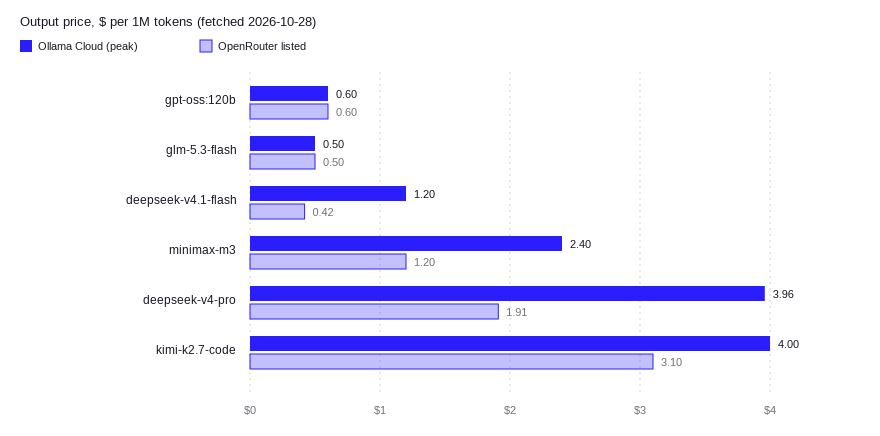
- On some models Ollama's per-token rate matches OpenRouter's listed price; on others it is about twice as high.
- Ollama states prompts and responses are never logged or trained on, and requires zero data retention from its GPU partners.
What is Ollama Cloud?
Ollama Cloud is Ollama’s hosted inference service: you call open-weight models through the same ollama CLI and API you use locally, but the model runs on Ollama’s GPUs. It launched in preview on September 19, 2025 with four models, including qwen3-coder:480b-cloud and deepseek-v3.1:671b-cloud. The pitch was, and still is, models that won’t fit on a personal machine. Ollama’s own pricing announcement cites Kimi K3 at 2.8 trillion parameters as an example (Ollama blog, Aug 31, 2026).
As of October 28, 2026 the cloud catalog lists about twenty models, mostly large mixture-of-experts coding and agent models: GLM-5.3 and GLM-5.3 Flash, DeepSeek V4 Pro and V4.1 Flash, Kimi K3 and K2.7 Code, MiniMax M3, Mistral Large 4, Nemotron 3, Gemma 4 and gpt-oss (cloud model list). Ollama says it serves native weights as released, and that on recent NVIDIA hardware a model may run in an accelerated format such as NVFP4 (pricing FAQ).
Which plans are available, and what do they cost?
Ollama Cloud has four self-serve plans, all billed per token since August 31, 2026, with included usage credits on the paid tiers. Before that, plans were metered by GPU time with 5-hour session and weekly limits. The new plans drop those limits, and when the included pool runs out you keep going at the same per-token rate (Ollama blog).
| Plan | Price | Included usage | Concurrent requests | Notes |
|---|---|---|---|---|
| Pay as you go | $0 | Small starter amount for starter models | 3 | Buy credits to unlock all models |
| Pro | $20/mo ($200/yr) | $60 per month | 3 | Larger “pro” models |
| Max | $100/mo | $300 per month | 10 | Early access to new models |
| Team (early access) | $500/mo | $1,000 shared, unlimited users | 10 | Central billing, priority support |
Source: ollama.com/pricing and the Aug 31 announcement, fetched October 28, 2026.
Three details matter more than the headline price:
- Credits don’t roll over. Included usage resets on your subscription day each month, annual plans included.
- Excess requests queue, then fail. Requests over your concurrency limit are queued; if the queue is full they are rejected until a slot opens.
- Legacy plans persist. Subscribers from before August 31 stay on GPU-time billing until they change tier or billing cycle.
Ollama Cloud pricing per model
Per-million-token prices on October 28, 2026 range from $0.07 input / $0.30 output for gpt-oss:20b to $3.00 / $15.00 for kimi-k3. GLM-5.3 costs $1.40 / $4.40, DeepSeek V4 Pro $1.32 / $3.96, and GLM-5.3 Flash $0.15 / $0.50. DeepSeek models get half price off-peak, which Ollama defines as outside 12:00 to 18:00 UTC on weekdays and all day on weekends (pricing).
To make the Pro plan concrete: a month of 30 million uncached input tokens and 2 million output tokens on GLM-5.3 costs 30 × $1.40 + 2 × $4.40 = $50.80, inside the $60 Pro allowance. Prompt caching changes this a lot for agents, since cached input on GLM-5.3 is $0.26 instead of $1.40. You can check your own spend with GET https://ollama.com/api/usage (cloud usage API).
How do you use cloud models from the CLI and API?
You use Ollama Cloud either through your local Ollama install, after signing in, or directly over HTTPS with an API key and no install at all (docs).
Through the local CLI, sign in once, then run any model with a :cloud tag. It never downloads weights:
ollama signin
ollama run gemma4:cloud
ollama launch claude --model glm-5.3:cloud
ollama launch configures and starts coding agents (Claude Code, Codex CLI, OpenCode) against an Ollama model. That makes “ollama cloud claude code” a one-liner rather than a proxy setup; see our Ollama with Claude Code guide for the local side. Your local server at localhost:11434 also forwards :cloud models once you’re signed in, so existing apps keep their base URL.
For direct access, create a key at ollama.com/settings/keys and point any client at https://ollama.com:
export OLLAMA_API_KEY="your_api_key"
curl https://ollama.com/v1/chat/completions \
  -H "Authorization: Bearer $OLLAMA_API_KEY" \
  -H "Content-Type: application/json" \
  -d '{"model": "gemma4:31b", "messages": [{"role": "user", "content": "hello"}]}'
The cloud base URL is https://ollama.com/v1 for OpenAI clients, https://ollama.com/v1/messages for Anthropic-style clients, and https://ollama.com/api/chat for Ollama’s native API. Note the model name differs by path: gemma4:31b over the direct API, gemma4:cloud in the CLI. Both compatibility layers are subsets. The cloud endpoint does not support stateful Responses, built-in web search through /v1/responses, or custom tool-call replay (OpenAI compatibility). The Anthropic endpoint requires Authorization: Bearer and won’t accept x-api-key alone (Anthropic compatibility). The local endpoints are covered in our Ollama API reference.
What does Ollama say about data retention and privacy?
Ollama states that cloud prompts and responses are processed only to answer the request and are never logged or trained on, and that it requires zero data retention from its hosting partners. The exact wording, fetched October 28, 2026:
- Pricing FAQ: “Prompt or response data is never logged or trained on.” On partners: “When Ollama partners with providers, we require no logging, no training, and zero data retention policies in place.” (pricing)
- Privacy Policy: Ollama processes cloud content “transiently to provide the Service and this content is not stored beyond the time required to fulfill the request.” (privacy policy)
Hosting is “primarily in the United States,” with routing to Europe for extra capacity, on NVIDIA Cloud Partner infrastructure. Ollama still collects account data, IP address, device information and usage metadata such as request counts, which it says excludes prompt content.
If you want a machine that can’t reach the cloud at all, set "disable_ollama_cloud": true in ~/.ollama/server.json or export OLLAMA_NO_CLOUD=1, then restart. The logs should show Ollama cloud disabled: true (FAQ). How these promises compare to other providers is covered in zero data retention LLM APIs, and the broader security question in is Ollama safe.
How does Ollama Cloud compare to OpenRouter and self-hosting?
Ollama Cloud is simpler than OpenRouter and sometimes as cheap, but on several models its peak per-token rate is roughly double OpenRouter’s lowest listed price. Self-hosting only beats both when the model fits your hardware.
| Ollama Cloud | OpenRouter | Self-hosting | |
|---|---|---|---|
| Models | ~20 large open models, curated | Hundreds, open and closed | Whatever fits your VRAM |
| Billing | Per token, monthly credit pools | Per token, prepaid credits | Hardware and power |
| Data policy | No logging, no training, ZDR required of partners | Varies by provider; ZDR routing is opt-in | Never leaves your machine |
| Same tool locally | Yes, one CLI and API | No | Yes |
| Trillion-parameter models | Yes | Yes | Rarely practical |
OpenRouter’s listed price is the cheapest route it knows, and providers on that route differ in data policy, so the gap partly reflects a different privacy bar. Off-peak, Ollama’s DeepSeek V4 Pro output falls to $1.98, level with OpenRouter. If cost per token is your only metric, see OpenRouter free models for coding. For when owning GPUs pays off, see self-hosting vs API cost.
What do developers report in practice?
Developer reports on Ollama Cloud are mostly positive about value for coding agents, with a few sharp warnings about privacy incidents and model quality. All of the following are community reports, not our tests.
- Value on the $20 plan. Several Hacker News commenters describe running coding agents all day on the Pro plan. One uses DeepSeek V4 Pro and reports never hitting the plan’s limits (HN, May 2026). Another runs two to four concurrent GLM-5.2 sessions without hitting quotas (HN, Jul 2026). Both predate the switch to token billing, so they describe the old quota system.
- Not unlimited. One developer estimated the plan was worth about $160 a week in usage, against roughly $500 for Claude’s subscription in the same period (HN, Aug 2026). Another noted that Ollama Cloud used to have a free inference program that is no longer offered (HN, Jul 2026).
- Off-peak DeepSeek. A commenter called the off-peak price for DeepSeek V4.1 Flash “extremely competitive” (HN, Oct 2026).
- Quality doubts. One user found Kimi K2.7 underwhelming on Ollama Cloud and wondered if it was quantized (HN, Jul 2026). Ollama’s FAQ says it serves native weights, with formats like NVFP4 possible on Blackwell hardware, so treat this as one unverified report.
- A crosstalk scare. In March 2026, a developer reported a coding question to
deepseek-v3.1:671b-cloudcoming back with an answer to an unrelated medical prompt. They linked an r/ollama thread showing a similar mismatch (HN, r/ollama). We found no official confirmation or explanation. Still, a mixed-up response would be a privacy failure no policy text covers. - Community pushback. When cloud models arrived, part of r/ollama saw them as a departure from local-first Ollama, and some users said they would leave over it (r/ollama thread). Others simply don’t use the feature.
Who should use Ollama Cloud, and who shouldn’t?
Use Ollama Cloud if you already live in Ollama and need models your hardware can’t run. Skip it if your model fits locally or if per-token price is all you care about.
Good fit:
- You run coding agents and want GLM, DeepSeek or Kimi-class models without managing a second provider.
- You want one tool for local and hosted models, switching with a tag.
- You need a stated no-logging, no-training policy from a US-based provider.
Poor fit:
- Your model fits in VRAM. Local is free per token and fully private.
- You need closed models, a wide catalog, or the lowest price on a given model. OpenRouter is wider and often cheaper.
- Your compliance team needs contractual guarantees. Ollama’s self-serve terms are policy statements. Enterprise plans add security questionnaires, but ask before you assume a DPA.
FAQ
Is Ollama Cloud free?
Partly. The $0 pay-as-you-go plan includes a small monthly amount for a set of starter models; everything else is billed per token from purchased credits. Running models locally stays free and unlimited.
What is the Ollama Cloud base URL?
https://ollama.com/v1 for OpenAI-compatible clients and https://ollama.com/api for the native API, authenticated with Authorization: Bearer $OLLAMA_API_KEY.
Is Ollama Cloud safe for private code?
Ollama states prompts and responses are never logged or trained on and that partners must follow zero data retention. That is a policy, not something you can verify, and one unconfirmed crosstalk report exists from March 2026. For code that must never leave your network, run locally with cloud disabled.
Can I use Ollama Cloud with Claude Code?
Yes. Run ollama launch claude --model <model>:cloud, or point an Anthropic client at https://ollama.com/v1/messages with a Bearer key. Hosted web search and some tool-choice controls are not fully supported.
What are the Ollama Cloud usage limits?
On plans started after August 31, 2026 there are no session or weekly caps, only the monthly credit pool and a concurrency limit of 3 (Pay as you go, Pro) or 10 (Max, Team). Legacy subscriptions keep the old limits until they change plans.
Sources (10)
- Ollama pricing and plan FAQ (fetched Oct 28, 2026)
- Ollama's transparent pricing, Ollama blog (Aug 31, 2026)
- Cloud, Ollama documentation
- OpenAI compatibility, Ollama documentation
- Anthropic compatibility, Ollama documentation
- Ollama FAQ: How do I disable Ollama's cloud features?
- Ollama Privacy Policy (last updated March 2026)
- Cloud models, Ollama blog (Sep 19, 2025)
- OpenRouter models API, listed prices (fetched Oct 28, 2026)
- Tell HN: Crosstalk when using Ollama with cloud DeepSeek models? (Mar 11, 2026)