A sourced 2026 roundup of AI pentesting tools: XBOW, RunSybil, NodeZero, Strix and PentestGPT, with published evidence, limits and a buyer checklist.
AI pentesting tools are agent systems that run reconnaissance, probing and exploit validation against targets you are authorized to test. In 2026 the field splits into commercial platforms (XBOW, RunSybil, Horizon3.ai NodeZero) and open-source agents (Strix, PentestGPT). Published evidence is mostly vendor-run. The one peer-reviewed live comparison found an agent beat 9 of 10 human testers, with more false positives.
- XBOW, RunSybil, NodeZero
- Strix (Apache-2.0), PentestGPT (MIT)
- ARTEMIS vs 10 humans, arXiv 2512.09882
- None found
Key takeaways
- Commercial platforms sell continuous, validated findings. Open-source agents sell control and low cost but give you the evaluation work.
- Most published evidence is self-reported: leaderboard rankings, vendor benchmarks and README scores. XBOW itself calls its 2024 benchmark suite outdated.
- The strongest independent data point is an arXiv study on a live university network: ARTEMIS found 9 valid vulnerabilities and beat 9 of 10 humans, but had more false positives and struggled with GUI tasks.
- No vendor in this roundup publishes pricing. Expect a demo call, not a rate card.
- Authorization, scope enforcement and action logging matter more than headline benchmark scores.
What does an AI pentesting tool do today, and what doesn’t it do?
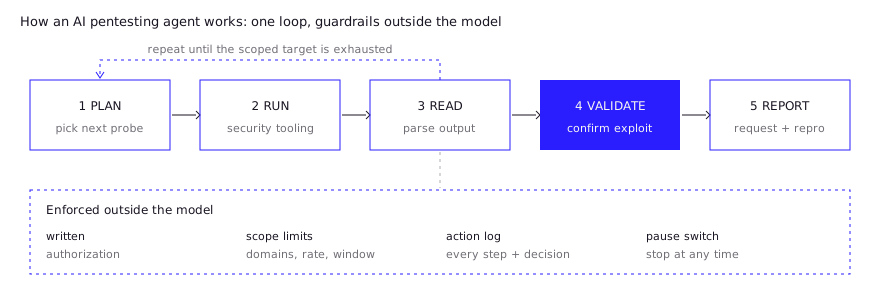
An AI pentesting tool wraps a language model in an agent loop that plans, runs security tooling against a target, reads the output and decides the next step, then tries to validate what it found. This roundup covers authorized testing only, and it describes capabilities at a high level on purpose.
What the tools do reasonably well, according to their own documentation and the one academic study below: systematic enumeration, running many probes in parallel, and writing up validated findings. What they do less well: GUI-driven workflows, keeping findings free of false positives, and deterministic repeatability. A tool that can look impressive on a leaderboard can still behave differently on your estate.
Two distinctions help when you read vendor pages:
- Validated findings versus scanner output. XBOW says it reports only findings it can exploit, each with the request, response and reproduction steps. That is a claim about its pipeline, not an independent measurement.
- Autonomous agent versus assistant. PentestGPT started in 2023 as a guided assistant for a human tester. Its v1.0 README now describes an agentic pipeline driven by Claude Code or Codex.
Which AI pentesting tools exist, and how do they compare?
Five names come up in almost every 2026 roundup: three commercial platforms and two open-source projects. The table uses only what each project says about itself, so “published evidence” is vendor- or author-reported unless marked otherwise.
| Tool | Type | What it covers (per vendor) | Deployment | Published evidence | Pricing |
|---|---|---|---|---|---|
| XBOW | Commercial | Web apps and APIs; continuous or on-demand runs; exploit-validated findings | SaaS with data-residency options, CI/CD API | HackerOne #1 ranking for Q2 2025 (company blog); Microsoft MSRC leaderboard; SOC 2, ISO 27001 and others listed | Not public |
| RunSybil | Commercial | Apps, APIs, cloud, infrastructure, IAM, CI/CD secrets; runs on every deployment | Not described on page | Customer testimonials and a case study; no specific metrics found on page | Not public |
| Horizon3.ai NodeZero | Commercial | Attack-path chaining across internal and external networks, with fix verification | Docker host or OVA appliance internally, vendor cloud externally; “no agents” | No benchmark figures on the product page | Not public |
| Strix | Open source (Apache-2.0) | Source code, web apps and APIs; CI scanning of pull requests; auto-generated patches | Local CLI with Docker plus any LLM API key; hosted and enterprise options | No benchmark results in the README | Free, plus LLM costs |
| PentestGPT | Open source (MIT) | CTF and pentest-style workflows | Local or Docker, needs an authenticated Claude Code or Codex CLI | USENIX Security 2024 paper; README reports 90 of 104 XBOW benchmarks (86.5%) in a Dec 2025 run | Free, plus LLM costs |
Two notes on the table. XBOW is the only vendor here that states its scope controls on the page: you define testable domains, protected URLs, rate limits and testing windows, and can pause at any time. And Strix’s 72k-star popularity is a measure of attention, not of accuracy.
How are AI pentesting tools evaluated?
Evaluation comes from three places: public benchmarks, live bug bounty rankings and academic studies. Each answers a different question, and none of them is a substitute for a pilot on your own systems.
- Benchmarks. XBOW released 104 web-application benchmarks in November 2024, built by outside pentesting firms. XBOW’s own page now says they are outdated and should no longer be used to measure offensive performance. Scores on them, like PentestGPT’s reported 90 of 104, are best read as historical.
- Bug bounty rankings. XBOW says it reached #1 globally on HackerOne’s leaderboard in Q2 2025. The post gives no duplicate or severity breakdown and is the company’s own account, so it shows capability on public programs rather than how it will perform on your estate.
- Academic studies. The strongest independent evidence is Lin et al., arXiv 2512.09882, a Stanford, Carnegie Mellon and Gray Swan AI study on a live university network of about 8,000 hosts. Ten professional testers and six existing agents took part, plus the authors’ ARTEMIS scaffold. ARTEMIS placed second overall with 9 valid vulnerabilities and an 82% valid submission rate, beating 9 of 10 humans. The authors report ARTEMIS variants cost about $18 an hour against $60 an hour for professional testers, and that agents had higher false-positive rates and struggled with GUI-based tasks. Off-the-shelf agents like Codex and CyAgent did worse than most humans.
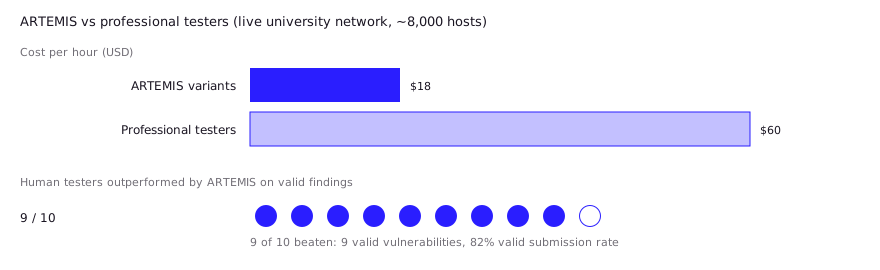
The takeaway is that the agent system matters: the purpose-built ARTEMIS scaffold outperformed off-the-shelf agents in the same study.
What do developers report in practice?
Community reports are mixed, and mostly about open-source tools because those are the ones people can run. These are individual experiences, not our tests, and they are why the numbers above should be re-measured on your own estate.
- A cautionary hands-on. One personal blogger ran Strix with GPT-5 against deliberately vulnerable apps in August 2025 and reported roughly 7 million tokens, about $7.89 and 2.5 days for a single finding, which they had to point the tool at directly. The author says the test was unscientific and discloses a bias against AI in this field, and that a fast conventional scanner did the same job in under a second.
- A systematic attempt. Another author posted a comparison of 18 LLMs running Strix in a home lab, spanning close to a hundred hours. The post says the results depend on the author’s provider tier, pricing and rate limits, which is exactly why you should repeat any comparison yourself.
- The source-aware split. In a Hacker News thread on an April 2026 technical analysis, commenters argued that agents with access to source code are the ones finding real CVEs, while black-box agents are only a modest step beyond commercial scanners. They also said token costs make black-box agents impractical for many teams for now.
- Small local models. The author of Nightcrawler, an open-source agent on a phone running a 1.2B-parameter model, reports about 13 tokens a second and a usable command about half the time. They say their authorized tests found one minor CVE.
What should you check before adopting one?
The sharpest practitioner warning comes from the Nightcrawler thread on Hacker News: a commenter pointed out that a well-formed command aimed at the wrong host can pass a scope check unnoticed until the final report. Adopt an AI pentesting tool only after confirming four things: authorization, scope enforcement, logging and data handling. They matter more than a benchmark score because an autonomous agent acts on real systems.
- Authorization. Get written permission for every target. Strix’s README is explicit that it should only be pointed at systems you own or are permitted to test, and that it is provided without warranty for misuse.
- Scope control. Look for hard limits on domains, rate and testing windows, and a way to pause. Ask whether scope is enforced outside the model, since a model-chosen command can drift.
- Logging. You want a record of every action and the decision behind each finding. XBOW lists a full decision log per finding. For open-source agents, check what lands on disk: Strix stores runs locally in
strix_runs/. - Data handling. Sending source code and responses to a third-party LLM is a data transfer. Ask where data resides and whether it trains models; XBOW states that no model is trained on customer data. Self-hosted models avoid the question, at a cost in capability.
- Prompt injection. An agent that reads attacker-controlled content can be steered by it. See prompt injection in coding agents for the general risk.
- Licensing. Frontier-model providers restrict security use in their terms. LLM license and acceptable-use terms covers how to read them.
- A pilot. Run it against a staging system with known issues, and count true positives, false positives and cost per validated finding.
Where do humans stay essential?
Humans stay essential for scoping, judgment about business impact, GUI and logic-heavy testing, and signing off on findings. The ARTEMIS authors themselves report that the agents struggled with GUI-based tasks and produced more false positives, and XBOW describes its own product as augmenting human pentesters.
In practice, a security lead should treat these tools as extra capacity for repetitive coverage rather than a replacement for a tester who understands the application. For learning and practice on legal targets, see AI for security research and AI for CTF learning.
FAQ
Are AI pentesting tools legal to use?
Yes, against systems you own or have explicit written permission to test. Unauthorized testing is illegal in most jurisdictions regardless of whether a tool or a person does it.
What is the best open-source AI pentesting tool?
There is no verified winner. Strix (Apache-2.0) and PentestGPT (MIT) are the most visible projects, but their benchmark claims are self-reported and results depend heavily on the LLM behind them, so pilot both.
Can AI replace human penetration testers?
Not yet, based on the evidence here. In the one live academic comparison, the best agent system beat 9 of 10 testers on valid findings but had more false positives and struggled with GUI tasks.
How much do AI pentesting tools cost?
Commercial vendors in this roundup do not publish prices. Open-source tools are free but you pay for LLM tokens, and one blogger reported about $7.89 for a weak result on small test apps, so costs vary widely.
Which AI pentesting benchmark should I trust?
Treat all of them cautiously. XBOW’s public 104-challenge suite is described by XBOW as outdated, and the strongest independent evidence is the live-network ARTEMIS study.
Sources (10)
- XBOW, autonomous offensive security platform (vendor site)
- XBOW: validation benchmarks, XBOW blog (Nov 2024)
- XBOW on HackerOne: what's next, XBOW blog (Aug 18, 2025)
- NodeZero autonomous pentesting, Horizon3.ai
- RunSybil, AI-powered offensive security (vendor site)
- Strix, open-source AI penetration testing tool (GitHub, Apache-2.0)
- PentestGPT (GitHub, MIT), USENIX Security 2024
- Comparing AI Agents to Cybersecurity Professionals in Real-World Penetration Testing, Lin et al., arXiv 2512.09882 (2025, rev. Mar 2026)
- GPT-5 is not a good web application tester in 2025, personal blog (Aug 21, 2025)
- Show HN: Nightcrawler, a local AI pentesting agent on a smartphone (Hacker News, Aug 2026)