How to use AI for CTF learning: what it does well by category, which events ban it, what Cybench and other benchmarks show, and how to practice legally.
AI for CTF means using a language model as a tutor, code reader and script helper while you play capture-the-flag challenges. It works best for explaining concepts and reading unfamiliar code, and worst as an answer key. Rules vary by event, from outright bans to open agent divisions, so read the rules of the specific competition before you paste a challenge into any model.
- 40 CTF tasks, 4 competitions, ICLR 2025 Oral
- About 100 of roughly 800 teams
- 24h 54m for human teams
- n = 1 (exploratory)
Key takeaways
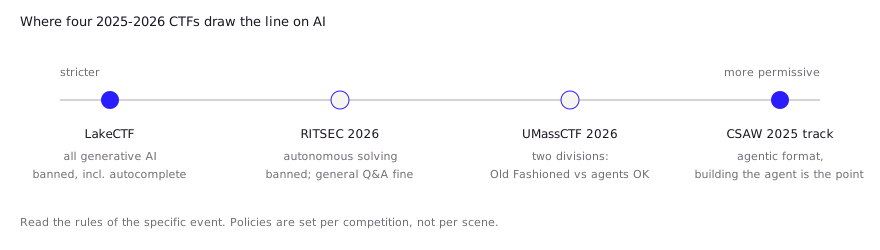
- There is no universal rule. LakeCTF bans all generative AI, UMassCTF splits divisions, and RITSEC banned autonomous solving and disqualified about 100 of roughly 800 teams.
- Frontier models now solve most easy and medium challenges in some events, so an AI-assisted solve proves little about your own skill.
- A 2026 single-participant study found AI lowered early cognitive load for a novice but raised trust and dependency concerns.
- Use the model for explanations, code reading and debugging your own scripts. Attempt the challenge first and write the solution yourself.
- For practice, use permanent platforms and retired challenges where rules allow it, and run models locally if you want offline, private help.
Is using AI for CTF challenges allowed?
Whether AI for CTF play is allowed depends entirely on the event, and in 2026 the range is wide. Before you open a chat window during a live competition, find the AI clause in that CTF’s rules. If there isn’t one, ask the organizers.
Three published policies show the spread:
| Event | Policy | Notes |
|---|---|---|
| LakeCTF | Full ban on generative AI and LLMs | Covers agentic workflows, a chat window and Copilot-style autocomplete. Organizers say they rejected softer options in favor of one bright-line rule. |
| UMassCTF 2026 | Two divisions | An “Old Fashioned” division bars autonomous agents that one-shot challenges, enforced on the honor system. A separate division allows LLM agents. |
| RITSEC CTF 2026 | Ban on using AI to autonomously solve | Per the organizer’s write-up, asking an LLM a general question was fine, while feeding it challenge files was not. |
RITSEC also shows what enforcement can look like. According to its organizer, about 100 of roughly 800 teams were disqualified. Triggers included hallucinated flags, near-instant solves on challenges built to take a human 10 to 30 minutes, and polished but hollow write-ups when teams were asked to explain a solve.
Some events go the other way: a CSAW 2025 track ran a separate agentic format where building the agent was the point. No AI clause turned up in the picoCTF rules pages available for research (2020 and 2023 seasons), which say participants must solve problems themselves. Check the current season’s rules page instead of assuming.
What is AI good at in CTFs, by category?
One engineer’s account of 404CTF is the most concrete: Copilot in VS Code was a strong investigation tool on web challenges, but it could not interpret raw pcapng files or binaries until the author exported them to text. Their summary: AI “mostly raises the floor, not the ceiling.” AI is strongest where the work is reading, explaining or scaffolding, and weakest where a challenge needs a long chain of custom reasoning. The picture changes quickly, so treat any category ranking as a snapshot.
A July 2026 mixed-methods paper from the University of Warwick (n = 3 interviews, so directional) says easy and intermediate cryptography, web and binary exploitation challenges are now reliably automated. It lists advanced lattice cryptography, request-smuggling chains, race conditions and kernel exploitation as still resisting.
| Category | Where AI tends to help | Where it tends to fail |
|---|---|---|
| Web | Explaining unfamiliar config, listing candidate bug classes, reading backend code | Suggesting attacks that are impossible, then burning hours of your time |
| Crypto | Identifying the scheme, writing the math into code | Niche or advanced constructions; reported as mixed by one practitioner |
| Reverse engineering | Explaining decompiler or assembly text you paste in | Raw binaries it cannot read directly |
| Pwn | Starter scripts, explaining a crash | Hard heap and kernel work, per the Warwick paper |
| Forensics | Summarizing filtered, exported traffic | Raw captures with thousands of irrelevant packets |
The web, forensics and reverse engineering rows come from that 404CTF account.
How do you use AI as a tutor, not an answer key?
Use the model to explain and check, and keep the decisions and the final solve yours. Research on novices points both ways. A 2026 single-participant case study found that an agentic framework gave a first-time player overview, structure and guidance, which lowered early cognitive load, while also raising concerns about trust and dependency. With one participant, treat that as a hypothesis, not a result.
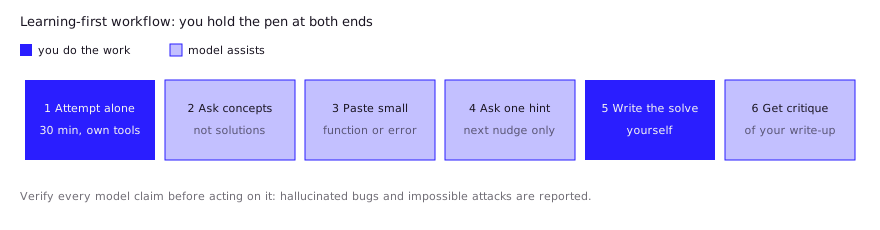
A workflow that keeps the learning in:
- Attempt first. Spend a fixed time (say 30 minutes) with your own tools before asking anything.
- Ask for concepts, not solutions. “What does a padding oracle let an attacker learn?” teaches more than “solve this.”
- Paste small, specific pieces. A function, an error message, a Wireshark filter result. The 404CTF write-up found output matched needs only when prompts named the language, libraries and goal.
- Ask for a hint ladder. Request the next nudge only, not the full path.
- Verify everything. The same author reports hallucinated issues, impossible attack suggestions and a recommendation for an unmaintained library.
- Write the solution and the write-up yourself, then ask the model to critique your write-up.
On a practice platform where outside help is allowed, this is cheap. On a ranked event with a no-AI rule, none of it applies.
Which models and tools do CTF players use?
Community reports mention general coding agents, editor assistants and reverse engineering integrations, not CTF-specific models. These are practitioner reports, not our tests.
- Coding agents. One April 2026 write-up from a security firm describes Claude Code and Codex solving nearly every challenge at BSides SF 2026, with a Ghidra MCP server for binaries. The author reports the top 10 teams fully automated solving.
- Editor assistants. The 404CTF player used GitHub Copilot in VS Code alongside Binary Ninja.
- Security agent frameworks. CAI from Alias Robotics lists Ollama among its model providers. Its CTF results are self-reported, and the repository is now archived. It tells users to run it only against systems they are authorized to test.
- Local models for offline practice. If you want help without sending challenge material to a third party, or while offline, a local model through Ollama or LM Studio works. See run an uncensored LLM locally for hardware and setup.
One practical wrinkle: hosted assistants sometimes decline attack-themed questions even when you state the CTF context. The 404CTF author reported this with Copilot. Why LLMs over-refuse explains the mechanism. Rephrasing around a refusal on a hosted service is against that service’s terms in some cases, so a local model you are licensed to run is the cleaner route, subject to the model’s own acceptable-use terms.
What do players report in practice?
The community is split, and much of the disagreement is about what a CTF is for. Three views recur on Hacker News in discussion of a May 2026 essay arguing that frontier AI has broken the open CTF format:
- Several commenters say beginners who lean on AI skip building the instincts the tools replace (thread comment).
- One describes how teammates running an AI tool replaced the explanation-sharing they enjoyed with friends (comment).
- Another suggests learners compete in human-only teams and notes that some CTFs now split rankings (comment).
The essay’s author, a long-time competitor, argues open CTFs have become pay-to-win and points beginners to permanent platforms such as picoGym and Hack The Box. These are opinions from individual players, not measurements. No r/securityCTF or r/LocalLLaMA thread had a snippet citable here, so this section leans on Hacker News and practitioner blogs.
What do CTF benchmarks say about AI capability?
Benchmarks show models solving tasks that take humans minutes to hours, with the hardest tasks out of reach in the original studies. They are capability context, not guidance on how you should learn.
- Cybench (arXiv 2408.08926, ICLR 2025 Oral) has 40 professional-level tasks from 4 competitions. Across 8 evaluated models, agents without subtask guidance fully solved only tasks that took human teams up to 11 minutes. The hardest task took human teams 24 hours and 54 minutes.
- NYU CTF Bench (arXiv 2406.05590) evaluated five LLMs against human performance on challenges from popular competitions.
- Live events have moved faster than these papers. The Warwick paper reports an AI-assisted top team solving 27 of 30 challenges at one major event and notes that frontier-model task length is doubling every few months, per the UK AI Security Institute. It also reports one team spending around $8,000 in model credits at a single event.
Static benchmarks age fast. A 2024 Cybench result says little about what a 2026 model does on today’s challenges, so read dates before quoting a number.
How can you practice safely and legally?
Practice on systems built to be attacked, and only on those. A CTF challenge or a lab you signed up for is authorized by its organizer. Anything else is not, whatever tool you use.
- Permanent platforms and retired challenges. picoGym and Hack The Box were recommended by the essay author above for building fundamentals. Check each platform’s terms for AI use.
- Your own lab. Deliberately vulnerable apps and VMs on your machine, with no one else’s systems in scope.
- Mixed-mode practice. Solve unaided first, then use a model to compare approaches and explain what you missed.
- Keep work and CTF separate. Employer or client code and credentials do not go into a hosted model without permission. For professional work, see AI for authorized security research.
FAQ
Is it cheating to use ChatGPT or Claude in a CTF?
Only if the event’s rules prohibit it. LakeCTF bans all generative AI, while UMassCTF runs a division that allows agents. Read the rules for each event and, if unclear, ask the organizers before you play.
What is the best AI for CTF?
There is no verified single best. Players report using coding agents such as Claude Code and Codex, and editor assistants such as Copilot. Capability shifts every few months, so pick on the event’s rules and your learning goal rather than a ranking.
Can AI solve CTF challenges on its own?
On many easy and medium challenges, yes, according to 2026 practitioner and academic reports. Hard challenges still often defeat it. Benchmarks such as Cybench show the gap between minutes-long and day-long tasks.
Will relying on AI hurt my CTF skills?
It can. A 2026 study of one novice found lower early cognitive load alongside dependency concerns, and many players say skipping the struggle skips the learning. Attempt first, ask for hints, and write your own solution.
Can I run an AI for CTF practice offline?
Yes. A local model served through Ollama or LM Studio runs without sending data out. Model quality varies with your hardware, and each model’s license still applies.
Sources (10)
- The no-LLM policy, LakeCTF (EPFL)
- UMassCTF 2026: Old Fashioned Division
- RITSEC CTF 2026 write-up, sylvie.fyi
- CTFs in the AI Era, Laurence Tennant, Include Security (April 2026)
- Cybench: A Framework for Evaluating Cybersecurity Capabilities and Risks of Language Models, arXiv 2408.08926
- NYU CTF Bench: A Scalable Open-Source Benchmark Dataset for Evaluating LLMs in Offensive Security, arXiv 2406.05590
- The Disruptive Impact of Large Language Models on Capture the Flag Competitions and the Path Toward Fair Play, Macaulay et al. (July 2026)
- Can AI Lower the Barrier to Cybersecurity? Novice CTF Learning, Schachner and Wachter, arXiv 2602.18172
- Cracking the code: How Copilot supercharged my last CTF and where it fell short, Thomas Betous, DEV Community (June 2025)
- The CTF scene is dead (Frontier AI has broken the open CTF format), kabir.au