The best abliterated model per its Hugging Face card: base, method, refusals, KL and benchmarks for top Qwen, Gemma and DeepSeek releases. Updated Oct 2026.
The best abliterated model is the one whose card names its base model, method and evals, and whose numbers hold up on your own tasks. As of October 2026, the most downloaded releases are Qwen3.8-27B variants from huihui-ai and Heretic users, but only some cards report refusal rate, KL divergence or MMLU. This page maps what each card documents. We rank nothing we have not measured.
- Oct 26, 2026
- Huihui-Qwen3.8-27B (2.64M)
- 5,000+ (author's claim)
- None yet
Key takeaways
- Judge a release by what its card discloses: base model, method, license and evals. Several of the most downloaded abliterated repos report no benchmarks at all.
- Heretic cards usually report refusals and KL divergence against the original model. Classic huihui-ai cards usually report neither.
- Author-reported numbers are not comparable across cards: refusal prompt sets and judging differ, and most cards do not publish them.
- For coding, the documented options are Qwen-based: Qwen3-Coder-30B-A3B and Qwen3.8-27B variants. The coding benchmark scores on file belong to the base models, not the abliterated copies.
- License and acceptable-use terms of the base model still apply, and several uploaders advise against production use.
Which is the best abliterated model? No independent test has ranked them yet, so this page maps what each Hugging Face card documents instead. Refusal Rate, an independent guide to open-weight and abliterated LLMs for developers, has not yet run its own tests, so nothing below is ranked by our own scores. Every figure comes from a model card or README fetched on October 26, 2026, and is the uploader’s own claim unless stated otherwise. The field moves monthly, so check the live card before you download.
How do you judge an abliterated model without running it?
You judge it by what the card discloses: the base model, the method, the license, and any evaluation against the original. If a card gives none of these, you are downloading a guess. Five checks take a minute each:
- Base model. The card should link the exact upstream checkpoint. Quality, context length and license all come from there.
- Method. Classic abliteration (a difference-of-means refusal direction removed from the weights, see what is abliteration) or an optimizer-driven variant such as Heretic.
- Evals against the original. Refusal count, KL divergence from the base model, and at least one capability benchmark such as MMLU. A card that reports only “>90% acceptance” tells you little about damage.
- License. The abliterated weights inherit the base model’s license. For how that differs from fine-tuned “uncensored” models, see abliterated vs uncensored vs fine-tuned.
- Adoption. Downloads and likes are a weak signal. They show that many people tried a file, not that it works well. The top two repos in the search below have 2.64M and 2.55M downloads, and neither is a rigorous evaluation.
One warning on comparing cards. Refusal rates such as “3/100” or “10/100” depend on the prompt set and on how a refusal is judged. Most cards do not publish either, so a 3 on one card and a 10 on another cannot be ranked against each other.
What do developers report about the best abliterated models?
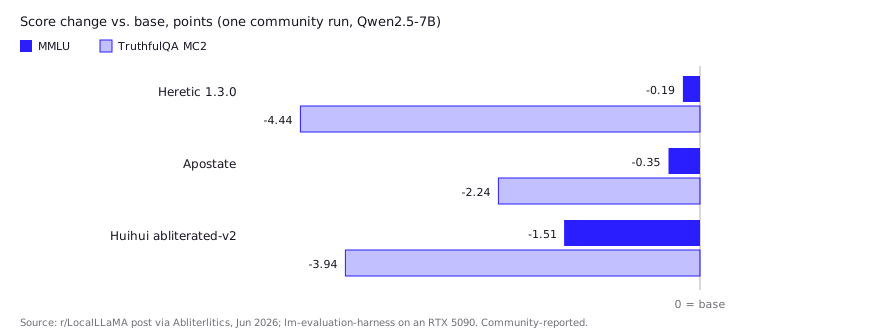
Community comparisons are sparse and mostly test refusal suppression, not coding. The most detailed one we found is a June 2026 r/LocalLLaMA post, mirrored by Abliterlitics, that ran Qwen2.5-7B-Instruct and three abliterated versions through lm-evaluation-harness and HarmBench on an RTX 5090. Treat it as one person’s run on a small, older model.
| Qwen2.5-7B-Instruct | HarmBench attack success | KL divergence | MMLU | TruthfulQA MC2 |
|---|---|---|---|---|
| Base | 31.0% | n/a | 71.78 | 64.83 |
| Heretic 1.3.0 | 100.0% | 0.211 | 71.59 | 60.39 |
| Apostate | 98.8% | 0.134 | 71.43 | 62.59 |
| Huihui abliterated-v2 | 98.2% | 0.190 | 70.27 | 60.89 |
Community-reported, one run. The pattern matches the cards below: refusal suppression is near-complete across tools, MMLU barely moves, and TruthfulQA drops 2 to 4 points for all three. Heretic had the highest KL in this run, so “lowest KL” is not a given and depends on model and settings.
Two other threads add context. On Hacker News, a commenter running Qwen 3.8 27B locally for media-library automation said the stock model flatly refused and an abliterated build would not (HN), while another reported abliterated models they tried were not 100% successful and could still hit the same walls (HN). And ProjectDiscovery’s October 2026 research showed a small fine-tune could backdoor a tool-calling model while passing normal use, which is why benchmark tables, ours included, say nothing about uploader trust (ProjectDiscovery).
What are the notable abliterated models by size?
The notable releases cluster around Qwen, Gemma and DeepSeek bases, mostly in the 4B to 30B range for local use. The table lists a sample taken from the Hugging Face search sorted by downloads, plus the Heretic-tagged list, on October 26, 2026. It is a selection, not a complete census: the search returns hundreds of repos, and 6,417 models carry the heretic tag.
| Model (repo) | Base | Method per card | Size | License | Evals in card |
|---|---|---|---|---|---|
| Huihui-Qwen3.8-27B-abliterated-GGUF (huihui-ai, 2.64M downloads) | Qwen3.8-27B | Abliteration, layers 22 to 52 | 27B dense | Apache-2.0 | None |
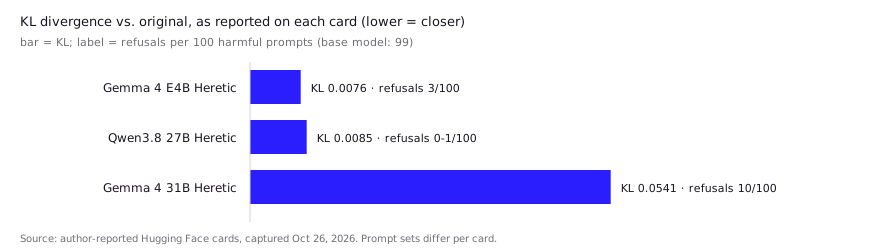
| Qwen3.8-27B-Heretic-Abliterated-Uncensored-GGUF (0bserverx, 1.12M) | Qwen3.8-27B | Heretic ARA, two extra full-weight passes | 27B dense | Apache-2.0 | Refusals 0 to 1 of 100 (base ~99); KL 0.0085 |
| gemma-4-31B-it-uncensored-heretic-GGUF (llmfan46, 82.1k) | Gemma 4 31B | Heretic 1.2.0, ARA | 30.7B dense | Apache-2.0 | Refusals 10 of 100 (base 99); KL 0.0541; MMLU 85.90% vs 86.50% |
| gemma-4-E4B-it-ultra-uncensored-heretic-GGUF (llmfan46, 88k) | Gemma 4 E4B | Heretic 1.2.0, ARA | 4.5B effective (8B with embeddings) | Apache-2.0 | Refusals 3 of 100 (base 99); KL 0.0076; MMLU 68.60% vs 69.46%; PIQA 85.85% vs 86.02% |
| Huihui-Qwen3-Coder-30B-A3B-Instruct-abliterated (huihui-ai, 21.5k last month) | Qwen3-Coder-30B-A3B-Instruct | Abliteration, “new and faster method” | 31B total, A3B | Apache-2.0 | None |
| Huihui-DeepSeek-V4-Flash-0731-abliterated-GGUF (huihui-ai, 356k) | DeepSeek-V4-Flash-0731 | Abliteration, expert modules not ablated | 284B | MIT | None |
| gemma-3-27b-it-abliterated (mlabonne, 3.7k last month) | Gemma 3 27B | Layer-wise abliteration, refusal weight 1.5 | 27B | Gemma | “>90% acceptance”, no benchmarks |
Three patterns stand out.
- Disclosure splits by uploader style. The huihui-ai cards describe their method as a “crude, proof-of-concept implementation” and report no numbers. The Heretic-based cards publish a refusal count and a KL divergence, the two quantities Heretic’s README says it co-minimizes.
- Small models lose less in absolute terms, but not nothing. The E4B card reports an MMLU drop of about 0.86 points, with larger drops in some subjects such as moral_scenarios (43.91% to 41.23%). The 31B card reports a 0.6-point MMLU drop, and its machine_learning subject fell from 0.8462 to 0.7692.
- Newer is not always better documented. The older mlabonne Gemma 3 release states its method and refusal weight, but its only quality statement is a “>90% acceptance rate” with no benchmarks.
Quantized GGUF repos add another variable. The Qwen3.8 Heretic card reports perplexity against its F16 reference of +2.23% at Q5_K_M, +7.20% at Q4_K_M and +24.2% at Q3_K_M, which is quantization damage on top of any abliteration damage.
Which abliterated models are best for coding work?
For coding, the documented candidates are Qwen-based: the Qwen3-Coder-30B-A3B abliteration and the Qwen3.8-27B variants. No card we found reports a coding benchmark for the abliterated weights themselves. The only coding scores on file belong to the unmodified base. The Qwen3.8-27B card lists LiveCodeBench v6 at 90.3, SWE-bench Pro at 61.7 and Terminal Bench 2.1 at 73.0. Those say what the base can do. They say nothing about what survives ablation.
A practical shortlist, by constraint:
- Fits a single consumer GPU: the Gemma 4 E4B Heretic release, with the lowest reported KL divergence in the table (0.0076).
- Mid-size dense model: the Qwen3.8-27B Heretic repo, which reports KL 0.0085 and 0 to 1 refusals in 100. Per the card, the one prompt it still refuses was intentionally left in place.
- Coder-tuned mixture-of-experts: Huihui-Qwen3-Coder-30B-A3B-Instruct-abliterated, which has the base model’s coding focus but no published evals for the edit.
Coder-named derivatives deserve extra caution. The Qwen3.8-27B “Coder390-EfficientThink” repo from huihui-ai has two different parent models listed (one in its model tree and a different one in its description), and the card defines neither suffix. Treat that as a merge or fine-tune of unclear lineage until the author documents it.
The honest test is your own: run 20 to 50 representative prompts from your codebase against the base model and the abliterated one, and diff the results. Our own tests, with hardware and settings stated, are planned but not yet run.
Does the method matter: classic abliteration or Heretic?
Heretic’s pitch is less collateral change for the same refusal suppression, and the evidence is the author’s own. Heretic uses a TPE optimizer from Optuna to search ablation parameters, minimizing refusals and KL divergence from the original together. An earlier version of its README (read October 2026) compared three abliterations of gemma-3-12b-it on 100 harmful prompts. The current README (checked November 11, 2026) dropped that table; only the Heretic row is still on p-e-w’s model card:
| Model | Refusals | KL divergence (harmless prompts) |
|---|---|---|
| google/gemma-3-12b-it (original) | 97/100 | 0 |
| mlabonne/gemma-3-12b-it-abliterated-v2 | 3/100 | 1.04 |
| huihui-ai/gemma-3-12b-it-abliterated | 3/100 | 0.45 |
| p-e-w/gemma-3-12b-it-heretic | 3/100 | 0.16 |
All three suppress refusals equally on that test. The difference is how far each moves the model on harmless prompts. The caveats are real: the author ran the comparison, the README says results may vary by platform and hardware, and it reports MMLU and GSM8K results that “compare favorably” without giving numbers. Heretic is licensed AGPL-3.0, and the README claims “well over 5000” published models made with it. For a side-by-side of the tooling, see Heretic vs abliteration.
Classic abliteration, as Maxime Labonne described it, picks a refusal direction by hand-testing candidates and then orthogonalizes the weights. His post reports a performance drop across all benchmarks for Daredevil-8B, mostly recovered by a DPO pass that took about 6 hours 45 minutes on 6 A6000 GPUs. The lesson for roundups is that automated parameter search tries to avoid that repair step, but only the cards’ KL numbers, not independent tests, say how well it does.
Where can you run abliterated models?
Most developers run them locally through GGUF files, since almost every repo above is a GGUF quantization. Hugging Face documents running any public GGUF in Ollama with one command, ollama run hf.co/{username}/{repository}, which defaults to the Q4_K_M quantization when present and accepts a tag such as :Q8_0 to pick another. The setup details, including chat templates, are in abliterated models on Ollama.
ollama run hf.co/{username}/{repository}:Q8_0Two license points before you ship anything. The base licenses in the table are Apache-2.0, MIT or Gemma terms, and they carry through. And the huihui-ai cards we read recommend avoiding “direct use in production or public-facing commercial applications” and disclaim responsibility for consequences. Hosted inference is a separate question, because a provider’s terms then apply as well. We have not verified any hosted provider’s abliterated catalog for this page, so it is left out rather than guessed.
FAQ
What is the best abliterated model right now?
No source we found has run an independent, comparable evaluation, so there is no verified best. The most downloaded is Huihui-Qwen3.8-27B (2.64M downloads), but its card reports no evals. The best documented by its own numbers is the Qwen3.8-27B Heretic release (KL 0.0085, 0 to 1 refusals per 100).
What is the best abliterated model for coding?
There is no verified answer. The Qwen3-Coder-30B-A3B abliteration and the Qwen3.8-27B variants are the main Qwen-based options. The coding benchmark scores published for Qwen3.8-27B apply to the unmodified base model, not the abliterated copies.
Do abliterated models lose quality?
Usually a little, and it is measurable. The Gemma 4 31B Heretic card reports MMLU of 85.90% against 86.50% for the original, and the E4B card reports 68.60% against 69.46%. Quantizing to Q3 or Q4 adds more loss on top.
What does KL divergence mean on a Heretic model card?
It measures how far the edited model’s outputs on harmless prompts drift from the original’s. Zero means identical, so lower is better. It does not measure capability directly, which is why cards pair it with benchmarks like MMLU.
Are abliterated models on Hugging Face safe to download?
Treat any community upload as unvetted. Check who the uploader is, compare the card’s claims with the repo’s files, and read the base model’s license first. The huihui-ai cards themselves say the models have not undergone rigorous safety optimization.
Sources (11)
- Hugging Face model search: abliterated, sorted by downloads (captured Oct 26, 2026)
- p-e-w/heretic, GitHub README
- Uncensor any LLM with abliteration, Maxime Labonne, Hugging Face blog (2024)
- huihui-ai/Huihui-Qwen3.8-27B-abliterated-GGUF, model card
- 0bserverx/Qwen3.8-27B-Heretic-Abliterated-Uncensored-GGUF, model card
- llmfan46/gemma-4-31B-it-uncensored-heretic-GGUF, model card
- llmfan46/gemma-4-E4B-it-ultra-uncensored-heretic-GGUF, model card
- huihui-ai/Huihui-Qwen3-Coder-30B-A3B-Instruct-abliterated, model card
- Qwen/Qwen3.8-27B, model card
- How does the new abliteration tool Apostate compare with others? r/LocalLLaMA post (mirrored by Abliterlitics, June 2026)
- How abliterated models can get you pwned, ProjectDiscovery (Oct 2026)