An open source LLM leaderboard guide: what Arena, Artificial Analysis, SWE-rebench, Aider and LiveCodeBench measure, which are stale, and which fit coding.
No single open source LLM leaderboard is enough in 2026. Arena ranks chat preference, Artificial Analysis aggregates nine hard evals into one index, and SWE-rebench scores agentic coding on fresh GitHub tasks. The Hugging Face Open LLM Leaderboard retired in March 2025, and the Aider and LiveCodeBench boards have not been updated since 2025. For a local coding model, combine a fresh coding board with your own tests on your own hardware.
- Nov 6, 2026 (Arena data published Oct 28, 2026)
- Kimi K3 (Max), #19 of 419
- Kimi K3.1 Pro, 46 (leader: 60)
- HF Open LLM Leaderboard (retired Mar 2025), Aider (Nov 2025), LiveCodeBench (Apr 2025 problems)
Key takeaways
- Match the board to the job: Arena for chat preference, Artificial Analysis for a broad capability index, SWE-rebench for agentic coding on tasks newer than most training cutoffs.
- Check the update date first. The Hugging Face Open LLM Leaderboard retired in March 2025; Aider's polyglot board was last updated November 20, 2025; LiveCodeBench's public data ends with problems from April 2025.
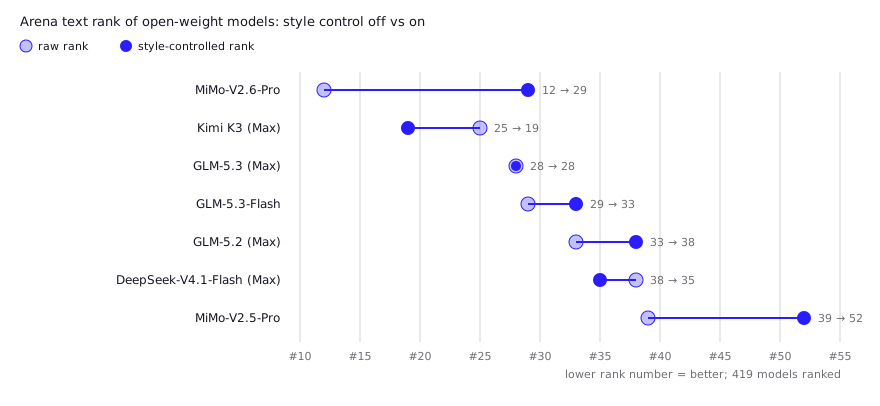
- Style control changes Arena ranks a lot. On the October 28, 2026 text board, MiMo-V2.6-Pro is #12 raw but #29 with style control; Kimi K3 moves the other way, #25 to #19.
- Open weights are close on fresh coding tasks and further behind on broad indexes: GLM-5.2 is 1.6 points off the SWE-rebench leader, while Kimi K3.1 Pro trails the top Intelligence Index score by 14.
- Leaderboards test the full-precision model on someone else's hardware. Your quant, runtime and harness change the result, so re-run a small eval locally.
An open source LLM leaderboard is only as useful as its method and its last update date, and in November 2026 several of the boards people still search for are retired or frozen. This page sorts the live ones by what they measure, flags the stale ones, and gives a dated snapshot of where open-weight models stand. Every number below was read from the board or its published data on November 6, 2026. Arena figures come from its October 28, 2026 data release.
Which leaderboard should you use for what?
Pick the board that measures the task you care about, then check that it was updated after the models you are comparing were released.
| Leaderboard | What it measures | Open models included | Status on Nov 6, 2026 | Use it for |
|---|---|---|---|---|
| Arena (arena.ai, formerly LMArena) | Crowdsourced pairwise votes on chat answers | Yes, with a license column | Live; data release Oct 28, 2026 | General chat preference, writing, WebDev UI generation |
| Artificial Analysis Intelligence Index | Average of 9 hard evals (knowledge work, coding, science, general) | Yes, separate open-weights view | Live, v5.0.1 | Broad capability ranking, plus price and speed |
| SWE-rebench | Agentic fixes on fresh GitHub issues, full test suite must pass | Yes | Live; default window May 15 to Jul 1, 2026 | Choosing a coding-agent model |
| SWE-bench Verified | Agentic fixes on a fixed set of 500 Python issues | Some | Newest entry Feb 26, 2026 | History; see what SWE-bench measures |
| Aider polyglot | 225 Exercism exercises in 6 languages, edit format | Few | Last updated Nov 20, 2025 | Historical reference only |
| LiveCodeBench | Contest problems dated after a model’s cutoff | Yes | Problems end Apr 2025; data file last changed Aug 1, 2025 | Historical reference only |
| Hugging Face Open LLM Leaderboard | Automated academic benchmarks on open checkpoints | Open only | Retired March 2025 | Nothing current |
Two rules fall out of the table. First, a board that has not been refreshed since 2025 cannot rank Qwen3.8, GLM-5.3 or Kimi K3.1, because those models did not exist yet. Second, the boards measure different things, so disagreement between them is expected rather than a sign that one is broken.
What does each leaderboard actually measure?
Each board answers a narrower question than its name suggests.
- Arena shows two anonymous model answers to a user’s own prompt and records which one the user prefers. Ratings come from a Bradley-Terry model fitted to those pairwise votes, a method described in the Chatbot Arena paper. The October 28 text board ranks 419 models, 227 of them under a non-proprietary license. Separate tables exist for coding prompts, hard prompts and WebDev.
- Artificial Analysis Intelligence Index v5.0.1 averages nine evaluations in four equally weighted groups: knowledge work (AA-Briefcase, AutomationBench-AA, GDP.pdf), coding (FrontierCode 2.0, Terminal-Bench 4.0), science (Terminal-Bench-Science, CritPt) and general (AA-Omniscience, HLE-Diamond). Artificial Analysis runs the evals itself rather than copying vendor numbers.
- SWE-rebench pulls new GitHub issues each window, gives the model a minimal agent loop, and counts an issue as resolved only if the repository’s tests pass. The default window shown on November 6 covers 111 problems from 65 repositories. It also reports pass@5 and cost per problem.
- Aider polyglot checks whether a model can edit code correctly in Aider’s edit formats across C++, Go, Java, JavaScript, Python and Rust.
- LiveCodeBench scores competitive-programming problems by release date, so you can exclude problems published before a model’s training cutoff.
The retired Hugging Face board ran automated benchmarks on any open checkpoint anyone submitted. Hugging Face staff described it on March 14, 2025 as “completed, retired”, pointing users to community-run leaderboards instead.
Which leaderboards are best for coding models?
For choosing a coding model in late 2026, SWE-rebench is the most useful live board, with Artificial Analysis’s coding evals and Arena’s coding table as cross-checks.
SWE-rebench’s design answers the main objection to static coding benchmarks: its tasks are newer than most models’ training data, so a high score is harder to get by memorization. In its default window, the top open-weight entry is Z.ai’s GLM-5.2 at 62.9% resolved, 1.6 points behind the leader, Anthropic’s Fable 5 at 64.5%. Lower down, MiniMax M3 resolves 47.2%, MiMo V2.5 Pro 46.5%, DeepSeek-V4 Pro 40.2% and Qwen3.6-27B 31.2%. GLM-5.2 also reports a cost of $1.40 per problem against $4.40 for Fable 5.
The other coding boards come with caveats. Aider’s polyglot table was a staple in 2025, but its newest results are from November 20, 2025, so its top open entry is DeepSeek-V3.2-Exp (74.2%). LiveCodeBench’s public data stops at April 2025 problems. SWE-bench Verified has not added an entry since February 26, 2026; our SWE-bench explainer covers its variants and why vendor-reported scores need care.
On Arena’s coding category (style-controlled), Kimi K3 (Max) is the best open model at #13 and MiMo-V2.6-Pro is #14. On the WebDev board, which rates generated web apps, DeepSeek-V4.1-Flash-20261017 (Max) leads the open models at #16 of 152.
What are the known problems with leaderboards?
The main failure modes are contamination, style bias, selective testing and stale data, and each board fixes some of these but not all of them.
- Contamination. A fixed public test set ends up in training data. Fresh-task boards such as SWE-rebench and LiveCodeBench exist for this reason, and only help if they keep refreshing.
- Style bias in human votes. Voters favor longer, more formatted answers. Arena’s style control, introduced in August 2024, adds answer length and counts of markdown headers, bold text and list items as variables in the Bradley-Terry regression. The effect on open models is large, as the figure below shows.
- Selective testing. The Leaderboard Illusion (Singh et al., 2025) reported that some providers privately test many variants before release and publish the best one; it counted 27 private Meta variants before Llama 4. It also estimated that 83 open-weight models together received 29.7% of Arena battle data, while Google and OpenAI received 19.2% and 20.4% each.
- Benchmark gaming. A widely discussed Hacker News post from March 2026 described topping the old Hugging Face board by duplicating a block of seven middle layers in Qwen2-72B, with no weight changes, on two RTX 4090s (HN thread, write-up).
- Thin vote counts. A new model’s Arena rating rests on few battles. MiMo-V2.6-Pro has 4,037 votes and a confidence interval about 19 points wide, against 53,702 votes and an 8-point interval for GLM-5.2 (Max).
What are the top open models across boards right now?
On November 6, 2026, Kimi models lead open weights on the broad boards, GLM-5.2 leads on fresh coding tasks, and no single family wins everywhere.
| Board (date) | #1 open-weight model | Score | Overall leader | Score |
|---|---|---|---|---|
| Arena text, style control (Oct 28) | Kimi K3 (Max) | 1488, rank #19 | Gemini 4 Carbon (High) | 1528 |
| Arena text, raw (Oct 28) | MiMo-V2.6-Pro | 1491, rank #12 | Gemini 4 Carbon (High) | 1540 |
| Arena WebDev (Oct 28) | DeepSeek-V4.1-Flash-20261017 (Max) | 1665, rank #16 | Claude Opus 5.5 (Max) | 1810 |
| AA Intelligence Index v5.0.1 | Kimi K3.1 Pro | 46 | Gemini 4 Carbon (High) | 60 |
| SWE-rebench (May 15 to Jul 1 window) | GLM-5.2 [high] | 62.9% | Fable 5 [high] | 64.5% |
Below Kimi K3.1 Pro, the Artificial Analysis open-weights list continues with DeepSeek V4.1 Flash 1017 (Max) at 33, GLM-5.3 (Max) at 32, MiMo-V2.6-Pro and Ling 3.1 Flash at 30, MiniMax-M3.1-Flash at 29 and Mistral Large 4 (High) at 26.
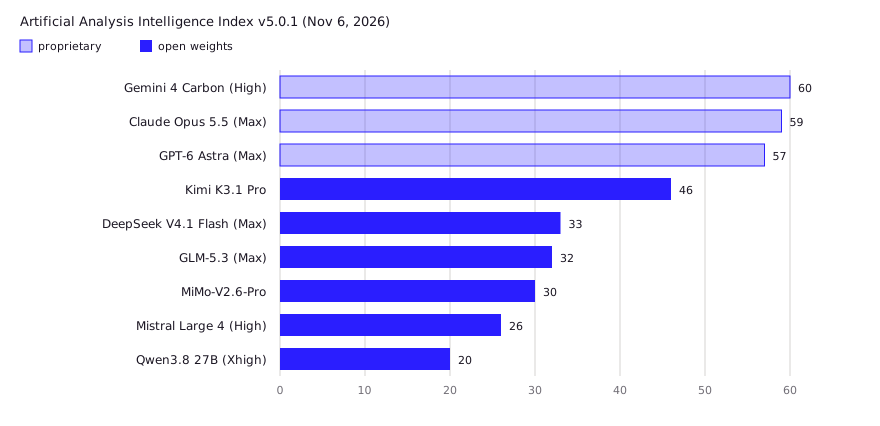
There is a catch for local users. Most of the top open models are not small: Artificial Analysis lists Kimi K3.1 Pro at 2.8 trillion total parameters, GLM-5.3 at 753 billion and DeepSeek V4.1 Flash at 552 billion. The highest-ranked model in its open list that fits one consumer GPU is Qwen3.8 27B, at 20. For picks by VRAM tier, see the best local LLM for coding.
What do developers report in practice?
Practitioners mostly say the same thing: leaderboards are a shortlist, and the final call comes from testing on your own prompts and setup.
- In the Hacker News discussion of The Leaderboard Illusion (thread), commenters noted that Arena seems to reward bullet points and emoji, and one reported that DeepSeek did best in their private evaluations despite ranking lower publicly. Another reply pointed out that chat rankings say little about tool calling, which matters for agents.
- On r/LocalLLaMA’s thread about the March to May 2026 SWE-rebench update (thread), commenters asked for local models such as Qwen 3.6 27B to be added because many “seem benchmaxed”, asked whether the harness would be released so they could compare Q4, Q5 and Q8 quants, and suggested reporting retries or wall-clock time.
- An r/LocalLLaMA thread asking whether benchmarks predict real-world performance (thread) described a model scoring 94% on multiple-choice benchmarks but about 70% on a team’s own prompts. Replies advised testing through the actual inference provider, since quantization and provider bugs change results, and keeping a held-out set of real app prompts.
- The layer-duplication post above is a reminder that a top score on an automated board can come from tuning to the benchmark rather than from general improvement.
How do you check results on your own hardware?
Use the leaderboards to shortlist two or three models, then measure speed and quality locally with the quant you will actually run.
Speed is easy to measure with llama.cpp’s llama-bench, which reports prompt processing and generation tokens per second for a GGUF file:
llama-bench -m qwen3.8-27b-Q4_K_M.gguf -p 512 -n 128 -o mdFor quality, build a small eval of 30 to 100 tasks from your own repositories and score them with an eval tool; our Promptfoo vs DeepEval comparison covers both options with local models. Checklist:
- Note each board’s date and confirm your candidate models were released before it.
- Prefer boards that state the harness and settings (SWE-rebench lists cost and token use per problem).
- Run your eval at the quant and context length you will use, not at full precision.
- Keep the eval set private so it stays uncontaminated.
- If refusals matter for your work, measure them separately; leaderboards do not, and our LLM refusal benchmarks page explains how.
FAQ
Is the Hugging Face Open LLM Leaderboard still active?
No. Hugging Face staff announced on March 14, 2025 that it was retired. The Space still loads, but it does not rank models released since then.
What is the best open source LLM leaderboard for coding?
In November 2026, SWE-rebench, because it uses fresh GitHub tasks and is still updated. Cross-check with Arena’s coding category and Artificial Analysis’s coding evals, and avoid treating Aider or LiveCodeBench results as current.
Does LMArena (Arena) rank open-source models?
Yes. Arena includes a license column, and its published data shows 227 non-proprietary models among 419 on the October 28, 2026 text board. Kimi K3 (Max) is the top open model with style control on.
Why do leaderboards disagree on the best open model?
They measure different things: human chat preference, an average of nine hard evals, and resolved GitHub issues. Update dates also differ, so newer models are missing from some boards.
Are leaderboard scores valid for quantized local models?
Not directly. Boards test the model as served by the vendor or at full precision. A Q4 GGUF on your GPU can score differently, so re-run a small eval at your quant.
Sources (10)
- Arena leaderboard dataset on Hugging Face (text, text_style_control, webdev; published Oct 28, 2026)
- Chiang et al., Chatbot Arena: An Open Platform for Evaluating LLMs by Human Preference (arXiv 2403.04132)
- LMSYS: Does style matter? Disentangling style and substance in Chatbot Arena (Aug 2024)
- Singh et al., The Leaderboard Illusion (arXiv 2504.20879)
- Artificial Analysis: Intelligence Index methodology (v5.0.1)
- Artificial Analysis: open-weights models leaderboard
- SWE-rebench leaderboard (Nebius)
- Aider LLM leaderboards (polyglot benchmark)
- LiveCodeBench leaderboard
- Hugging Face post: the Open LLM Leaderboard is retired (Mar 14, 2025)